Rejoignez-nous pour un voyage dans le monde des livres!
Ajouter ce livre à l'électronique
Grey
Ecrivez un nouveau commentaire Default profile 50px
Grey
Abonnez-vous pour lire le livre complet ou lisez les premières pages gratuitement!
All characters reduced
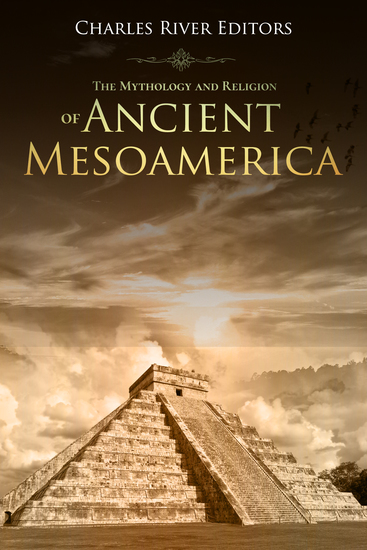
The Mythology and Religion of Ancient Mesoamerica - cover

The Mythology and Religion of Ancient Mesoamerica

Editors Charles River

Maison d'édition: Charles River Editors

  • 0
  • 0
  • 0

Synopsis

"They strike open the wretched Indian's chest with flint knives and hastily tear out the palpitating heart which, with the blood, they present to the idols…They cut off the arms, thighs and head, eating the arms and thighs at ceremonial banquets. The head they hang up on a beam, and the body is…given to the beasts of prey." – Bernal Diaz, a Spaniard who described the Aztec’s human sacrifice
 
The Olmec people are widely recognized as the first major civilization of Mexico and are thus generally regarded as the mother civilization of Mesoamerica, making them the people from which all subsequent Mesoamerican cultures derived. In fact, the term Olmec is thought to have originated with the Aztec people, as Olmec in their Nahuatl language means “the rubber people”, a reference to the inhabitants of the land from which they accessed rubber.  By and large, the Olmec culture is perhaps best identifiable by their so-called colossal heads, mammoth basalt head-statues wearing helmet-like headdresses found throughout Olmec habitation sites.
 
Around 2500 B.C., the Olmec settled primarily along Mexico's Gulf Coast in the tropical lowlands of south-central Mexico (in the modern-day States of Veracruz and Tabasco), and they flourished during North America's Prehistoric Indian Formative period from about 1700-400 B.C. Their direct cultural contributions were still evident as late as 300 A.D. Among Mesoamerican scholars, the Formative period is subdivided into the Preclassic (Olmec period), Classic (Maya period), and Postclassic (Toltec and Aztec periods). 
 
From a cultural standpoint, their pyramids, open plazas, their ballgame, and possibly even centers of human sacrifice are thought to have established the societal model that subsequent societies like the Maya, Zapotec, Teotihuacano, Toltec, Mixtec, and Aztec would emulate. In the same vein, some scholars believe that they also affected the cultural development of  the Native American groups of the United States and those of Central and South America as well. Proving to be one the most enduring models ever, the religious and cultural structure the Olmec established held reign for over 3,000 years, and it would likely have endured much longer without the arrival of the Spanish conquistadors.
 
In the years leading up to 2012, there has been much interest in the Maya calendar. Largely, this is because the calendar will complete its 5,200-year cycle on December 21, 2012, and this auspicious event has been misinterpreted as signaling the end of the world. For the Maya, the endings of calendar period of all lengths (cycles ranged from 20 days to centuries in length) were very important and required various types of rituals and offerings to be properly recognized. Often, the best acceptable “offering” was human blood, and Maya elites engaged in autosacrificial bloodletting to appease the deity presiding over the transition in question. Combined with the detailed Maya knowledge of astronomy, the calendar system functioned as a way for Maya priests and elites to know which particular god in their crowded pantheon was ruling at a particular moment. The Maya believed that each interval of time, embedded in units like the day, the night, the solar year, the k’atun (20 year cycle), the lunar cycle, and Venus’s cycle, was governed by a certain deity. Such knowledge was considered vital in Maya cosmology and allowed the elites to maintain and consolidate power, effect political change, and lend religious veracity to monumental building projects. The blending of technologies and religion extended to writing for the Maya, who used a writing system to codify and standardize religio-political beliefs.
Disponible depuis: 01/05/2025.
Longueur d'impression: 90 pages.
D'autres livres qui pourraient vous intéresser

  • Planning to Stay - Burnout Demoralization Exploitation and How to Reclaim Self-Care Your Classroom and Your Life Anyway - cover

    Planning to Stay - Burnout...

    Jess Cleeves

    • 0
    • 0
    • 0
    Teaching has never been easy, but these days it seems to keep getting harder. As the pressure builds, many educators are calling it quits on a profession that once felt like a calling.Planning to Stay offers a hopeful alternative; in spite of teachings' very real challenges, you can rediscover joy in the classroom and live a connected, fulfilling life year-round.An easy read for such a monumental task, this conversational book validates with relatable examples and orients with useful structural analysis. Respect for educators underpins specific, concrete exercises to support readers to make this work, this hope, and their lives their own.
    Voir livre
  • Mughal Empire The: The History of the Modern Dynasty that Ruled Much of India Before the British - cover

    Mughal Empire The: The History...

    Editors Charles River

    • 0
    • 0
    • 0
    In the late 15th century, Western Europe entered the Renaissance, which is often credited with the origins of modern, scientific thought. The Age of Exploration also began around that time, and 1517 is when the Reformation began. Meanwhile, the Islamic world was also quickly evolving around the same time, with the Ottoman Empire expanding into Eastern Europe and wiping the Orthodox Christian Byzantine Empire off the face of the map. And while the Ottomans were establishing themselves as the premier Islamic power with the help of early gunpowder weapons, hundreds of miles away in Central Asia, another “gunpowder empire” was forming.  
    	The Mughals, a group with Turkish and Mongolian roots, also used gunpowder weapons to sweep into northern India, topple the existing Islamic dynasty in Delhi, and eventually subject most of India to their rule. The term “gunpowder empire” was originally coined by Russian scholar V. V. Bartold and popularized by American historians William McNeil and Marshall Hodgson in the mid-20th century to describe the Islamic Ottoman, Safavid, and Mughal empires, which they claimed came to power through gunpowder. Although that core thesis has been challenged by historians in recent years, who argue that gunpowder weapons were a feature or result of the rise of these empires, not the cause for them, the term is still used (Streusand 2011, 3).  
    	To be fair, the Mughals rose through a combination of political acumen and battlefield brutality, and they held onto their empire for hundreds of years in much the same way. In the process, the Mughals developed a state that was unique in many ways, adopting elements of Islamic culture and meshing them with native Indian culture and even Western European culture. When the British conquered India in the mid-19th century, they had the benefit of inheriting the Mughal system, which, despite many problems, proved to be a suitable template for rule over a land as vast and diverse as India.
    Voir livre
  • Bad Thoughts - A Preacher and a Shrink's Guide to Reclaiming Your Mind and Soul - cover

    Bad Thoughts - A Preacher and a...

    Judah Smith, Les Parrott

    • 0
    • 0
    • 0
    Read by the authors. 
    Overcome bad thoughts and discover lasting inner health that transforms your life and faith by the renewing of your mind. 
    Your thoughts don't have to control you. You can control your thoughts--if you know how. And that's exactly what Judah Smith (New York Times bestselling author and popular pastor) and Les Parrott (New York Times bestselling author and trusted psychologist) will teach you. 
    Drawing on cutting-edge neuroscience, the principles of Christian formation, and their unique relationship as therapist and client, Smith and Parrott give you a fresh, easy-to-understand, and highly practical guide to curbing your compulsive negativity and finding inner health that lasts. 
    In these pages, they dive into what they call the "Big 5"--the most commonly held self-destructive thoughts--revealing what they are, why they happen, and how you can overcome them. You'll be equipped to:Let go of false guilt and discover the road to graceCure your disease to please and cultivate authentic relationshipsExtinguish self-doubt and rekindle your confidencePut pride in its place and embrace humilityQuit questioning your personal value and receive God's gift of love 
      
    Smith brings the sermon. Parrott brings the science. Together, they're dedicated to helping you retrain your brain and refresh your spirit. 
    Assessments and visuals can be found in the audiobook companion PDF download.
    Voir livre
  • Pacific Theater in 1944 The: The History of the Decisive Campaigns that Contributed to the Allies’ Victory over Japan - cover

    Pacific Theater in 1944 The: The...

    Editors Charles River

    • 0
    • 0
    • 0
    The powerful forces of the United States Navy (USN), Marine Corps, and Army advanced inexorably against Imperial Japan in 1944. Following massive interdiction of Japanese merchant shipping by American submarines and multiple naval victories, the Americans stood poised to liberate the Philippines, then move on to locations closer to the Japanese home islands. 
    In early 1944, arguments raged over the best approach to the “strategic triangle” created by Formosa, Luzon, and China. Finally, on March 12th, the Joint Chiefs of Staff – consisting of Admirals William D. Leahy and Ernest J. King, and Generals George C. Marshall and Henry H. “Hap” Arnold - issued a directive picking the next target: “[T]he most feasible approach to the Formosa-Luzon-China area is by way of Marianas-Carolines-Palau-Mindanao area, and that the control of the Marianas-Carolines-Palau area is essential to the projection of our forces into the former area, and their subsequent effective employment therefrom.” 
    The Americans' plans focused on three islands near the southern end of a 15-island, north to south aligned island chain: Saipan, Tinian, and Guam. These islands, relatively large, offered space for the construction of large air bases within strategic bomber range of Japan itself, as well as closer targets. 
    The Japanese also recognized the strategic importance of the Mariana Islands, and Saipan in particular, given its location just 1,272 miles from Tokyo itself. This would place the Japanese capital well within the 3,250 mile range of the Boeing B-29 Superfortress. With these facts in their possession and the Marianas as one of the Americans' most logical next choices, the Japanese worked to move both reinforcements and materials for new fortifications to the southern Marianas in early 1944. 
    With that, the stage was set for the kind of deadly amphibious operations that would take place not only on the Marianas but also Iwo Jima and Okinawa after it. 
    Voir livre
  • The Slow Lane - Why Quick Fixes Fail and How to Achieve Real Change - cover

    The Slow Lane - Why Quick Fixes...

    Sascha Haselmayer

    • 0
    • 0
    • 0
    Avoid the speed trap! Discover how changemakers can find lasting solutions to urgent social problems through a proven 5-step process for listening thoughtfully, building broad support, and exploring unconventional options. 
     
     
    Society celebrates leaders who promise fast, easy solutions to the world's problems-but quick fixes are just mirages that fade, leaving us with the same broken systems. The truth is, effective social change happens through slow, intentional actions. The author, a globally acclaimed social entrepreneur, offers a 5-step process for taking the slow lane to change-the lane that gets you to the right place faster: 
     
    -	Listening-Listen to build trust, which can change hearts and minds and allow for something new to emerge. 
    -	Holding the urgency-Accept that even in moments of crisis you can move only at the speed of trust instead of rushing into action. 
    -	Sharing the agency-Create an inclusive environment where everyone can lead. 
    -	Healing democracy-Build bridges that allow marginalized people to participate. 
    -	Maintaining curiosity-Be inspired by nontraditional sources. 
     
    Using dozens of examples-prison reform in England, urban development in Venezuela, healthcare in the Navajo Nation, early childhood education in New York, and many more-The Slow Lane shows how, by following the principles taught in this book, readers can create lasting change.
    Voir livre
  • Summary: Greenlights - by Matthew McConaughey: Key Takeaways Summary & Analysis - cover

    Summary: Greenlights - by...

    Brooks Bryant

    • 0
    • 0
    • 0
    Disclaimer: This is not the official book, but a summary & it does not accompany the official book. 
    "Delve into the fascinating life of Matthew McConaughey with our summary guide to 'Greenlights.' Uncover the layers behind the actor's intriguing philosophy of life, condensed into digestible takeaways and compelling stories. 
    In this concise overview of 'Greenlights,' we encapsulate McConaughey's life journey, from his modest Texan upbringing to his skyrocketing fame in Hollywood, mapping out the 'greenlights' that guided his path. Discover the unconventional wisdom that has propelled his successful career and personal growth, reflected in a series of anecdotes, poems, and philosophical musings. 
    This summary guide to 'Greenlights' distills McConaughey's key insights about resilience, introspection, and personal transformation, offering readers the chance to embark on their own quest for life's 'greenlights.'
    Voir livre