Join us on a literary world trip!
Add this book to bookshelf
Grey
Write a new comment Default profile 50px
Grey
Subscribe to read the full book or read the first pages for free!
All characters reduced
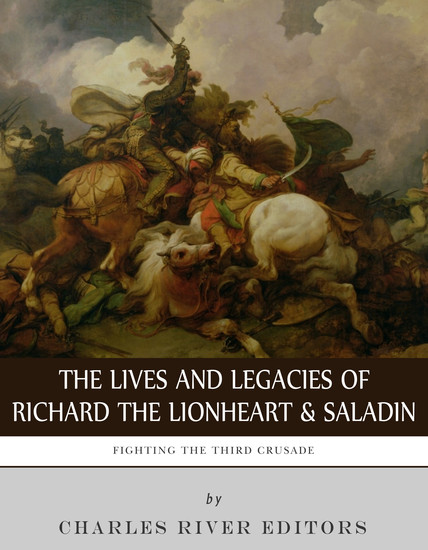
The Lives and Legacies of Richard the Lionheart and Saladin - Fighting the Third Crusade - cover

The Lives and Legacies of Richard the Lionheart and Saladin - Fighting the Third Crusade

Editors Charles River

Publisher: Charles River Editors

  • 0
  • 0
  • 0

Summary

Saladin is widely considered one of the greatest generals in history and one of the most famous leaders of the Middle Ages, but he remains a paradox, both in personal and in historical terms. A military genius, he first served other generals and was overshadowed, late in life, by his greatest rival, Richard I of England. He was far more admired by his Christian enemies, who extolled his chivalry, than some of his Muslim rivals, who fought him for control of Egypt and Syria in the 12th century. His Christian enemies continued his name long after it was forgotten in the Middle East, only to spark a revival of his reputation in Arab culture in the 20th century.
 
Revered as the flower of Arab culture, he was really a Kurd who nearly destroyed it. Taught to Egyptian children as a native born Egyptian hero, he was, in fact, Egypt's conqueror, the man who destroyed its native dynasty and suppressed the local Shi'ite sect. Praised for his mild temper and mercy, he made it his mission in the last decade of his life to destroy the Frankish states created by the First Crusade in 1099. The most powerful man in the Levant for the last ten years of his life, he died a virtual pauper after giving away his personal fortune to the poor. Having united almost all of the Levant under one rule, he left it as divided as before. He founded a dynasty that was eventually destroyed by slaves.
 
Richard I Plantagenet (1157-1199), nicknamed “Coeur de Lion” (Lionheart), eventually became King of England, Grand Duke of Aquitaine, Duke of Poitou, and Duke of Anjou, but as the third son in a large family, he did not expect to or even want to rule England. Nevertheless, it was he who eventually came to the throne upon his father's death. Richard lived in an age when knights were first asserting themselves as capable of being moral forces for good rather than only agents of chaos. This attitude resolved itself into the mystique of chivalry. As one of the strongest knights of his age, Richard was also considered a flower of chivalry and greatly admired as a model of what it meant to be a knight, both in his lifetime and afterward. But as the son of the most famous power couple of the age – Henry II of England (1133-89) and Eleanor of Aquitaine (1122/24-1204) – and an expansionist noble contesting over land with other expansionist nobles, he also had many enemies. These enemies portrayed Richard as evil incarnate, at the same time his admirers were portraying him an emblem of virtue. As with all such great and controversial figures, the real Richard lay somewhere in between.
 
 In many parts of the world today, Richard the Lionheart is remembered not for being a medieval king but for being perhaps the Crusades’ most famous European figher. In the Third Crusade, Richard was pitted against the best known Muslim leader in history, Saladin, who like Richard was considered a flower of chivalry by some, a tyrant by others, and even a herald of the Antichrist by Christians. Richard and Saladin's contest was cast by their contemporaries as a battle between Good and Evil (though who was Good and who was Evil depended greatly on the source), but eventually the legend and lore of mutual respect between the two and popular depictions of both leaders helped cement their legacies. Richard's eventual reputation was bound up as much in the crusading spirit of his age as in his reputation as a fearsome warrior or the history of his tumultuous family. If anything, stories like The Lion in Winter have oversimplified the complex Plantagenets who were Richard's closest kin.
Available since: 06/29/2025.
Print length: 64 pages.

Other books that might interest you

  • Summary: Counting the Cost - By Jill Duggar Derick Dillard & Craig Borlase: Key Takeaways Summary and Analysis - cover

    Summary: Counting the Cost - By...

    Brooks Bryant

    • 0
    • 0
    • 0
    DISCLAIMER: THIS IS NOT THE OFFICIAL BOOK. 
    This is a summary, and it does not accompany the official 
    'Counting the Cost' by Jill Duggar, Derick Dillard, and Craig Borlase recounts the life of Jill Duggar, who grew up in the spotlight on the reality show '19 Kids and Counting.' In a family that adhered to strict patriarchal principles, Jill initially accepted her role as a daughter, wife, and mother without questioning it. However, as she matured and started her own family with Derick, they began to see the flaws in their upbringing. 
    While they initially tried to conform to their family's expectations, Jill and Derick eventually realized they couldn't ignore the red flags any longer. Their story is one of transformation and the power of truth. Through therapy, tears, and the strength they found in their faith, they decided to share their journey openly. 'Counting the Cost' is a compelling account of their path to healing through honesty and serves as an inspirational example of the importance of confronting one's past to build a better future.
    Show book
  • Finding Margaret - Solving the mystery of my birth mother - cover

    Finding Margaret - Solving the...

    Andrew Pierce

    • 0
    • 0
    • 0
    Finding Margaret is the moving story of journalist and broadcaster Andrew Pierce's search for his birth mother. As he was approaching fifty, Pierce decided that it was finally time to track down his biological mother. He knew that he had lived in a Roman Catholic orphanage in Cheltenham for more than two years and was adopted at the age of three by a family who loved and nurtured him. As his career in journalism flourished and despite feeling like he was betraying the adoptive parents who loved him so much, Pierce began to tentatively search for his birth mother, only to find that she had done everything she could to ensure he would never find her. 
     
    When he finally managed to meet her, the mystery only deepened, leading him to Ireland in search of the man who may or may not have been his father. During his search, Pierce also realises the extent of the mistreatment he suffered at the orphanage and attempts to forge a relationship with the woman who gave him away. 
     
    This candid book is a heartwarming page turner that takes the reader on an extraordinary journey. Full of amusing and arresting anecdotes, at its heart lies the inspirational story of one man's extensive search for his birth mother and what happened when he finally found her.
    Show book
  • Academic Inferno - My Academic Trip Through Adjunct Hell - cover

    Academic Inferno - My Academic...

    Virgil Henry

    • 0
    • 0
    • 0
    Welcome to Adjunct Hell, where second-class teachers do first-class work. 
    A 30-year veteran of higher-education, Professor Virgil Henry uses Dante's Inferno as a guide to take readers on an epic adventure through the hellscape of higher education in the United States. 
    Follow Virgil and his band of like-minded adjuncts as they battle educational bureaucracy, low-pay, lack of health-care or job security, and social and professional indignities, all while showing up every day (and every night) for the students they care for and the job they love.
    Show book
  • Ayn Rand - Writing a Gospel of Success - cover

    Ayn Rand - Writing a Gospel of...

    Alexandra Popoff

    • 0
    • 0
    • 0
    A deeply researched biography of the prominent and divisive writer Ayn Rand, whose pro-capitalist novels and nonfiction have influenced three generations of Americans 
     
    Biographer Alexandra Popoff traces the life and creative achievement of Ayn Rand (1905–1982), one of America’s most provocative writers and whose best-selling novels The Fountainhead and Atlas Shrugged have enjoyed impressive longevity. Born into a Jewish family in Saint Petersburg, Russia, Rand (then Alisa Rosenbaum) lived through the 1917 Bolshevik Revolution, Civil War, and the onset of Soviet totalitarian dictatorships––experiences that made her profoundly anticommunist. When in 1926 Rand escaped from Stalinist Russia to realize her talent in America, she was also determined to expose the Communist system. 
     
    Through her apprenticeship in Hollywood, where she worked as a scriptwriter, to her first anti-Communist novel, We the Living, Rand doggedly pursued her goal, battling the Soviet belief system, along with its precepts of collectivism and statism. She defended American capitalism, individualism, prosperity, and creativity; her literary heroes were talented high achievers. While Marx had declared war on capitalism and prophesied the triumph of the proletariat, Rand, whose family was dispossessed by the Bolsheviks, glorified the wealth-creator and held the masses in contempt. In Atlas Shrugged, her most controversial novel, she promoted laissez-faire capitalism and the morality of rational self-interest. She envisaged apocalypse in America if it followed the socialist path.
    Show book
  • The Barber Astronaut and The Golf Ball - cover

    The Barber Astronaut and The...

    Barbara Radnofsky, Ed Supkis

    • 0
    • 0
    • 0
    In 1971, famed astronaut Alan Shepard returned from the moon and went to get a haircut. Before settling into the barber’s chair in Webster, Texas, near NASA’s Mission Control, Shepard gave his longtime barber and friend, Carlos Villagomez, an autographed golf ball. 
    During his Apollo 14 moonwalk, Shepard had conducted a world-famous demonstration of gravity by hitting a golf ball in an out-of-this-world sand trap. It took him two tries. 
    Carlos, a Navy combat veteran and barber for numerous astronauts, says Shepard gave him the ball immediately after he returned to earth and was released from quarantine. 
     ●     Had Shepard taken a third ball to the moon? 
    ●     Did he give it to his barber as a token of their long friendship? 
    ●     Is the ball one of the most significant pieces of sports memorabilia in history, or simply a gift of enduring friendship? 
    ●     Did the barber’s golf ball fly to the moon? 
    The debate provides a backdrop for The Barber, The Astronaut, and the Golf Ball, a story of two extraordinary men and their lasting friendship. The book is based on recollections of Carlos himself, the authors—both children of NASA scientists—as well as other astronauts, memorabilia experts, and family and friends of Shepard, who died in 1998.
    Show book
  • Our Stars Still Shine: Pet Memoirs of Love Grief and Hope - cover

    Our Stars Still Shine: Pet...

    Rheanna Rasico

    • 0
    • 0
    • 0
    Society often questions and ridicules the pace and depth at which we grieve a loss, but especially the loss of a pet. The same pointed questions and hollow phrases are repeated over again, which ultimately create more pain and social withdrawal as we fall short of their expectations. 
    But there are others who understand that losing a pet is one of the most devastating experiences while the process of mourning has no timeframe. The first step to healing is understanding grief is unique, personal, and necessary. Through emotional validation and shared insight of others who've experienced similar circumstances, there is a community of compassion. Grief may not have a roadmap, but there is hope through the trauma and pain. 
    Our Stars Still Shine is a collection of heartfelt memoirs from 22 different authors, written in their own words. From across the world, their stories connect them through shared experiences of deep love, pain, and finding life after loss. Read their stories as they recount some of the happiest and most painful moments of being a pet parent.
    Show book