Join us on a literary world trip!
Add this book to bookshelf
Grey
Write a new comment Default profile 50px
Grey
Subscribe to read the full book or read the first pages for free!
All characters reduced
The Life and Death of John F Kennedy - The Remarkable Life and Shocking Assassination of America’s Youngest President - cover

The Life and Death of John F Kennedy - The Remarkable Life and Shocking Assassination of America’s Youngest President

Editors Charles River

Publisher: Charles River Editors

  • 0
  • 0
  • 0

Summary

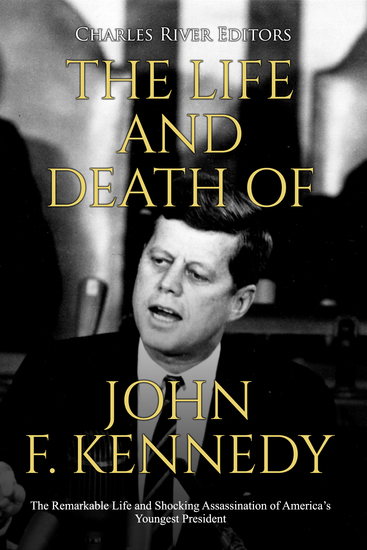
In many ways, John Fitzgerald Kennedy and his young family were the perfect embodiment of the ‘60s. The decade began with a sense of idealism, personified by the attractive Kennedy, his beautiful and fashionable wife Jackie, and his young children. Months into his presidency, Kennedy exhorted the country to reach for the stars, calling upon the nation to send a man to the Moon and back by the end of the decade. In 1961, Kennedy made it seem like anything was possible, and Americans were eager to believe him. The Kennedy years were fondly and famously labeled “Camelot,” by Jackie herself, suggesting an almost mythical quality about the young President and his family. 
 
As it turned out, the ‘60s closely reflected the glossy, idealistic portrayal of John F. Kennedy, as well as the uglier truths. The country would achieve Kennedy’s goal of a manned moon mission, and the landmark Civil Rights Act of 1964 finally guaranteed minorities their civil rights and restored equality, ensuring that the country “would live out the true meaning of its creed.” But the idealism and optimism of the decade was quickly shattered, starting with Kennedy’s assassination in 1963. The ‘60s were permanently marred by the Vietnam War, and by the time Robert F. Kennedy and Martin Luther King, Jr. were assassinated in 1968, the country was irreversibly jaded. The events of the decade produced protests and countercultures unlike anything the country had seen before, as young people came of age more quickly than ever.
 
The Life and Death of John F. Kennedy: The Remarkable Life and Shocking Assassination of America’s Youngest President chronicles the president’s life, and the assassination that rocked the country. Along with pictures and a bibliography, you will learn about Kennedy’s life and death like never before.


Available since: 05/01/2025.
Print length: 58 pages.

Other books that might interest you

  • LSAT Secrets for Instant Success - "Elevate your LSAT prep! Dive into our engaging audio lessons for guaranteed success!" - cover

    LSAT Secrets for Instant Success...

    Griffith Ormsbee

    • 0
    • 0
    • 0
    LSAT Secrets for Instant Success 
    ⭐⭐ Simplified Guide & Explanations Included ⭐⭐ 
    Are you aiming to advance your career and strengthen your knowledge by acing the LSAT? 
    In search of a thorough guide packed with everything you need to conquer the LSAT? 
    Your quest ends here! 
    This audiobook is your ultimate companion for enhancing your understanding, honing your skills, and engaging in practical exercises. With this resource, you're set for triumph. 
    Updated for the LSAT Exam Structure. 
    Key features of this comprehensive guide include: 
    - In-depth insights into LSAT Certification 
    - Clear explanations of the LSAT process 
    - Effective strategies for exam preparation and problem-solving 
    Our guide stands out with its extensive coverage, which is vital for your exam success. Concepts are explored in depth, not just brushed over. 
    Please note that this guide is an independent resource and is not affiliated with any official LSAT organization. 
    Crafted with a clear layout and accessible language, our LSAT Exam Guide ensures seamless transitions between topics. Say goodbye to complicated jargon and embrace straightforward, precise, and technically accurate content. 
    So, why wait? Click the BUY NOW button, secure your guide, and embark on your journey towards LSAT success! 
    Transform your LSAT preparation with this essential guide today!
    Show book
  • A Rare Recording of President Dwight D Eisenhower's 1961 Military-Industrial Complex Speech - cover

    A Rare Recording of President...

    President Dwight D. Eisenhower

    • 0
    • 0
    • 0
    On January 17, 1961, President Dwight Eisenhower delivered his political farewell to the American people on national television from the Oval Office of the White House. Those who expected the military leader and hero of World War II to depart his Presidency with a nostalgic, "old soldier" speech like Gen. Douglas MacArthur's, were surprised at his strong warnings about the dangers of the "military-industrial complex." As President of the United States for two terms, Eisenhower had slowed the push for increased defense spending despite pressure to build more military equipment during the Cold War’s arms race. Nonetheless, the American military services and the defense industry had expanded a great deal in the 1950s. Eisenhower thought this growth was needed to counter the Soviet Union, but it confounded him. Though he did not say so explicitly, his standing as a military leader helped give him the credibility to stand up to the pressures of this new, powerful interest group. He eventually described it as a necessary evil. The following is a transcript of the speech: 
     
    "Good Evening My Fellow Americans: 
     
    First, I should like to express my gratitude to the radio and television networks for the opportunities they have given me over the years to bring reports and messages to our nation. My special thanks go to them for the opportunity of addressing you this evening. 
     
    Three days from now, after half a century in the service of our country, I shall lay down the responsibilities of office as, in traditional and solemn ceremony, the authority of the Presidency is vested in my successor. 
     
    This evening I come to you with a message of leave-taking and farewell, and to share a few final thoughts with you, my countrymen. 
     
    Like every other citizen, I wish the new President, and all who will labor with him, Godspeed. I pray that the coming years will be blessed with peace and prosperity for all...
    Show book
  • Boardroom to Bedroom - Gay First Time M M Romance - cover

    Boardroom to Bedroom - Gay First...

    Michael Mullen

    • 0
    • 0
    • 0
    He came for a business trip. He left with a secret craving he never expected.  
    When a routine out-of-town business trip leads to an unexpected connection, two corporate men find themselves indulging in a night of passion that neither of them saw coming. What begins as casual drinks and shared glances soon escalates into a seductive encounter that blurs the lines between business and pleasure. 
    As the night unfolds, the suits come off, inhibitions are forgotten, and desire takes control. A luxurious suite, a bottle of wine, and two men exploring unspoken fantasies create an unforgettable escape from reality. But when morning comes, will they part ways as colleagues—or as something more? 
    "Boardroom to Bedroom" is a tantalizing tale of temptation, exploration, and the thrill of unexpected desire. If you love steamy MM encounters, forbidden temptations, and nights that spiral into unrelenting passion, this erotic short story is for you. 
    For mature readers only. One night can change everything.
    Show book
  • The Psychology of Christian Nationalism - Why People Are Drawn In and How to Talk Across the Divide - cover

    The Psychology of Christian...

    Pamela Cooper-White

    • 0
    • 0
    • 0
    How do we overcome polarization in American society? How do we advocate for justice when one side won't listen to the other and cycles of outrage escalate? 


    These questions have been pressing for years, but the emergence of a vocal, virulent Christian nationalism have made it even more urgent that we find a way forward. 


    In three brief, incisive chapters Pamela Cooper-White uncovers the troubling extent of Christian nationalism, explores its deep psychological roots, and discusses ways in which advocates for justice can safely and effectively attempt to talk across the deep divides in our society.
    Show book
  • Quiet by Susan Cain - Book Summary - The Power of Introverts in a World That Can't Stop Talking - cover

    Quiet by Susan Cain - Book...

    FlashBooks, Dean Bokhari

    • 0
    • 0
    • 0
    Quiet by Susan Cain - Book Summary 
    Important note: This is not the original book, this is a book summary. 
    About 
    Quiet: The Power of Introverts in a World That Can't Stop Talking by Susan Cain • Susan Cain’s book Quiet is a respectfully written, long-needed validation for introverts everywhere. In addition to using research findings to help introverts understand why they experience the world the way they do, Susan Cain offers insight and strategies for introverts to use to thrive in an extrovert-driven world. She also gives useful explanations to extroverts, partners and managers of introverts, and parents of introverted children to bring out the best in their innate gifts, while helping them cope with the extroverted requirements of daily life. 
     
    Here’s what you’ll learn about in this summary: 
     
    An appreciation for introverts, and for being an introvert (if you are one).An explanation of the wonderful and challenging aspects of being an introvert.How to thrive as an introvert, and how to help other introverts function optimally.
    Show book
  • Misinformation Nation - Foreign News and the Politics of Truth in Revolutionary America - cover

    Misinformation Nation - Foreign...

    Jordan E. Taylor

    • 0
    • 0
    • 0
    In Misinformation Nation, Jordan E. Taylor reveals how foreign news defined the boundaries of early American politics and ultimately drove colonists to revolt against Britain and create a new nation. 


    News was the lifeblood of early American politics, but newspaper printers had few reliable sources to report on events from abroad. Though frequently false, the information that Americans encountered in newspapers, letters, and conversations framed their sense of reality, leading them to respond with protests, boycotts, violence, and the creation of new political institutions. Fearing that their enemies were spreading fake news, American colonists fought for control of the news media. As their basic perceptions of reality diverged, Loyalists separated from Patriots and, in the new nation created by the revolution, Republicans inhabited a political reality quite distinct from that of their Federalist rivals. 


    The American Revolution was not only a political contest for liberty, equality, and independence (for white men, at least); it was also a contest to define certain accounts of reality to be truthful while defining others as false and dangerous. Misinformation Nation argues that we must also conceive of the American Revolution as a series of misperceptions, misunderstandings, and uninformed overreactions.
    Show book