Rejoignez-nous pour un voyage dans le monde des livres!
Ajouter ce livre à l'électronique
Grey
Ecrivez un nouveau commentaire Default profile 50px
Grey
Abonnez-vous pour lire le livre complet ou lisez les premières pages gratuitement!
All characters reduced
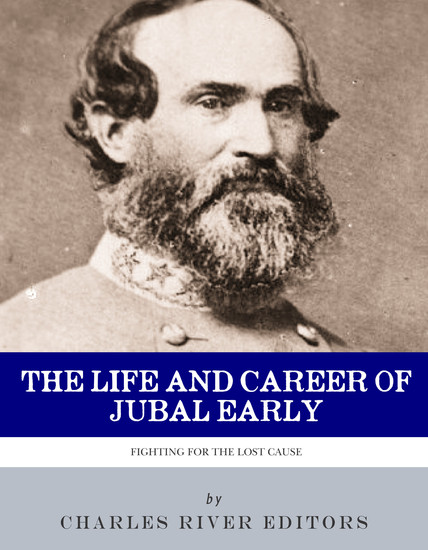
The Life and Career of General Jubal Early - Fighting for the Lost Cause - cover

The Life and Career of General Jubal Early - Fighting for the Lost Cause

Editors Charles River

Maison d'édition: Charles River Editors

  • 0
  • 0
  • 0

Synopsis

Jubal Early (1816-1894) fought two big wars during his life. About 150 years ago, Early played an important role as a general for the Confederacy, fighting his way up the ranks until he was eventually given an independent command by Robert E. Lee in late 1864. Early served under Stonewall Jackson and Robert E. Lee, rising from regiment commander to Corps commander in the Army of Northern Virginia, and he played crucial roles in key battles like Gettysburg and in the Shenandoah Valley campaigns. During his raid toward Washington D.C., his forces nearly killed President Lincoln during a battle at Fort Stevens, making Lincoln the only sitting president to come under live fire.


However, it was Early’s writing that truly changed history.  During the 1870s, Early was one of the writers for the Southern Historical Society who helped establish the Lost Cause, a cultural phenomenon that dominated the writing of Civil War history for a century and is still a widely held view today. His autobiography, Lieutenant General Jubal A. Early , Confederate States of America, is a perfect example of Lost Cause writing, in which the Confederacy is unable to overcome the North’s vast advantage in men and resources. At the same time, the Lost Cause was primarily a creation of men from Virginia, so in turn they deified Lee and are widely responsible for Lee’s immense popularity today. And since Lee could do no wrong in their eyes, writers like Early looked for others to blame for the South’s loss, especially at Gettysburg, which was widely viewed then and now as the chief turning point of the war. For years, Early and James Longstreet argued in writing over who was to blame for the loss at Gettysburg, leading both men to attack each other in print.


Those who personally knew Early wouldn’t have been shocked by his writing. Though Lee admired Early and playfully referred to him as his “Bad Old Man” due to Early’s short temper, that same temper crossed many of Early’s subordinates. Early also alienated subordinates by being quick to point the finger at them for mistakes, even if they were his fault. Nevertheless, Early’s biography is a great read not just for the story it tells but also as one of the best examples of Lost Cause writing, and how the Lost Cause was developed in the years after the war.
 
 
Disponible depuis: 20/06/2025.
Longueur d'impression: 97 pages.

D'autres livres qui pourraient vous intéresser

  • Han Dynasty - Silk Roads Science and the Confucian Revival - cover

    Han Dynasty - Silk Roads Science...

    Rolf Hedger

    • 0
    • 0
    • 0
    The Han Dynasty, lasting from 206 BCE to 220 CE, is one of the most significant periods in Chinese history, shaping the culture, politics, and identity of China for centuries. It followed the brief but influential Qin Dynasty, which had laid the foundations for imperial rule but also faced internal strife and rebellion. The Han emerged as the new power, restoring stability and expanding China's borders, making significant contributions to science, technology, trade, and philosophy. 
    The dynasty's rise was primarily due to the leadership of Liu Bang, a former peasant who became Emperor Gaozu. He defeated his rival, Xiang Yu, and took control of the vast Qin Empire, establishing the Han Dynasty. Gaozu's leadership marked the beginning of a new era, one that would see the consolidation of power and the implementation of reforms that would shape the future of the empire. 
    The Han Dynasty’s political structure was deeply influenced by the collapse of the Qin Dynasty. Emperor Gaozu restored the decentralized feudal system of governance, but with modifications to ensure more central control. Over time, the emperors of the Han Dynasty would strengthen the centralized bureaucracy, establishing a model that would endure for centuries in imperial China. One of the key developments was the introduction of Confucianism as the state philosophy. Confucian ideals, emphasizing hierarchy, duty, and moral governance, became deeply embedded in the political and social structure of the Han Empire. Confucian scholars played an essential role in the administration, and the dynasty itself was viewed as a time when the state was governed by virtuous and learned rulers.
    Voir livre
  • 17A Keong Saik Road - cover

    17A Keong Saik Road

    Charmaine Leung

    • 0
    • 0
    • 0
    Mummy, why do you always have to leave for 17A… 


    17A Keong Saik Road recounts Charmaine Leung’s growing-up years on Keong Saik Road in the 1970s when it was a prominent red-light precinct in Chinatown in Singapore. An interweaving of past and present narratives, 17A Keong Saik Road tells of her mother’s journey as a young child put up for sale to becoming the madame of a brothel in Keong Saik. Unfolding her story as the daughter of a brothel operator and witnessing these changes to her family, Charmaine traces the transformation of the Keong Saik area from the 1930s to the present, and through writing, finds reconciliation. 
     
    A beautiful dedication to the past, to memory, and to the people who have gone before us, 17A Keong Saik Road tells the rich stories of the Ma Je, the Pei Pa Zai, and the Dai Gu Liong—marginalised, forgotten women of the past, who despite their difficulties, persevered in working towards the hope of a better future.
    Voir livre
  • Summary: The Light We Carry - Overcoming in Uncertain Times by Michelle Obama: Key Takeaways Summary & Analysis - cover

    Summary: The Light We Carry -...

    Brooks Bryant

    • 0
    • 0
    • 0
    DISCLAIMER: This is NOT the official book. This is a summary & it does NOT accompany the official book. 
    This summary book condenses the essence of her memoir, capturing her inspiring life trajectory and the transformative lessons it carries. It presents the defining moments of her life, the struggles faced, the triumphs savored, and the wisdom earned. From the trials of political life to the joys of family and the tireless advocacy for women's rights, the light she carries shines bright in every endeavor. 
    Delve into the powerful summary of "The Light we Carry" by Michelle Obama, and allow the lessons from her life to illuminate your own path. This book is not just a recounting of a remarkable life—it's an inspiring narrative, a treasure trove of wisdom, and a testament to the transformative power of resilience and hope.
    Voir livre
  • JRR Tolkien: The True Story of the Life and Time of the Great Author - cover

    JRR Tolkien: The True Story of...

    Liam Dale

    • 0
    • 0
    • 0
    There are some names that just fall off the tongue with the promise of great things, and John Ronald Reuel Tolkien is a perfect example. In his own lifetime this softly spoken, pipe smoking, tweed clad Oxford College Professor, the quintessential Englishman, caused a tremendous stir when he wrote first “The Hobbit” and then “The Lord of the Rings”. But Tolkien could never have guessed the impact his beloved books would continue to have on future generations of listeners, and since Peter Jackson’s wonderful 21st Century movie adaptations filmgoers and even computer gamers as well! Whether JRR would have approved of all this modern technology, is as you are about to discover, debatable. However, the adulation of millions of grateful fans might just have won him over. Most people could tell you that “The Lord of the Rings” was written by JRR Tolkien, but who the man behind the great epic was, few would even be able to hazard a guess. This is due in part to Tolkien’s very private nature and the fact that when he died, he was, quite simply, a pleasantly successful English author, no more, no less. Those who loved his books did so with a passion, but there were also plenty of dissenters. The huge cult status of “The Lord of the Rings” did not fully evolve until some years after Tolkien’s death and therefore there are few publicity pictures of him, and unlike J K Rowling, the world-famous author of the Harry Potter books, JRR Tolkien never became a celebrity. Now, unless your name’s Rip Van Winkle and you’ve been asleep for the last twenty years, even if you’ve never read “The Lord of the Rings” you’ll know it’s all about adventure with a capital “A”, on an incredible journey of discovery. With the people and places that inspired JRR to write such an incredible piece of fiction this will prove to be an equally enlightening pathway to travel, uncovering a real-life character way more complex than Hobbits, Orcs, Elves, Ents, Dwarves and Wizards put together!
    Voir livre
  • The Ransom Of Red Chief - cover

    The Ransom Of Red Chief

    O. Henry

    • 0
    • 0
    • 0
    "The Ransom of Red Chief" is a short story by O. Henry first published in the July 6, 1907 issue of The Saturday Evening Post. It follows two men who kidnap, and demand a ransom for, a wealthy Alabamian's son. Eventually, the men are driven crazy by the boy's spoiled and hyperactive behavior, and they pay the boy's father to take him back.
    The story and its main idea have become a part of popular culture, with many children's television programs depicting versions of the story as one of their episodes. It has also been often used as a classic example of two ultimate comic ironies – a supposed "hostage" actually liking his abductors and enjoying being captured, and his captors getting their just deserts by having the tables turned on them, and being compelled to pay to be rid of him.
    Voir livre
  • Washington - A Legacy of Leadership - cover

    Washington - A Legacy of Leadership

    Dr. Paul Vickery

    • 0
    • 0
    • 0
    His name is carved in granite, his likeness cast in bronze, his legend as large as the role he played as America's first president. But before he was a commander-in-chief, George Washington was a general in a revolution that would decide the future of the people and land he called his own. If victorious, he would gain immortality. If defeated, he would find his neck in a hangman's noose. 
    Washington knew the sting of defeat—at Brandywine, at Germantown—yet this unwavering leadership and his vision for a new and independent nation emboldened an army prepared to fight barefoot if necessary to win that independence. Wrote an officer after the Battle of Princeton:  "I saw him brave all the dangers of the field and his important life hanging as it were by a single hair with a thousand deaths flying around him." 
    Among America's pantheon of Founding Fathers, one man to this day stands out.  Author Paul Vickery tracks the unlikely rise of Washington, a man whose stature in command of a young army became prelude to a presidency. As Vickery writes, "He learned to become the father of our country by first being the father of our military." 
    Accompanying images are included in the audiobook companion PDF download.
    Voir livre