Begleiten Sie uns auf eine literarische Weltreise!
Buch zum Bücherregal hinzufügen
Grey
Einen neuen Kommentar schreiben Default profile 50px
Grey
Jetzt das ganze Buch im Abo oder die ersten Seiten gratis lesen!
All characters reduced
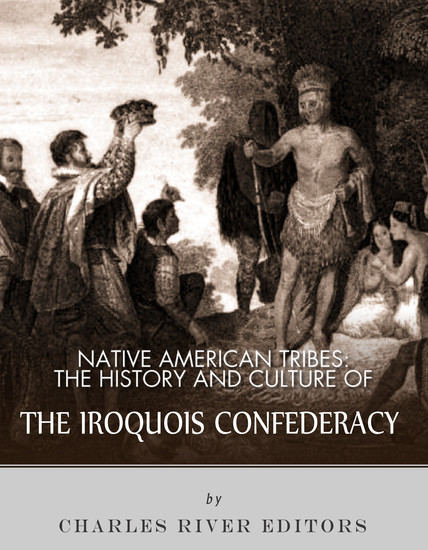
The History and Culture of the Iroquois Confederacy - cover

The History and Culture of the Iroquois Confederacy

Editors Charles River

Verlag: Charles River Editors

  • 0
  • 0
  • 0

Beschreibung

From the “Trail of Tears” to Wounded Knee and Little Bighorn, the narrative of American history is incomplete without the inclusion of the Native Americans that lived on the continent before European settlers arrived in the 16th and 17th centuries. Since the first contact between natives and settlers, tribes like the Sioux, Cherokee, and Navajo have both fascinated and perplexed outsiders with their history, language, and culture. In Charles River Editors’ Native American Tribes series, readers can get caught up to speed on the history and culture of North America’s most famous native tribes in the time it takes to finish a commute, while learning interesting facts long forgotten or never known.
 
Among all the Native American tribes, the Iroquois people are some of the most well documented Native Americans in history. Indigenous to the northeast region of what is now the United States and parts of Canada, they were among some of the earliest contacts Europeans had with the native tribes. And yet they have remained a constant source of mystery.
 
The name "Iroquois", like many Native American tribal names, is not a name the people knew themselves by, but a word applied to them by their enemies the Huron, who called them “Iroquo” (rattlesnake) as an insult. The French later added the suffix “ois.” Moreover, the Iroquois are not even a single tribe but a confederation of several different tribal nations that include the Seneca, Oneida, Onondaga, Mohawk, Cayuga and the Tuscarora, who didn’t become part of the union until the early 1700’s.  The name Haudenosaunee (pronounced “ho-den-oh-SHO-nee”) is the name the people use for themselves, which translates as “the People of the Longhouse.” They are also commonly known as the Six Nations.
 
Despite their own cultural differences, the nations that comprised the Iroquois Confederacy established their political dominance across much of America’s East Coast and Midwest through conquest, and it is that aspect which has perhaps best endured among Americans in terms of the Iroquois’ legacy. European settlers who came into contact with the Mohawks in the Northeast certainly learned to respect their combat skills, to the point that there were literally bounties on the Mohawks’ heads, with scalps fetching money for colonists who succeeded in slaying them and carrying away the “battle prize”.
 
In addition to the constant state of conflict between the Iroquois and different nations, including the French and the colonists, the Six Nations are perhaps best known for their political structure, and their influence on American democracy is well documented if not well known by most Americans.
 
Far from being relics of history, they are living communities who maintain political relationships with United States and Canada, as they have occupied their territories long before international borders were drawn. Their histories have left an indelible mark on the formation of the United States and Canada. Native American Tribes: The History and Culture of the Iroquois Confederacy comprehensively covers the culture and history of the Six Nations. Along with pictures depicting the Iroquois, you will learn about the Iroquois like you never have before, in no time at all.
Verfügbar seit: 27.05.2025.
Drucklänge: 32 Seiten.

Weitere Bücher, die Sie mögen werden

  • Why War? - cover

    Why War?

    Richard Overy

    • 0
    • 0
    • 0
    Why has war been such a consistent presence throughout the human past? A leading historian explains, drawing on rich examples and keen insight. 


    Richard Overy is not the first scholar to take up the title question. In 1931, at the request of the League of Nations, Albert Einstein asked Sigmund Freud to collaborate on a short work examining whether there was "a way of delivering mankind from the menace of war." Published the next year as a pamphlet entitled Why War?, it conveyed Freud's conclusion that the "death drive" made any deliverance impossible—the psychological impulse to destruction was universal in the animal kingdom. The global wars of the later 1930s and 1940s seemed ample evidence of the dismal conclusion. 


    A preeminent historian of those wars, Overy brings vast knowledge to the title question and years of experience unraveling the knotted motivations of war. His approach is to separate the major drivers and motivations, and consider the ways each has contributed to organized conflict. They range from the impulses embedded in human biology and psychology, to the incentives to conflict developed through cultural evolution, to competition for resources. The discussions show remarkable range, delving deep into the Neolithic past, through the twentieth-century world wars, and up to the current conflict in Ukraine.
    Zum Buch
  • The Uses of Delusion - Why It's Not Always Rational to Be Rational - cover

    The Uses of Delusion - Why It's...

    Stuart Vyse

    • 0
    • 0
    • 0
    Although reason and rationality are our friends in almost all contexts, in some cases people are better off putting reason aside. In a number of very important situations, we benefit by not seeing the world as it is, and by not behaving like logic-driven machines. 


    The Uses of Delusion is about aspects of human nature that are not altogether rational but, nonetheless, help us achieve our social and personal goals. Psychologist Stuart Vyse presents a lively, accessible exploration of the psychological concepts behind "useful delusions," fleshing out how delusional thinking may play a role in love and relationships, illness and loss, and personality and behavior. Along the way Vyse draws on the work of William James, Daniel Kahneman, and Joan Didion—who wrote about her compelling belief that her husband, though deceased, would soon return to her. 


    Throughout, Vyse strives to answer the question: why would some of our most illogical beliefs be as helpful as they are? The concluding chapter offers an explanation grounded in natural selection—the ability to fool ourselves, Vyse argues, has actually helped us to survive. In the last section of The Uses of Delusion, Vyse offers suggestions for determining when reason should rule and when intuition and emotion should be allowed to take over.
    Zum Buch
  • Egyptian Mythology - Legends Deities and the Mysteries of the Ancient Nile - cover

    Egyptian Mythology - Legends...

    Christiano Farrezi

    • 0
    • 0
    • 0
    Egyptian mythology forms the foundation of one of the most influential and enduring civilizations in human history. Rich with symbolism, these myths provided a framework through which the ancient Egyptians understood the universe, nature, and the spiritual world. Unlike other mythologies that may have developed primarily through folklore, Egyptian mythology was closely tied to religious practices and rituals that were integral to the culture. Its stories feature a pantheon of gods and goddesses, each with specific roles, attributes, and symbolic meanings, governing aspects of life, death, nature, and the cosmos. These divine beings were more than just mythological figures; they were living forces present in the daily lives of Egyptians, influencing their actions, decisions, and the very fabric of their society. 
      
    The mythological narratives of Egypt often revolved around cosmic battles between order and chaos, cycles of death and rebirth, and the journey of the soul. These stories were not only entertainment but also served as explanations for natural phenomena, like the yearly flooding of the Nile, the movement of the stars, or the transitions between day and night. Mythology also justified the divine right of the pharaohs, who were considered to be the living embodiments of gods on Earth, specifically the god Horus. By linking mythology with the ruling class, ancient Egyptians reinforced the authority of their leaders and established a divine connection that was essential to their social and political structure. Through sacred texts, temple inscriptions, and monumental architecture, these myths have been preserved, allowing us to glimpse into a world where gods and mortals coexisted in a harmonious balance.
    Zum Buch
  • The Spanish Wars - cover

    The Spanish Wars

    Julius Caesar

    • 0
    • 0
    • 0
    The Spanish Wars, a series of military campaigns led by Julius Caesar, encompassed a breadth of engagements in the Iberian Peninsula between 59 and 45 BC. These wars are notable for their significant contribution to Roman imperial expansion, as they enabled the subjugation and conquest of Hispania under Roman authority. Furthermore, the Spanish Wars were preeminent in Caesar's career as a general, providing ample opportunities to demonstrate his tactical acumen and superior leadership capabilities. Read in English, unabridged.
    Zum Buch
  • Hidden Worldviews - Eight Cultural Stories That Shape Our Lives - cover

    Hidden Worldviews - Eight...

    Mark L. Sanford, Steve Wilkens

    • 0
    • 0
    • 0
    Why do we buy what we buy, vote the way we vote, eat what we eat, and say what we say? Why do we have the friends we have, and work and play as we do? It's our choice? Yes, but there are forces, often unseen, that shape every decision we make and every action we take. 


    These hidden, life-shaping values and ideas are not promoted through organized religions or rival philosophies but fostered by cultural habits, lifestyles and the institutional structures of society. Steve Wilkens and Mark Sanford shine a spotlight on the profound challenges to Christianity and faithful Christian living that come from worldviews that comprise the cultural soup we swim in. 


    The authors show how to detect the individualism, consumerism, nationalism, moral relativism, scientific naturalism, New Age thinking, postmodern tribalism, and salvation as therapy that fly under our radar. Building on the work of worldview thinkers like James Sire, this book helps those committed to the gospel story recognize those rival cultural stories that compete for our hearts and minds.
    Zum Buch
  • Battle of Waterloo - The Determining Moment of Napoleon’s Demise - cover

    Battle of Waterloo - The...

    Kelly Mass

    • 0
    • 0
    • 0
    The Battle of Waterloo, fought on June 18, 1815, near the village of Waterloo in the United Kingdom of the Netherlands (present-day Belgium), was a decisive conflict that ended the Napoleonic Wars. The battle pitted the French army, led by Napoleon Bonaparte, against two powerful forces from the Seventh Coalition. One of these was a British-led coalition under the command of the Duke of Wellington, which included troops from the United Kingdom, the Netherlands, Hanover, Brunswick, and Nassau. The other force was a larger Prussian army commanded by Field Marshal Gebhard Leberecht von Blücher. Together, these forces effectively crushed Napoleon's ambitions and marked the final chapter in his reign. The battle was also known as the Battle of Mont Saint-Jean (to the French) or La Belle Alliance (to the Prussians). 
    The events leading to Waterloo began when Napoleon returned to power in March 1815, following his exile to the island of Elba. His return prompted his former enemies to form the Seventh Coalition, a group determined to prevent his resurgence. The British and Prussian armies were stationed along France's northern border, preparing for a possible confrontation. Napoleon, keen to defeat his enemies before they could join forces, planned to strike at each army individually. On June 16, he attacked the Prussian army at the Battle of Ligny, inflicting a significant defeat, which forced the Prussians to retreat northward. However, the Prussian retreat was conducted in good order, and they maintained contact with Wellington's forces, who were stationed nearby.
    Zum Buch