Join us on a literary world trip!
Add this book to bookshelf
Grey
Write a new comment Default profile 50px
Grey
Subscribe to read the full book or read the first pages for free!
All characters reduced
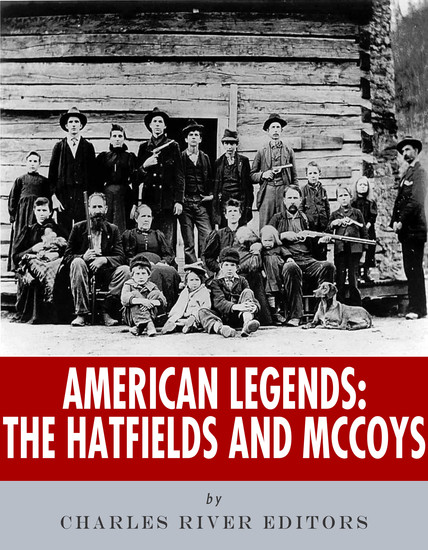
The Hatfields & The McCoys - cover

The Hatfields & The McCoys

Editors Charles River

Publisher: Charles River Editors

  • 0
  • 0
  • 0

Summary

"They were men, who matched the mountains, they were Hatfields and McCoys. They were men, who matched the mountains. They were men, when they were boys." – Jimmy Wolford
 
A lot of ink has been spilled covering the lives of history’s most influential figures, but how much of the forest is lost for the trees? In Charles River Editors’ American Legends series, readers can get caught up to speed on the lives of America’s most important men and women in the time it takes to finish a commute, while learning interesting facts long forgotten or never known.
 
The feud between the Hatfields and McCoys is the stuff of American legend and has become synonymous for vendettas.  In fact, it has become its own term for any large scale disagreement and has made its way into everything from music to television and movies. Though the fighting took place over a century ago, Americans remain so fascinated by it that The History Channel’s 2012 miniseries about the feuding families set records for cable television ratings.
 
These days, the feud between the Hatfields and McCoys is a celebrated piece of American folklore, but for two families living along the West Virginia–Kentucky border during the last half of the 19th century, the feud was literally a matter of life and death. 21st century America might celebrate this relic of the country’s rural past, but modern society would also likely scoff at the idea of a couple of rural families taking pot shots at each other through the woods over slights as insignificant as a stolen pig. Nevertheless, for the Hatfields and McCoys, the feud was every bit as dangerous as a modern gang war or organized crime activity.
 
While the feud may be harder to understand today, it was a microcosm of other conflicts that shaped America’s destiny.  First, it represents the heritage of the blood feud that came to the United States with those immigrating from Scotland and Ireland.  The backcountry of the South was settled primarily by immigrants from the “Celtic fringe” of Great Britain:  Scotland, Northern England, Cornwall, Wales, and Ireland.   For these settlers, family ties were paramount; loyalty was key, and conflicts were settled with violence.  The feud also demonstrated the continuing importance of honor in the South in the late 19th century, and a notion that personal honor should be defended against actual or perceived slights with violence. Clearly, the South’s code of honor persisted long after the Civil War, as did tension between supporters of the Union and the Confederacy. 
 
American Legends: The Hatfields & The McCoys chronicles America’s most famous blood feud, from the origins of each family to the events that sparked the fighting. Along with pictures of important people, places, and events, you will learn about The Hatfields and The McCoys like you never have before, in no time at all.
Available since: 06/21/2025.
Print length: 29 pages.

Other books that might interest you

  • Sulla and Gaius Marius: The Lives and Legacies of the Leaders Who Fought Rome’s First Civil War - cover

    Sulla and Gaius Marius: The...

    Editors Charles River

    • 0
    • 0
    • 0
    Caesar is still remembered for winning a civil war and helping bring about the end of the Roman Republic, leaving a line of emperors in its place, but it’s quite possible that none of what Caesar did would’ve happened without the template for such actions being set 40 years earlier. At the time, when Caesar was in his teens, war was being waged both on the Italian peninsula and abroad, with domestic politics pitting the conservative, aristocratic optimates against the populist, reformist populares, and this tension ultimately escalated into an all-out war. One of the leading populares was Caesar’s uncle, Gaius Marius, a military visionary who had restructured the legions and extended the privileges of land ownership and citizenship to legionaries on condition of successful completion of a fixed term of service. In the late 2nd century BCE, Marius had waged a successful campaign against several Germanic tribes, and after earning eternal fame in the Eternal City, Marius was appointed a consul several times. In 88 BCE, he entered into conflict with his erstwhile protégé, the optimate Sulla, over command of the army to be dispatched against Mithridates VI of Pontus, a long-time enemy of Rome and its Greek allies.   
    	Ironically, Marius’s reforms had made the legions fiercely loyal to their individual generals rather than the state, which allowed Sulla to march his army against Rome and force Marius into exile. With that, Rome’s first civil war was officially underway, but Sulla’s triumph proved short-lived. Just as Sulla departed for a campaign, Marius returned at the head of a scratch army of veterans and mercenaries, taking over the city and purging it of Sulla’s optimate supporters, and though Marius died in 86 BCE, his party remained in power. 
    Show book
  • Cannibal Capitalism - How our System is Devouring Democracy Care and the Planet – and What We Can Do About It - cover

    Cannibal Capitalism - How our...

    Nancy Fraser

    • 0
    • 0
    • 0
    A trenchant look at contemporary capitalism's insatiable appetite—and a rallying cry for everyone who wants to stop it from devouring our world 


    Capital is currently cannibalizing every sphere of life—guzzling wealth from nature and racialized populations, sucking up our ability to care for each other, and gutting the practice of politics. In this tightly argued and urgent volume, leading Marxist feminist theorist Nancy Fraser charts the voracious appetite of capital, tracking it from crisis point to crisis point, from ecological devastation to the collapse of democracy, from racial violence to the devaluing of care work. These crisis points all come to a head in Covid-19, which Fraser argues can help us envision the resistance we need to end the feeding frenzy. 


    What we need, she argues, is a wide-ranging socialist movement that can recognize the rapaciousness of capital—and starve it to death.
    Show book
  • Occult Rulers of the World - cover

    Occult Rulers of the World

    Phil G

    • 0
    • 0
    • 0
    Have you ever wondered who actually rules the world? Where did they come from? Why do they have power? We may believe that we actually elect our leaders, but the truth is much more sinister and ancient. In actual fact, wealth and power was created over a vast period of time from within the world of the occult. Secret societies emerged within royalty and religion. Secret societies that had occult knowledge. Today we can still see traces of their original belief systems in huge business, governments, organizations, buildings, art and so much more. This is the story of the occult rulers of the world.
    Show book
  • Infinite Fountain of Light An - Jonathan Edwards for the Twenty-First Century - cover

    Infinite Fountain of Light An -...

    George M. Marsden

    • 0
    • 0
    • 0
    For perspective on our own times and how we got here, it helps to listen to wise guides from other eras. In An Infinite Fountain of Light, the renowned American historian George Marsden illuminates the landscape with wisdom from one such mentor: Jonathan Edwards. Drawing on his deep expertise on Edwards and American culture, Marsden explains where Edwards stood within his historical context and sets forth key points of his complex thought. By also considering Benjamin Franklin and George Whitefield, two of Edwards's most influential contemporaries, Marsden unpacks the competing cultural and religious impulses that have shaped our times. In contrast, Edwards offered us an exhilarating view of the centrality of God's beauty and love. Christians' love for God, he taught, can be the guiding love of our lives, opening us to transformative joy and orienting all our lesser loves. There is an infinite fullness of all possible good in God, a fullness of every perfection, of all excellency and beauty, and of infinite happiness, wrote Edwards. This infinite fountain of light should, diffusing its excellent fullness, pour forth light all around. With Marsden's guidance, listeners will discover how Edwards's insights can renew our own vision of the divine, of creation, and of ourselves.
    Show book
  • Creating Good Content - The Ultimate on How to Write Quality Content to Help Increase the Profits of Your Business - cover

    Creating Good Content - The...

    Gil Fairfax

    • 0
    • 0
    • 0
    Creating Good Content: The Ultimate on How to Write Quality Content to Help Increase the Profits of Your BusinessWith the age of print advertising fading into the abyss, having a strong online presence is more important than ever. It doesn’t matter what industry you're in or what size your business is! Getting noticed online must be a central part of your marketing strategy if you want customers to find you. In this audiobook, you will learn how to create quality content for your business. It will also teach you about content marketing that can greatly increase the success of your business.This audiobook will cover the following topics:- Why Publishing Content Online is Important to Business- Importance of Creating Content that Attracts People- Utilizing Different Types of Content to Achieve Your Objectives- Incorporating Images and Videos in Your Content- Promoting Your Content- And many more!If you want to learn more, scroll up and click “add to cart” now!
    Show book
  • For F*ck's Sake - Why Swearing is Shocking Rude and Fun - cover

    For F*ck's Sake - Why Swearing...

    Rebecca Roache

    • 0
    • 0
    • 0
    Why do we love to swear so much? Why do we get so offended when others do it? 


    In this lively and amusing exploration of the various puzzles that surround swearing, philosopher Rebecca Roache argues that what makes swearing offensive is not really the words at all: the offensiveness lies in what we don't say. The unspoken—and usually unconscious—inferences that speakers and listeners make about each other are key to explaining swearwords' capacity to shock. Swearing is unique among etiquette breaches in that it is designed to convey disrespect—swearing packs more of a punch than failing to say "please." 


    Roache helps listeners understand how swearing works, celebrating its power as a communicative tool and source of humor while also taking a close and serious look at specific words—those directed at women and women's bodies, for example—that function in particular, complex ways. She also examines the often-hypocritical ways swearing can be punished or censored. 


    Finally, Roache helps listeners appreciate that swearing isn't always bad. When it's not used offensively, it can foster social intimacy, can help people withstand pain, and might even help us curb our violent impulses.
    Show book