Join us on a literary world trip!
Add this book to bookshelf
Grey
Write a new comment Default profile 50px
Grey
Subscribe to read the full book or read the first pages for free!
All characters reduced
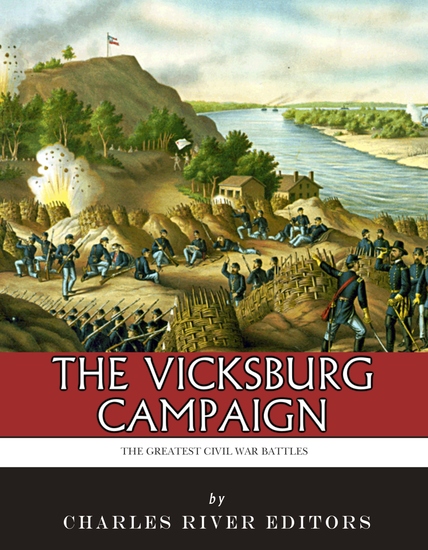
The Greatest Civil War Battles - The Vicksburg Campaign - cover

The Greatest Civil War Battles - The Vicksburg Campaign

Editors Charles River

Publisher: Charles River Editors

  • 0
  • 0
  • 0

Summary

At the start of 1863, Robert E. Lee’s Army of Northern Virginia had been frustrating the Union in the Eastern theater for several months, but the situation in the West was completely different. The Confederates had lost control of several important states throughout 1862, and after New Orleans was taken by the Union, the North controlled almost all of the Mississippi River, which Confederate general James Longstreet called “the lungs of the Confederacy”. By taking control of that vital river, the North would virtually cut the Confederacy in two, putting the South in a dire situation.
 
The only domino left to fall was the stronghold of Vicksburg, and both sides knew it. The Union Army of the Tennessee, led by Ulysses S. Grant, would spend months trying to encircle the army and eventually force John Pemberton’s Confederate army to surrender. Grant eventually succeeded on July 4, 1863, but since it came a day after the climactic finish of the Battle of Gettysburg, Vicksburg was (and still is) frequently overlooked as one of the turning points of the Civil War. In fact, had the Confederate’s military leadership listened to Longstreet, who advocated detaching soldiers from Lee’s army to head west and help the Confederates deal with Grant or Rosecrans in that theater, the Battle of Gettysburg might never have happened.
 
While many read about the siege of Vicksburg in the summer of 1863, as well as the desperate straits the Confederate soldiers and Vicksburg residents found themselves in, Grant’s initial attempts to advance towards Vicksburg met with several miserable failures, and it took several months just to get to the point where the Union forces could start a siege. First, Grant’s supply base at Holly Springs was captured, and then an assault launched by Union General Sherman at Chickasaw Bayou was easily repulsed by Confederate forces, with serious Union casualties resulting.  Grant then attempted to have his men build canals north and west of the city to facilitate transportation, which included grueling work and disease in the bayous.
 
On April 30, 1863, Grant finally launched the successful campaign against Vicksburg, marching down the western side of the Mississippi River while the navy covered his movements. He then crossed the river south of Vicksburg and quickly took Port Gibson on May 1, Grand Gulf on May 3, and Raymond on May 12.  Realizing Vicksburg was the objective, the Confederate forces under the command of Pemberton gathered in that vicinity, but instead of going directly for Vicksburg, Grant took the state capital of Jackson instead, effectively isolating Vicksburg. Pemberton’s garrison now had broken communication and supply lines. With Grant in command, his forces won a couple of battles outside Vicksburg at Champion Hill and Big Black River on May 16 and 17, forcing Pemberton’s men into Vicksburg and completely enveloping it. When two frontal assaults were easily repulsed, Grant and his men settled into a nearly two month long siege that ultimately won the campaign. It was the largest troop surrender during the entire Civil War, and Vicksburg’s residents were so embittered that popular folklore maintained Vicksburg didn’t celebrate Independence Day for a generation.
 
In any telling of military history, people can be easily seduced by straightforward explanations that say why one side won and the other was doomed, but in the Civil War, no greater epic of war tests that like the Vicksburg campaign. The Greatest Civil War Battles: The Vicksburg Campaign comprehensively covers the events that led up to the siege, the fighting itself, and the aftermath of the campaign. Accounts of the battle by important participants are also included, along with maps of the battle and pictures of important people, places, and events. You will learn about Vicksburg like you never have before, in no time at all.
Available since: 05/02/2025.
Print length: 51 pages.

Other books that might interest you

  • Curlew Coast - Diversions on Maritime Suffolk - cover

    Curlew Coast - Diversions on...

    Judith Ellis

    • 0
    • 0
    • 0
    Have you ever wondered how to tell a brig from a barque? Or a sprat from a sardine? How salt is made and when Trinity House was founded? The answers to these and much more will be found within these pages. 
    Shortlisted for the Amberley Press Publishing Prize. Curlew Coast is the author’s second book about East Anglia’s maritime past. Using the coastal towns of Suffolk as a framework, the book explores a diversity of subjects from rope making to ship burials and from coastal erosion to the early navigators. Illustrated throughout with the author’s sketches, Curlew Coast covers the period from when the Anglo-Saxons first sailed up the East Anglian rivers, to the age of the railway when the engine began to take over from sail. 
    The author lives in Norfolk with memories of many happy hours sailing off the Suffolk coast and its rivers. A lifelong interest in traditional boats, sailing and maritime history has resulted in this unusual and engaging book.
    Show book
  • Virtues of Devotion - Faith and Spiritual Commitment (3 in 1) - cover

    Virtues of Devotion - Faith and...

    Esther Jameson

    • 0
    • 0
    • 0
    This book delves into the spiritual virtues that anchor and guide us toward a deeper connection with the divine. By embracing Faith, Trust in God, and Reverence, we develop a strong spiritual foundation that nurtures our relationship with God and fosters a life filled with devotion, peace, and purpose. These virtues are central to cultivating a life of spiritual commitment, love, and dedication. 
    Faith is the cornerstone of spiritual devotion. This section emphasizes the importance of believing in something greater than ourselves, even when faced with doubt or uncertainty. Faith in God allows us to see beyond the immediate challenges and trust that His plan for us is purposeful. It nurtures hope, provides guidance, and fosters resilience in the face of adversity. With faith, we find strength in moments of weakness and clarity in times of confusion. 
    Trust in God goes hand in hand with faith but focuses more specifically on surrendering our worries and uncertainties to God. This section explores how trust in God allows us to relinquish control and fully rely on His wisdom and timing. Trusting in God means believing that He is always with us, guiding our path, and providing the grace we need, even in moments of doubt or hardship. It nurtures a profound sense of peace and security, knowing that God’s love and guidance are unwavering. 
    Reverence involves a deep respect and awe for the divine. This part highlights the importance of showing honor, humility, and deep admiration for God's holiness. Reverence calls us to approach life with a sense of sacredness, recognizing the presence of the divine in all aspects of creation. It encourages us to live in a way that reflects our reverence for God, through acts of kindness, gratitude, and devotion. Reverence strengthens our spiritual connection and inspires us to live a life that honors the divine in all things.
    Show book
  • Rethinking Suicide - Why Prevention Fails and How We Can Do Better - cover

    Rethinking Suicide - Why...

    Craig J. Bryan

    • 0
    • 0
    • 0
    An examination of how suicide prevention efforts largely fail due to the mistaken assumption that greater mental health awareness is the key to saving lives. 


    Rethinking Suicide is a critical examination of what we think we know about suicide, with particular focus on the assumed role of mental illness. Craig J. Bryan, a leading expert on suicide prevention, argues that most prevention efforts have failed because they disproportionately emphasize mental health-focused solutions such as access to treatment and crisis services. Instead of classifying suicide as a mental health issue, careful analysis of research findings suggest it should instead be seen as a highly complex problem with many risk factors—from personal decision-making styles, to the availability of lethal means, to financial uncertainty. As such suicide rates will not be curtailed by conventional solution-oriented thinking; rather, we need process-based thinking that may, in some cases, defy or contradict many of our long-held assumptions about suicide. Rethinking Suicide interweaves the author's firsthand experiences with explanations of scientific findings to reveal the limitations of widely-used practices and to introduce new perspectives that may trigger a paradigm shift in how we understand and prevent suicide.
    Show book
  • The History of War - Volume 1 - cover

    The History of War - Volume 1

    History Nerds

    • 0
    • 0
    • 0
    Welcome to *The History of War - Volume 1*, an immersive journey through six of history’s most pivotal wars, from the medieval Wars of the Roses to the global devastation of World War II. These conflicts, though separated by time and geography, are deeply interconnected, forming a chain of events that shaped the modern world.  
    We begin with the **Wars of the Roses (1455–1487)**, a dynastic struggle that gave rise to the Tudor dynasty and positioned England as a future European power. Then, we delve into the **Napoleonic Wars (1803–1815)**, where Napoleon’s ambitions reshaped Europe and fueled the rise of nationalism—an idea that would spark later conflicts like the Crimean War and World War I. The **Crimean War (1853–1856)** revealed the fragility of empires and the complexities of European alliances, setting the stage for the global power struggles that would come in the 20th century. 
    Crossing the Atlantic, the **American Civil War (1861–1865)** reflected the ideological divisions seen in many European conflicts, while its innovations in warfare anticipated the strategies of World War I. **World War I (1914–1918)**, born from unresolved tensions of the Napoleonic era, shattered empires and left Europe in a fragile peace, while the harsh Treaty of Versailles directly led to **World War II (1939–1945)**, the most destructive conflict in history. 
    As you listen, you’ll see how these wars, driven by power, ambition, and survival, shaped the world and influenced future conflicts. History’s cycles of war and peace unfold before you, revealing the interconnectedness of these transformative events.
    Show book
  • Riyad as-Salihin English Audio - cover

    Riyad as-Salihin English Audio

    Imam an-Nawawi, Translator-Dar...

    • 0
    • 0
    • 0
    Riyad as-Salihin is a selection of hadith compiled by Imam Yahya ibn Sharaf an-Nawawi. It is one of the most widely known and read books of hadith all over the world, containing approximately 1,900 carefully chosen hadith on ethics, manners, worship, knowledge, and other topics compiled from the Six Books of hadith. It is practical and accessible to Muslims of all levels.
    Show book
  • The Best College Secrets for Your Future - "Unlock your future with 'The Best College Secrets' – dynamic audio lessons for ultimate academic success!" - cover

    The Best College Secrets for...

    Cyrus Tangent

    • 0
    • 0
    • 0
    The Best College Secrets for Your Future 
     ⭐⭐ A Simplified Guide with Expert Insights  ⭐⭐ 
    Are you eager to advance your career and enhance your knowledge as you navigate the path to finding your ideal college?  
    Searching for a thorough guide that includes everything you need to achieve college success?  
    Your quest ends here! 
    This guide is your ultimate resource for gaining invaluable insights, honing your skills, and participating in practical exercises. With this tool, you're set up for fruitful outcomes. 
    Updated to reflect the latest developments in college admissions. 
    Key features of this comprehensive guide include: 
    - In-depth insights into college fit and selection 
    - Clear explanations of the college application process 
    - Effective strategies for effective preparation and engagement 
    Our guide stands out due to its extensive coverage, vital for your success in the college selection process. Topics are explored deeply, ensuring you fully grasp each concept. 
    Please note that this guide is an independent resource and is not affiliated with any official college admissions entity. 
    Crafted with a logical structure and straightforward language, our guide ensures that transitions between topics are seamless. Say goodbye to confusing jargon and embrace clear, precise insights. 
    So, why wait? Click the BUY NOW button, secure your guide, and embark on your journey toward discovering your perfect college fit! 
     
    Don't miss out on the opportunity to transform your college journey with expert insights!
    Show book