Rejoignez-nous pour un voyage dans le monde des livres!
Ajouter ce livre à l'électronique
Grey
Ecrivez un nouveau commentaire Default profile 50px
Grey
Abonnez-vous pour lire le livre complet ou lisez les premières pages gratuitement!
All characters reduced
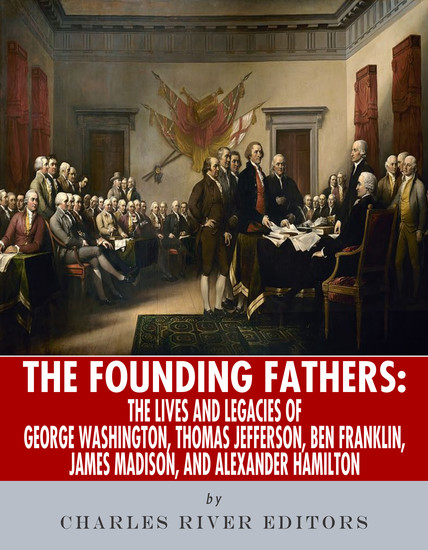
The Founding Fathers - The Lives and Legends of George Washington Thomas Jefferson Ben Franklin James Madison and Alexander Hamilton - cover

The Founding Fathers - The Lives and Legends of George Washington Thomas Jefferson Ben Franklin James Madison and Alexander Hamilton

Editors Charles River

Maison d'édition: Charles River Editors

  • 0
  • 0
  • 0

Synopsis

Every American is taught a pristine narrative of the life and legacy of George Washington and can easily recite the highlights of the “Father of Our Country”. The remarkable Virginian led an under-resourced rag-tag army to ultimate victory in the American Revolution before becoming the nation’s first president, setting it on its path toward superpower status. He may not have actually chopped down a cherry tree or tossed a silver dollar across the Potomac, but his contemporaries considered his character above reproach. When Washington voluntary resigned as commander of the armies, he stunned the world. Everyone in the colonies and the world realized that Washington, at the head of the last army standing in the colonies, could have made himself king of the new United States on the spot, and it would have been a move supported by his rank and file soldiers. Instead, Washington became the first Westerner to voluntarily demobilize his army, ensuring civilian control of the new nation. King George III called Washington "the greatest character of the age" for making that decision.
 
The story of the United States of America is one of a nation founded upon the loftiest ideals of representative government, attempting to fulfill its goals while encountering competing domestic and global forces.  From the beginning, Americans debated how their national government should govern, balancing powers between the federal government and the states, which led to the establishment of the first political parties. At the same time, the nation has struggled to reconcile its guarantee of universal rights and individual liberties with several stark realities, including the presence of millions of slaves at the time of the Declaration of Independence. 
 
Nobody spent more time in the thick of these debates than Thomas Jefferson, one of the most famous and revered Americans. Jefferson was instrumental in all of the aforementioned debates, authoring the Declaration of Independence, laying out the ideological groundwork of the notion of states’ rights, leading one of the first political parties, and overseeing the expansion of the United States during his presidency.
 
Before the United States of America even existed, the first American celebrity was Benjamin Franklin (1706-1790). In his career, Franklin was an author, printer, political theorist, politician, postmaster, scientist, musician, inventor, satirist, civic activist, statesman, and diplomat. After having his hand in all kinds of community service in Philadelphia, and inventing important devices like lightning rods, Franklin used his unique status as an international celebrity to become the colonies’ best diplomat, first as an ambassador to Britan and then as an ambassador to France during the American Revolution. Franklin was particularly revered in Enlightened France, where he skillfully negotiated French entry into the Revolutionary War in a manner that practically bankrupted them, a critical step that helped the colonists win their independence. After negotiating the Treaty of Paris, Franklin played a role at the Constitutional Convention in his adopted home town of Philadelphia during the twilight of his life.
Disponible depuis: 15/05/2025.
Longueur d'impression: 160 pages.

D'autres livres qui pourraient vous intéresser

  • My Mother's Murder - A Daughter's 35-Year Search For Truth - cover

    My Mother's Murder - A...

    Gina McGavin, Jane Hamilton

    • 0
    • 0
    • 0
    A 35-year-old unsolved murder. Mary’s murder gripped the town of Partick for years after her death. 
     
     
    A cold case reawakened because of the Daily Record with women at the heart of it. The victim, the daughter, the detective, the forensic scientist, the reporter. 
     
     
    For 35 years Gina McGavin hunted for her mother’s killer. 
     
     
    Mary McLaughlin’s senseless brutal murder ignited in Gina a deep sense of injustice and an insatiable need to seek the truth about her death. 
     
     
    The two women had only just begun to work on their broken relationship with Gina finding ways to forgive her mother for abandoning the family home when Gina was just two years old. Now she felt abandoned again and it awakened in her an obsessive quest that would overshadow her whole life. 
     
     
    Gina unravels family secrets and revelations about her mother as she began to suspect that some close to her knew more about Mary’s murder than they were letting on. 
     
     
    She puts family members on the spot and rakes over every detail she can find to not only lead her to a killer but to understand who her mother was and why she abandoned her family. 
     
     
    Gina delves into potential suspects, discovers shocking details about her family and explores how her mother’s death has impacted her own life, her marriage, her relationships and when the case is finally solved by police, it leaves Gina with unanswered questions. She doesn’t believe the man convicted acted alone. 
     
     
    This is the extraordinary journey of a daughter’s search for truth and justice for the mother she never really knew.
    Voir livre
  • Have We All Gone Mad? Why groupthink is rising and how to stop it - Why groupthink is rising and how to stop it - cover

    Have We All Gone Mad? Why...

    Jerome Booth

    • 0
    • 0
    • 0
    "With refreshingly clear-sighted analysis, Jerome Booth spells out how political, financial and social groupthink has damaged Britain – and, crucially, how we can tackle it. Highly recommended." – Liam Halligan, Daily Telegraph
    "Most of the worst political decisions of recent years were made when all the mainstream politicians thought the same thing and no one challenged them. Jerome Booth wisely analyses why this situation happens so often and what can be done about it. Every politician and every decision-maker should read this book." – Lord Frost, former Cabinet Office minister
    "It is a long time since I read a book with which I agreed so comprehensively." – Lord Lilley, former Secretary of State
    ***
    We like to think of ourselves as rational, but human beings are fundamentally irrational creatures – and nowhere is that more apparent than in the fug of groupthink we see around us, from the boardroom to social media.
    Of the various forms of collective irrationality, groupthink is particularly dangerous. It involves adherence to a faulty consensus, often has a binary moral dimension (one is seen as either virtuous or evil) and is sustained through fear to challenge. Counter-intuitively, the most intelligent and erudite amongst us are particularly susceptible, and when groupthink takes hold, vigorous efforts are made to shut down debate and to bully and punish transgressors.
    As a result, toleration, liberalism, history, reason and science are under threat. Mass groupthink amongst both the elite and the masses affects millions of people. It has led to financial mismanagement leading up to the 2008 crisis and beyond; poor decision-making at the onset of Covid-19; exaggerated, unchallenged claims which have motivated nonsensical policies; and distortions in academia and journalism.
    In this remarkable and prescient book, Dr Jerome Booth investigates why some of us have abandoned reason in favour of trite memes, intolerance and hatred. Have we all gone mad? Or can we identify the patterns and causes of what is happening and try to stop it?
    Voir livre
  • Rewire Your Food-Addicted Brain - Fight Cravings and Break Free from a High-Sugar Ultra-Processed Diet Using Neuroscience - cover

    Rewire Your Food-Addicted Brain...

    MD Claire Wilcox, Molly...

    • 0
    • 0
    • 0
    A game-changing approach to overcome food addiction and radically improve your health. 


    Have you ever wondered why you're addicted to certain foods? Would it shock you to learn that the food industry engineers food products with the express purpose of getting you hooked? With millions wrestling with food addiction, is it any surprise that much of what is meant to sustain us is in fact making us sick? The increasing dependence on unhealthy, ultra-processed foods invites a host of health problems—from obesity and heart disease to diabetes. So, how can you break free from this destructive cycle? 


    Written by an addiction psychiatrist with decades of experience, this powerful guide combines proven-effective techniques based in addiction and eating disorder treatments to help you overcome the unhealthy food habit, once and for all. In addition to real-world stories from others who have battled food addiction, you'll learn how certain foods can actually alter your neurochemistry—lighting up reward centers in your brain just like nicotine, alcohol, and other drugs. Most importantly, you'll discover how to move beyond the self-blame, shame, and internalized stigma that is associated with food addiction, so you can start taking steps toward lasting recovery. This powerful book can help you get started today.
    Voir livre
  • A Rare Recording of President Harry S Truman On The Bombing of Hiroshima - cover

    A Rare Recording of President...

    President Harry S. Truman

    • 0
    • 0
    • 0
    Harry S. Truman (May 8, 1884 - December 26, 1972) was the 33rd president of the United States, serving from 1945 to 1953. A member of the Democratic Party, he previously served as vice president from January to April 1945 under FDR and as a US senator from Missouri from 1935 to January 1945. Assuming the presidency after FDR's death, Truman implemented the Marshall Plan to rebuild the economy of Western Europe and established both the Truman Doctrine and NATO to contain the expansion of Soviet communism.
    Voir livre
  • Islamic Relics: The History of Some of the Holiest Items in Islam - cover

    Islamic Relics: The History of...

    Editors Charles River

    • 0
    • 0
    • 0
    Muslim relics have become sought after relatively recently, since in the tradition of Islam it is customary to bury the deceased together with his belongings. However, many religious relics have rather controversial origins. Sometimes the faithful sincerely worship artful forgeries masquerading as holy relics and things that supposedly belonged to saints. The real sanctuaries are carefully guarded and are not always accessible to believers. They are brought out for public viewing on especially festive days. It is often represented as creating a special ritual.  
    	It is curious that the attitude towards such relics gradually changed over the centuries. If, at first, they were considered amulets used by private individuals, then over time their purpose and comprehension took on a different character. Most notably, the possession of the relics of the prophet began to be considered one of the arguments in favor of the appointment of the Caliph. The concentration of several relics in one mosque immediately sharply increased, in the eyes of the believers, the piety of such a mosque; this, in turn, immediately affected the growth of its wealth and political influence. Thus, in the published catalog of relics stored in the former Badshahi mosque of the Mughal state in Lahore (now Pakistan), there are 28 items: seven belonged to the prophet himself, three to the son-in-law of the prophet Ali, two to the daughter of the prophet Fatima, five to the grandson of the prophet Hussein, etc. It is believed that some of these items were taken out by Timur after the capture of Damascus, and some were donated by Sultan Bayazid to Timur's descendant, Babur. After the fall of the Mughal dynasty in India, they were first in private possession in the second half of the 19th century. In different ways, they came to the Lahore Mosque.
    Voir livre
  • Archaic Humans: The History of the Different Prehistoric Species in the Genus Homo - cover

    Archaic Humans: The History of...

    Editors Charles River

    • 0
    • 0
    • 0
    The evolutionary path from the original primates to modern man is a long one and has taken many twists and turns, but naturally, as the fossil record grows, scientists gain a more complete understanding of our own mental and physical history in terms of genetics and anatomy. However, the correct order and relationships of the various specimen types are difficult to pin down. Many representative samples have been found in such minute amounts as to not preclude anomalies. They have been discovered in various stages of wear. Modern features did not occur simultaneously or uniformly, taking millions of years to become manifest in later types. Up to the present day’s Homo sapiens, examples of the main types have been hybrids of older and more modern features. 
    	One of the earliest species of the genus Homo to be discovered is Homo habilis, which basically means “handy man.” The name comes from the belief at the time of its discovery that this species was the first to start using stone tools. The first fossils to be uncovered in Olduvai Gorge were from the same stratigraphic layer as simple stone tools. Fossils of the crania and postcranial skeleton for this species have been found in both eastern and southern Africa and date to around 2.5–1.6 million years ago.  
    	Features of Homo erectus suggest an evolution toward modern humans, and the features which separate Homo erectus from the other Homo species are found in the skull. The size of the brain was approximately 900 cc, making it larger than the brain size of Homo habilis. Homo erectus would not have the largest brain capacity of the Homo genus during its existence, with the emergence of Homo heidelbergensis approximately 800,000 years ago. The larger brain size may not matter much when the size of the brain is considered with the size of the body, which also increased. 
    Voir livre