Begleiten Sie uns auf eine literarische Weltreise!
Buch zum Bücherregal hinzufügen
Grey
Einen neuen Kommentar schreiben Default profile 50px
Grey
Jetzt das ganze Buch im Abo oder die ersten Seiten gratis lesen!
All characters reduced
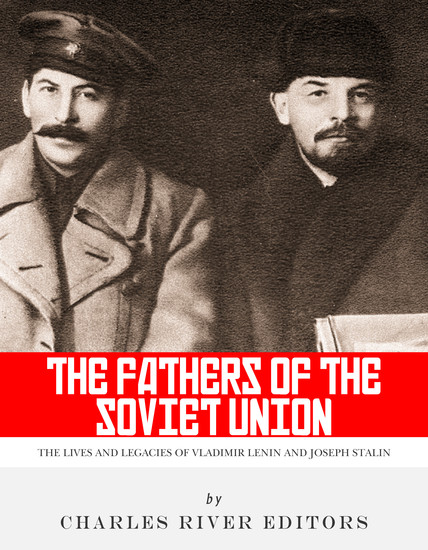
The Fathers of the Soviet Union - The Lives and Legacies of Vladimir Lenin and Joseph Stalin - cover

The Fathers of the Soviet Union - The Lives and Legacies of Vladimir Lenin and Joseph Stalin

Editors Charles River

Verlag: Charles River Editors

  • 0
  • 0
  • 0

Beschreibung

Among the leaders of the 20th century, arguably none shaped the course of history as much as Vladimir Lenin (1870-1942), the Communist revolutionary and political theorist who led the Bolshevik Revolution that established the Soviet Union. In addition to shaping the Marxist-Leninist political thought that steered Soviet ideology, he was the first Soviet premier until his death and set the Soviet Union on its way to becoming one of the world’s two superpowers for most of the century, in addition to being the West’s Cold War adversary.
 
Given the Red Scare and the nature of the Cold War, Lenin has always been a divisive and controversial figure in Western society, especially among those who equate the Soviets with brutal repression and human rights abuses. Lenin also has his champions, who point to the fact that he got Russia out of World War I, was the first to successfully implement a modern socialist state, and worked tirelessly to elevate the working classes.
 
As it turned out, the creation of the Soviet Union came near the end of Lenin’s life, as he worked so hard that he had burned himself out by his 50s, dying in 1924 after a series of strokes had completely debilitated him. Since his life before the Soviet Union naturally gets less focus, Lenin remains a bit of an unknown among many, and he is likely a lesser known or notorious figure than his successor, Joseph Stalin.
 
If Adolf Hitler had not inflicted the devastation of World War II upon Europe, it’s quite likely that the West would consider Joseph Stalin (1878-1953) the 20th century’s greatest tyrant. A Bolshevik revolutionary who played a crucial role in the Russian Revolution of 1917 and the establishment of the Soviet Union, Stalin was one of the Communist regime’s earliest leaders and went about consolidating power after the death of Vladimir Lenin, whose final wishes were that Stalin be removed from his post as General Secretary of the Communist Party and not be given the ability to take power.
 
Of course, Stalin managed to do just that, modernizing the Soviet Union at a breakneck pace on the backs of millions of poor laborers and prisoners. Before World War II, Stalin consolidated his position by frequently purging party leaders (most famously Leon Trotsky) and Red Army leaders, executing hundreds of thousands of people at the least. In one of history’s greatest textbook examples of the idea that the enemy of my enemy is my friend, Stalin’s Soviet Union allied with Britain and the United States to defeat Hitler in Europe, with the worst of the war’s carnage coming on the eastern front during Germany’s invasion of Russia. Nevertheless, the victory in World War II established the Soviet Union as of the world’s two superpowers for nearly 50 years, in addition to being the West’s Cold War adversary.
 
By the time Stalin died in 1953, it was written that he “had found Russia working with wooden ploughs and [is] leaving it equipped with atomic piles.” Of course, he was reviled in the West, where it was written, “The names of Lenin, Stalin, and Hitler will forever be linked to the tragic course of European history in the first half of the twentieth century.”
Verfügbar seit: 15.05.2025.
Drucklänge: 99 Seiten.

Weitere Bücher, die Sie mögen werden

  • 7 Steps to Mastering Your Finances - A No-Nonsense Playbook for Getting Out of Debt Saving More and Building Long-Term Wealth - cover

    7 Steps to Mastering Your...

    Joseph Marc Lalonde

    • 0
    • 0
    • 0
    What if financial freedom wasn’t a dream—but a formula?
     
    Most people struggle with money—not because they don’t earn enough, but because they lack a system to manage, grow, and control it. They live paycheck to paycheck, battle debt, and feel like financial security is always out of reach.
     
    The truth? Wealth isn’t about luck—it’s about strategy.
     
    In 7 Steps to Mastering Your Finances, entrepreneur and strategist Joseph Marc Lalonde delivers a clear, no-nonsense framework to help you escape financial stress and finally take control of your money—so you can stop struggling and start building real wealth.
     
    This audiobook doesn’t just talk about money—it gives you a step-by-step system to master it:
    
     
    Know Your Numbers – Gain clarity over income, expenses, and net worth.
    
     
    Cut the Financial Fat – Stop wasting money and keep more of what you earn.
    
     
    Destroy Your Debt Fast – Crush debt and free up cash flow.
    
     
    Save More, Stress Less – Automate savings and build a safety net.
    
     
    Multiply Your Income Streams – Unlock multiple ways to increase earnings.
    
     
    Invest Like a Pro – Make your money grow exponentially.
    
     
    Build Unshakable Financial Discipline – Create habits and systems that keep you wealthy for life.


    If you’ve ever felt overwhelmed by money, trapped by debt, or unsure how to build wealth—this audiobook is your roadmap to financial mastery. No fluff. No confusing jargon. Just practical strategies to help you master your money, build wealth, and change your future.
    Zum Buch
  • It's OK That You're Not OK - Meeting Grief and Loss in a Culture That Doesn't Understand - cover

    It's OK That You're Not OK -...

    LPC Megan Devine, Mark Nepo

    • 0
    • 0
    • 0
    A New Resource for Those Experiencing Loss   With It’s OK That You’re Not OK, Megan Devine offers a profound new approach to both the experience of grief and the way we help others who have endured tragedy. Having experienced grief from both sides—as both a therapist and as a woman who witnessed the accidental drowning of her beloved partner—Megan writes with deep insight about the unspoken truths of loss, love, and healing. She debunks the culturally prescribed goal of returning to a normal, “happy” life, replacing it with a far healthier middle path, one that invites us to build a life alongside grief rather than seeking to overcome it.   On this unabridged audio recording read by the author, Megan offers stories, research, life tips, and creative and mindfulness-based practices to guide us through an experience we all must face. With Megan’s gentle but direct guidance, you’ll learn:   • Why well-meaning advice, therapy, and spiritual wisdom so often end up making it harder for people in grief • How challenging the myths of grief—doing away with stages, timetables, and unrealistic ideals about how grief should unfold—allows us to accept it as a mystery to be honored instead of a problem to solve • Practical guidance for managing stress, improving sleep, and decreasing anxiety without trying to “fix” your pain   Many people who have suffered a loss feel judged, dismissed, and misunderstood by a culture that wants to “solve” grief. Megan writes, “Grief no more needs a solution than love needs a solution.” It’s OK That You’re Not OK is a book for grieving people, those who love them, and all those seeking to love themselves—and each other—better.
    Zum Buch
  • The Third History of Man - cover

    The Third History of Man

    MD John Bershof

    • 0
    • 0
    • 0
    In the spirit of medieval writer Chaucer, all human activity lies within the artist’s scope, the History of Man Series uses medicine as a jumping off point to explore precisely that, all history, all science, all human activity since the beginning of time. The jumping off style of writing takes the reader, the listener into worlds unknown, always returning to base, only to jump off again. History of Man are stories and tales of nearly everything. 
    The Third History of Man leaves bacteria in the rear-view mirror and jumps to viruses and viral infections, the cold, the flu and COVID-19, not just another flu. We’ll cover epidemics, pandemics, and vaccines, the pox infections, and the Spock principle that the needs of the many outweigh the needs of the few … or the one. From COVID and the rise of Zoom, we’ll venture into the rise of Homo sapiensand the fall of Neanderthals, the high sea adventures of Darwin aboard and the high sea adventures of dementia. Our travels will take us along the Silk Road and Spice Trade, another visit with the Age of Discovery when masted ships and European explorers went looking for that elusive sea route to the Far East, and looking for gold, annihilating huge swaths of indigenous Americans at every port of disembarkation, not by the pointy end of a sword, but by tiny infectious microbes. We’ll examine colonialism at its finest, the sordid European history of imperialism and the land grab into Africa and the New World Americas.
    Zum Buch
  • Voices of Dissent - An Essay (Unabridged) - cover

    Voices of Dissent - An Essay...

    Romila Thapar

    • 0
    • 0
    • 0
    Written by one of India's best-known public intellectuals, this book is essential reading for anyone interested in India's fascinating history as well as the direction in which the nation is headed.
    
    People have argued since time immemorial. Disagreement is a part of life, of human experience. But we now live in times when any form of protest in India is marked as anti-Indian and met with arguments that the very concept of dissent was imported into India from the West. As Romila Thapar explores in her timely historical essay, however, dissent has a long history in the subcontinent, even if its forms have evolved through the centuries.
     
    In Voices of Dissent: An Essay, Thapar looks at the articulation of nonviolent dissent and relates it to various pivotal moments throughout India's history. Beginning with Vedic times, she takes us from the second to the first millennium BCE, to the emergence of groups that were jointly called the Shramanas-the Jainas, Buddhists, and Ajivikas. Going forward in time, she also explores the views of the Bhakti sants and others of the fifteenth and sixteenth centuries and brings us to a major moment of dissent that helped to establish a free and democratic India: Mahatma Gandhi's satyagraha. Then Thapar places in context the recent peaceful protests against India's new, controversial citizenship law, maintaining that dissent in our time must be opposed to injustice and supportive of democratic rights so that society may change for the better.
    Zum Buch
  • How to Stay Focused: 7 Easy Steps to Master Mental Focus Self-Discipline Work Concentration & Avoiding Distractions - cover

    How to Stay Focused: 7 Easy...

    Miles Toole

    • 0
    • 0
    • 0
    Are you someone who cannot focus on the task at hand because of a nagging thought at the back of your head? Are you finding it difficult to remember some important things? 
      
    If you answered yes to any of these questions, it may be time for you to learn the benefits of staying focused. Stop being a slave to your mind because that is not going to help you in any way in achieving your goals. If you want to take your productivity to the next level, you need to be able to focus. Distractions are going to be endless but avoiding them is possible if you follow the right steps. 
      
    “How to Stay Focused” will show you how you can improve your mental focus and avoid distractions that come your way. Using a 7-step process with definitions, breakdowns, and explanations, this will become your go-to guide towards true concentration. Let this guide help you be the best version of yourself. 
      
    You will gain focusing abilities like never before. No matter what the obstacles are, you will not cow down once you have gone through this 7-step process. If you want to know how you can balance your life and set your priorities straight, you are at the right place. 
      
    YOU WILL LEARN:The art of avoiding distractions.How to enhance your mental focus.Increase productivity by boosting work concentration.How to practice mindfulnessHow to fight self-doubt.Instilling a sense of self-discipline.Goal setting techniques. 
      
    Stop hopping from one heap of unfinished paperwork to another and try to complete the work that you have already started. You might feel curious about a lot of things in a day and curiosity is not a bad trait, but like everything else, you have to learn how you can practice it in moderation. If you want to accomplish anything in your life then you first have to learn how to be more focused!
    Zum Buch
  • Fatal Chemistry - Inside the Fentanyl Crisis - cover

    Fatal Chemistry - Inside the...

    Davis Truman

    • 0
    • 0
    • 0
    In the book Fatal Chemistry, one gets to know the frightful reality of the rise of fentanyl, which is a synthetic opioid that has changed the face of addiction, broken families, and put the limits of medicine, policy, and even human nature to the test. This book, by its very compelling nature and with the power of the investigative journalists, dives deep into how fentanyl changed from being a breakthrough in medicine to a dangerous drug that is the cause of the drug epidemic in the community worldwide, which is distributed on the streets. 
    Aside from the history of the opiates, the dark side of the web in the illegal trade, Fatal Chemistry uncovers the driving forces behind the epidemic that are concealed. You understand how the stress, trauma, and social life problems of the early years lead to addiction – but also realize how science, empathy, and prevention can be the answer to it. 
    If so, the person is a medical provider, a policymaker, an educator, or simply someone who wants to know the real story behind the news. Fatal Chemistry is full of both learning and optimism – an uncommon mixture of reality, people's experiences, and useful insights. 
    In here, you will find: 
    •	The untold history of opioids and the birth of fentanyl 
    •	How illicit fentanyl entered the global market — and why it's so deadly 
    •	The anatomy of the epidemic and its devastating ripple effects 
    •	Real-world approaches to treatment, recovery, and harm reduction 
    •	The science behind stress, trauma, and addiction 
    •	Proven strategies for overdose prevention and community resilience 
    Fatal Chemistry: Inside the Fentanyl Crisis is more than a piece of writing; it is a realization. Informative, very emotional, and profoundly human, this must-have piece of writing will alter the way in which you view addiction, recovery, and the world surrounding you.
    Zum Buch