Begleiten Sie uns auf eine literarische Weltreise!
Buch zum Bücherregal hinzufügen
Grey
Einen neuen Kommentar schreiben Default profile 50px
Grey
Jetzt das ganze Buch im Abo oder die ersten Seiten gratis lesen!
All characters reduced
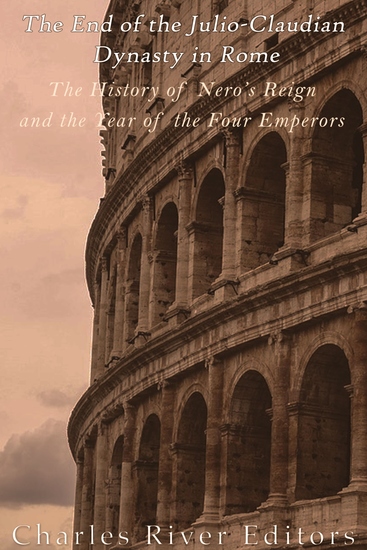
The End of the Julio-Claudian Dynasty in Rome - The History of Nero’s Reign and the Year of the Four Emperors - cover

The End of the Julio-Claudian Dynasty in Rome - The History of Nero’s Reign and the Year of the Four Emperors

Editors Charles River

Verlag: Charles River Editors

  • 0
  • 0
  • 0

Beschreibung

Throughout the annals of history, there have been few figures as reviled as Lucius Domitius Ahenobarbus, better known as Nero Claudius Caesar Drusus Germanicus, or more simply, Nero. Even today, he remains one of the Roman Empire’s most famous – or notorious – figures, a villain whose impact on popular culture is so vast that his name crops up consistently to this day in literature, film, TV and mediums as unlikely as video games and anime.
 
Nero ranks among the very worst of the Caesars, alongside the likes of mad Caligula, slothful Commodus, and paranoid Domitian, a figure so hated that, in many ancient Christian traditions, he is literally, without hyperbole, considered the Antichrist; according to a notable Biblical scholar, the coming of the Beast and the number 666 in the Book of Revelation are references to Nero. He was the man who, famously, “fiddled while Rome burned”, an inveterate lecher, a murderous tyrant who showed little compunction in murdering his mother and who liked to use Christian martyrs as a source of illumination at night – by burning them alive. His economic policies, according to many historians, virtually bankrupted Rome.
 
Even his appearance, apparently, was ill-favoured. His busts show him to be fleshy-faced, with a weak chin that he attempted to disguise with a distinctly unprepossessing beard, and according to Suetionius he was also spotty, stinking, pot-bellied and thin-legged – not a pretty picture.
 
The best known accounts of Nero come from biographers like Tacitus, Cassius Dio, Suetionius and Josephus, but there are also indications that, to some extent, reports of Nero’s cruelty were exaggerated. Nero was popular with the common people and much of the army, and during his reign the Empire enjoyed a period of remarkable peace and stability. Many historians, including some of his ancient biographers – such as Josephus – suggest that there existed a strong bias against Nero. Part of this is because his successors wished to discredit him, and justify the insurrections which eventually drove him, hounded from the throne, to a lonely suicide. Much of the bias against Nero can also be attributed to the fact that he was a renowned persecutor of Christians, and since many of the historians who wrote about Nero in the years after his death were Christians themselves, it made sense for them to have a jaundiced view of their erstwhile nemesis. Because of this, some historians have suggested that Nero’s demeanour and reputation might not be as black as the original sources might be inclined to suggest.
 
Having left no heir, Nero’s death plunged the empire into confusion and chaos, bringing to an end the Julio-Claudian lineage while at the same time offering no clear rule of succession. This presented the opportunity for influential individuals in the empire, and in particular provincial governors who also commanded large military garrisons, to express and further their own ambitions to power. The result was a period of instability and civil war as several pretenders to the throne, among them the emperors Galba, Otho and Vitellius, gained and lost power, until finally the emperor Vespasian seized and retained the imperial principate.  Vespasian imposed order and discipline on a chaotic empire and founded the Flavian Dynasty, which survived until CE 96, encompassing the reigns of Vespasian himself (69–79), and his two sons Titus (79–81) and Domitian (81–96).
Verfügbar seit: 01.05.2025.
Drucklänge: 51 Seiten.

Weitere Bücher, die Sie mögen werden

  • Yes Mistress - Why Men Crave Female Domination - cover

    Yes Mistress - Why Men Crave...

    Alicia Zadig

    • 0
    • 0
    • 0
    Discover the forbidden desire for Female Domination—and the real men who seek it out. 


    Leading Dominatrix and BDSM expert Alicia Zadig takes you on a provocative, eye-opening journey into the erotic world of Female Domination and male submission. Zadig explains the psychology behind male submission and answers the question: Why do men crave surrendering to a dominant woman? Hear from the men themselves as they reveal their most intimate desires. Learn why so many secretly fantasize about being dominated by a woman. Delve into their experiences with Dominatrices and see what keeps them coming back for more. 


    Yes, Mistress shines a spotlight on the everyday men who seek to explore their submissive fantasies—an aspect of sexuality that often goes unacknowledged, despite a long history and deep psychological roots. Set at the crossroads of psychology, culture, history, and media, this book challenges society's perception of BDSM, kink, and fetish. Male submission is more common than you think—and more rewarding than you can imagine!
    Zum Buch
  • The Busybody - cover

    The Busybody

    Susanna Centlivre

    • 0
    • 0
    • 0
    The Busybody is the most popular comedy by the eighteenth-century playwright Susanna Centlivre. The play centres on two couples trying to form a relationship against the wills of their guardians, and in a battle of wits, playing with many conventions from theatre traditions across the continent, a conclusion is eventually reached.
    Like her predecessor Aphra Behn, Centlivre was immensely successful in her day, drawing huge crowds to extended runs of her numerous plays, but the stabbing male pens of the nineteenth and twentieth centuries decried her work as being louche and dangerous, and her name slowly sunk into obscurity.
    This edition, published with William Hazlitt's prefatory note and extra material on Centlivre's life and writing, seeks to highlight the dexterity with which she took on the stage.
    Zum Buch
  • Mythology and Religion in Ancient Babylon: The History of Babylonian Legends and Religious Practices - cover

    Mythology and Religion in...

    Editors Charles River

    • 0
    • 0
    • 0
    The ancient world was full of many fantastic cities and places, and like today’s major cities, the great ancient cities were hubs of trade, religion, and science. Writing was first invented in ancient cities, and many important scientific discoveries were also made in them, some of which are still used in the modern world. Among the many cities of the ancient world, Rome and Athens may come to mind first, but the city of Babylon in the land of Mesopotamia was already an ancient, venerated city when the others were still inconsequential settlements.  
    	Today, Babylon has become a byword for greed, excess, and licentiousness, mostly due to its mention in the Bible, but a closer examination reveals that Babylon was so much more, and even perhaps the most important city in the ancient world. Ancient Babylon was home to great dynasties that produced some of the world’s most influential leaders, most notably Hammurabi and Nebuchadnezzar, and these rulers invoked their wills on the entire ancient Near East and have been remembered as both progressive and cruel all at the same time. Babylon was also the seat of culture in ancient Mesopotamia and the place where scholars made amazing scientific advances that would not be eclipsed for several centuries. An examination of ancient Babylon demonstrates that it was truly the first great city in the ancient world. 
    	Babylon was also instrumental in the development of the region’s religions, and the religions continue to captivate people for many of the same reasons today’s best known religions and their histories fascinate people. The religion practiced by the ancient Mesopotamians provides a certain mix between the mundane and the surreal, and at the same time aspects of it are both familiar and bizarre to people today. Some find themselves drawn to it based on its preeminent position in religious history as the oldest documented religion in the world.
    Zum Buch
  • Embracing New Beginnings - Poetry for Healing Hearts - cover

    Embracing New Beginnings -...

    Kelly Shelton

    • 0
    • 0
    • 0
    Ready to embrace a brighter tomorrow? 
    Embracing New Beginnings: Poetry for Healing Hearts by Kelly Shelton is a beacon of hope disguised as a book. Within these pages, you'll find a collection of poems, quotes, and heartfelt reflections designed to mend your spirit and guide you towards a brighter future. 
    Whether you're healing from a broken heart, facing a difficult decision, or simply yearning for a fresh start, this book will be your companion on the path to self-discovery. 
    Discover the power of: 
    Words that uplift: Find comfort and encouragement through the beauty of language. 
    Letting go and moving on: Learn to release past hurts and embrace the possibilities that lie ahead. 
    The strength within: Explore your resilience and rediscover your inner fire. 
    Self-love and acceptance: Cultivate a deeper appreciation for who you are. 
    Embracing New Beginnings isn't a prescriptive guide; it's a gentle nudge towards self-healing and transformation. It's the kind of book you keep close, ready to offer a warm hug whenever you need a reminder of your inner strength and the exciting possibilities that await.
    Zum Buch
  • A Rare Recording of Israeli Prime Minister Golda Meir - cover

    A Rare Recording of Israeli...

    Golda Meir

    • 0
    • 0
    • 0
    Golda Mabovitch Meir (May 3, 1898 - December 8, 1978) was an Israeli politician who served as the fourth prime minister of Israel from 1969 to 1974. She was Israel's first and only female head of government, the first female head of government in the Middle East, and the fourth elected female head of government or state in the world. Born in Kiev in the Russian Empire to Jewish parents, Meir immigrated as a child with her family to the United States in 1906. She graduated from the Milwaukee State Normal School and found work as a teacher. While in Milwaukee, she embraced the Labor Zionist movement and, in 1921, Meir and her husband emigrated to Mandatory Palestine. She was a signatory of the Israeli Declaration of Independence in 1948, and was elected to the Knesset in 1949. She served as Labor Minister until 1956, when she was appointed Foreign Minister by Prime Minister David Ben-Gurion. A controversial figure in Israel, Meir has been lionized as a founder of the state and described as the "Iron Lady" of Israeli politics, but also widely blamed for the country being caught by surprise during the war of 1973. 
     
    In this 1970 recording, Meir answers questions shortly after a Swissair Flight 330 from Zurich to Hong Kong, with a planned stopover in Tel Aviv, was brought down by a bomb planted by two PLO members soon after takeoff, killing all 47 passengers and crew.
    Zum Buch
  • Fascism: What It Is And How To Fight It - cover

    Fascism: What It Is And How To...

    Leon Trotsky

    • 0
    • 0
    • 0
    Leon Trotsky (1879-1940) was a Bolshevik revolutionary and Marxist theorist. He was one of the leaders of the Russian October Revolution, second only to Vladimir Lenin. During the early days of the Soviet Union, he served first as People's Commissar for Foreign Affairs and later as the founder and commander of the Red Army and People's Commissar of War. He was also among the first members of the Politburo. 
    Why fascism was able to conquer only in those countries where social democratic or Stalinist parties blocked the workers and their allies from utilizing a revolutionary situation to remove the capitalists from power. There is a scientific analysis of fascism. It was made by the exiled Bolshevik revolutionary Leon Trotsky not as a postmortem, but during the rise of fascism. This was — along with his analysis of the nature of Stalinism — Trotsky's greatest contribution to Marxist theory. He began the task after Mussolini's victory in Italy in 1922 and brought itto ahigh pointin the years preceding Hitler'striumphin Germany in 1933.
    Zum Buch