Rejoignez-nous pour un voyage dans le monde des livres!
Ajouter ce livre à l'électronique
Grey
Ecrivez un nouveau commentaire Default profile 50px
Grey
Abonnez-vous pour lire le livre complet ou lisez les premières pages gratuitement!
All characters reduced
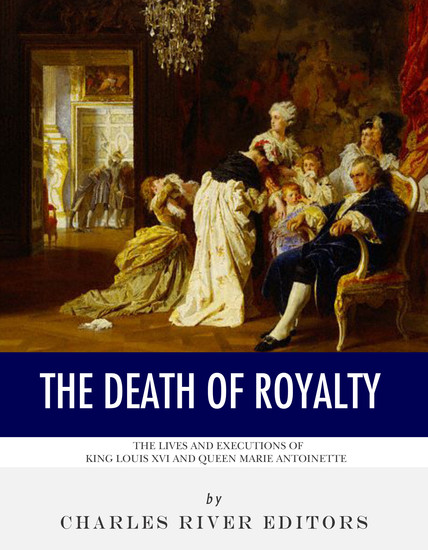
The Death of Royalty - The Lives and Executions of King Louis XVI and Queen Marie Antoinette - cover

The Death of Royalty - The Lives and Executions of King Louis XVI and Queen Marie Antoinette

Editors Charles River

Maison d'édition: Charles River Editors

  • 0
  • 0
  • 0

Synopsis

“I die perfectly innocent of the so-called crimes of which I am accused. I pardon those who are the cause of my misfortunes.” – Louis XVI
 
Louis XVI is one of the most famous Kings of France, but for reasons he would have much rather avoided. Coming of age in the wake of the reign of the Sun King, Louis XIV, and his father, Louis XV, Louis XVI initially intended to be one of France’s most enlightened Kings. Instead, he was destined to be the only French King ever executed. Indeed, it is his death and his role in fomenting the French Revolution (along with his infamous Queen, Marie Antoinette) that continue to play the central role in Louis XVI’s legacy.   
 
The abrupt demise of Louis XVI and his reign capped a tumultuous but important historical period for both France and the rest of the world. It was Louis XVI’s wish to reform France in the mold of the Enlightenment and his failure to push those reforms against a reluctant aristocracy that emboldened and spurred those who would rebel against him. At the same time, his support for the American cause during the American Revolution in the 1770s was integral in securing that nation’s freedom and further adding to France’s financial woes. Ironically, France’s role in assuring the success of the American Revolution provided a hopeful example for those who would overthrow him less than 15 years later.
 
The same cautious conservatism that marred his reign in the eyes of so many ultimately led to the chain of events that made him a victim of the guillotine. With French society in open revolt by the late 1780s, the King appeared indecisive at a number of crucial moments, including during a famous attempted escape that was thwarted at Vergennes, and he had to literally run for his life when a mob stormed the royal palace at Tuileries. Soon after, he was stripped of his dignity and his royal name, convicted of high treason in a sham trial as Citizen Louis Capet. Ironically, in death, some historians have asserted that his execution and the sympathy it engendered helped bring about the Restoration a generation later.
 
Throughout history, a countless number of historical figures have had their lives overshadowed by the myths and legends that surround them to the extent that their legacy comes to define them. In French history, this is truer of Marie Antoinette than just about everyone else. Nearly 220 years after she was put to the guillotine, Marie Antoinette is more famous than ever, fairly or unfairly coming to epitomize royalty and everything that was wrong with it.  
 
As France slid toward its own Revolution, rumors and innuendo against the queen took hold, and she was accused of being promiscuous and even defrauding a jeweler in what became known as the “Diamond Necklace Affair”. Though the rumors had no basis in truth, they were widely accepted and eventually used as partial justification for her execution. By 1792, with the Revolution in full swing, the Royal Family’s attempt to escape Paris was thwarted, and in January 1793, Louis XVI lost his head at the hands of the Jacobins. With her own health failing, the Queen herself was tried the following October, accused of sexually abusing the sickly Dauphin. Given that she had spent the last few years of her life carefully doting on her children at the expense of almost everything else, it was a particularly heinous accusation. On October 16, 1793, Antoinette herself was executed at the guillotine.
 
Since her death, Marie Antoinette has been the subject of sharp historical debate over whether she was actually a catalyst in the French Revolution or simply an insignificant scapegoat who was unfairly made a target. At the same time, the one thing everybody associates with Antoinette is the phrase “Let them eat cake”, a spoiled and ignorant comment supposedly made in response to being informed that the peasants had no bread. 
Disponible depuis: 06/05/2025.
Longueur d'impression: 71 pages.

D'autres livres qui pourraient vous intéresser

  • W E B DuBois on Sociology and the Black Community - cover

    W E B DuBois on Sociology and...

    W.E.B. Du Bois

    • 0
    • 0
    • 0
    Historian, journalist, educator, and civil rights advocate W. E. B. Du Bois was perhaps most accomplished as a sociologist of race relations and of the black community in the United States. This volume collects his most important sociological writings from 1898 to 1910. The eighteen selections include five on Du Bois’s conception of sociology and sociological research, especially as a tool in the struggle for racial justice; excerpts from studies of black communities in the South and the North, including The Philadelphia Negro; writings on black culture and social life, with a selection from The Negro American Family; and later works on race relations in the United States and elsewhere after World War II. This section includes a powerful fiftieth-anniversary reassessment of his classic 1901 article in the Atlantic in which he predicted that “the problem of the twentieth century is the problem of the color line.“ 
     
    The editors provide an annotated bibliography, a lengthy overview of Du Bois’s life and work, and detailed introductions to the selections.
    Voir livre
  • Popular Works Volume 2 - The Characteristics of the Present Age The Doctrine of Religion and Other Works - cover

    Popular Works Volume 2 - The...

    Johann Gottleib Fitche

    • 0
    • 0
    • 0
    Though born to a poor but pious family of ribbon weavers in in Saxony in 1762, Johann Gottlieb’s exceptional intelligence was apparent from an early age. Remarkably, from this humble background, he earned himself a respected place in the pantheon of late 18th and early 19th century German philosophers. That fact that he is placed between Kant and Hegel, yet still retains a significant and individual presence, says much about his work and personality. He became known, especially, for initiating the concept of ‘German idealism’ (linked with Romanticism and the revolutionary politics which emerged after the Enlightenment). In the 20th and 21st century, his importance and contribution to Western philosophy has been increasingly acknowledged.  
     
    There are two substantial lecture series and one essay stemming from his time in Berlin in Popular Works Volume 2: much of Fichte’s important work appeared initially in lectures. 
     
     The Characteristics of the Present Age, (1806) consists of 17 lectures in which Fichte presents his ‘speculative philosophy of history’. The series opens with ‘The Idea of Universal History’ in which he ‘divides earthly life into 5 Principal Epochs.’ Against this overview of history and culture, (including the state, civil and political freedom, science and religion) he develops his thesis with particular reference to his ‘present age’ – the time of Voltaire, Rousseau on the one hand and Lessing, Kant and Goethe on the other.  
     
    In The Way Towards The Blessed Life or The Doctrine Of Religion (1806) (11 lectures) Fichte considers the relationship between established religion and his particular view on ‘transcendental’ philosophy. His opening statement is ‘Life is Love; and hence Life and Blessedness are in themselves one and the same.’  He continues by examine metaphysics, ontology, mysticism, actual and apparent life, Christianity, and his Doctrine of Being.  
     
    The final work in this anthology is Outlines of the Doctrine of Knowledge (1810). It is a concise exposition of Fichte’s Wissenschaftslehre’ but in its strictly scientific form. It had an unusual provenance in that it was printed by Fichte at the conclusion of lectures as a form of a memorandum with 14 short sections. It opens with the question: ‘How this Knowledge can come into being, and what it is in its inward and essential Nature?’
    Voir livre
  • American Poly - A History - cover

    American Poly - A History

    Christopher M. Gleason

    • 0
    • 0
    • 0
    Recent studies have found that as many as one in five Americans have experimented with some form of sexual non-monogamy, and approximately one in fifteen knows someone who was or is polyamorous. The mainstream media has increasingly covered polyamorous lifestyles and the committed relationships of throuples, and dating apps have added polyamory as a status option. 


    This book is the first history to trace the evolution of polyamorous thought and practice within the broader context of American culture. Drawing on personal journals and letters, underground newsletters, and publications from the Kinsey Institute Archives, among other sources, it reconstructs polyamory's intellectual foundations, highlighting its unique blend of conservative political thought and countercultural spiritualism. Christopher M. Gleason locates its early foundations in the Roaring Twenties among bohemians. In the 1950s and 1960s it surprisingly emerged among libertarian science fiction writers. Throughout the 1990s, polyamorists utilized the internet to spread their ideas, often undermining any remaining religious or spiritual significance their ideas held. 


    Offering an original perspective on sexuality, marriage, and the family, American Poly reveals the history of polyamory in the United States from fringe practice to a new stage of the sexual revolution.
    Voir livre
  • Woman Up - 'One of the most prolific writers about women's football in the UK' Evening Standard - cover

    Woman Up - 'One of the most...

    Carrie Dunn

    • 0
    • 0
    • 0
    With the triumph of England’s Lionesses at Euro 2022, the women’s game has been in the spotlight like never before, enjoying unprecedented media attention.
    Voir livre
  • Eight Bears - Mythic Past and Imperiled Future - cover

    Eight Bears - Mythic Past and...

    Gloria Dickie

    • 0
    • 0
    • 0
    A global exploration of the eight remaining species of bears—and the dangers they face. 


    Bears have always held a central place in our collective memory, from Indigenous folklore and Greek mythology to nineteenth-century fairytales and the modern toy shop. But as humans and bears come into ever-closer contact, our relationship nears a tipping point. Today, most of the eight remaining bear species are threatened with extinction. Some, such as the panda bear and the polar bear, are icons of the natural world; others, such as the spectacled bear and the sloth bear, are far less known. 


    In Eight Bears, journalist Gloria Dickie embarks on a globe-trotting journey to explore each bear's story, whisking listeners from the cloud forests of the Andes to the ice floes of the Arctic; from the jungles of India to the backwoods of the Rocky Mountain West. She meets with key figures on the frontlines of modern conservation efforts—the head of a rescue center for sun and moon bears freed from bile farms, a biologist known as Papa Panda, who has led China's panda-breeding efforts for almost four decades, a conservationist retraining a military radar system to detect and track polar bears near towns—to reveal the unparalleled challenges bears face as they contend with a rapidly changing climate and encroaching human populations.
    Voir livre
  • Jane Austen's Little Book of Wisdom - Words on Love Life Society and Literature - cover

    Jane Austen's Little Book of...

    Jane Austen

    • 0
    • 1
    • 0
    The ultimate companion for the Jane Austen fan filled with her penetrating insights and humor on life, love, and death. Jane Austen is one of the most popular female writers in history, best known for her stories of love, loss, and hope, which are cleverly intertwined with her witty insights into the traits and expectations of English Georgian society.   Here, in this stunning little book, you will be able to read hundreds of individual quotes from her famous works—from Pride and Prejudice and Emma to Persuasion and Sense and Sensibility—each prompting an emotional response, thoughtful musing, or even a little snigger at the wise and shrewd perceptions that Austen had of the world around her.   Utterly charming and very profound, fans of Jane Austen can revel in these much-loved quotes, while a new audience will be introduced to the joys that her books have provided since their publication many years ago. With each chapter focusing on a different theme—from Love & Longing to Female Strength—this gorgeous gift book is the perfect compilation of Austen’s funny, moving, and thought-provoking words.   Content of themes:  Love & Longing  Friendship  Society  Female Strength  Life & Death  Faith  Art & Literature “The wit of Jane Austen has for a partner the perfection of her taste.” —Virginia Woolf   
    Voir livre