Rejoignez-nous pour un voyage dans le monde des livres!
Ajouter ce livre à l'électronique
Grey
Ecrivez un nouveau commentaire Default profile 50px
Grey
Abonnez-vous pour lire le livre complet ou lisez les premières pages gratuitement!
All characters reduced
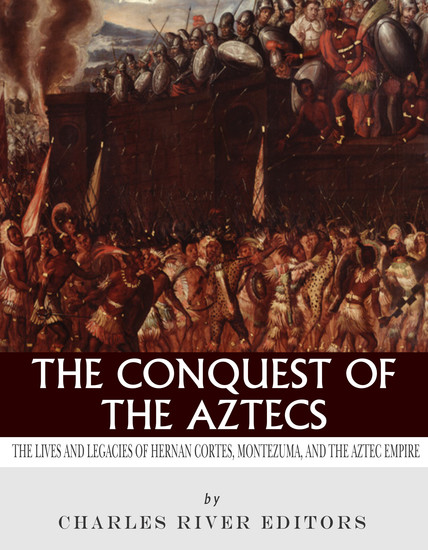
The Conquest of the Aztecs - The Lives and Legacies of Cortés Montezuma and the Aztec Empire - cover

The Conquest of the Aztecs - The Lives and Legacies of Cortés Montezuma and the Aztec Empire

Editors Charles River

Maison d'édition: Charles River Editors

  • 0
  • 0
  • 0

Synopsis

From the moment Spanish conquistador Hernan Cortés first found and confronted them, the Aztecs have fascinated the world, and they continue to hold a unique place both culturally and in pop culture. Nearly 500 years after the Spanish conquered their mighty empire, the Aztecs are often remembered today for their major capital, Tenochtitlan, as well as being fierce conquerors of the Valley of Mexico who often engaged in human sacrifice rituals.
 
Ironically, and unlike the Mayans, the Aztecs are not widely viewed or remembered with nuance, in part because their own leader burned extant Aztec writings and rewrote a mythologized history explaining his empire’s dominance less than a century before the Spanish arrived. Naturally, Cortes and other Spaniards depicted the Aztecs as savages greatly in need of conversion to Catholicism. While the Mayans are remembered for their astronomy, numeral system, and calendar, the Aztecs have primarily been remembered in a far narrower way, despite continuing to be a source of pride to Mexicans through the centuries.
 
As a result, even though the Aztecs continue to interest people across the world centuries after their demise, it has fallen on archaeologists and historians to try to determine the actual history, culture, and lives of the Aztecs from the beginning to the end, relying on excavations, primary accounts, and more.
 
Nearly 500 years after his death and the demise of his empire, Moctezuma II is the most famous ruler of the most famous civilization in the New World, the Aztec. For centuries the legends surrounding his life and the conquest of the Aztecs by Hernan Cortés have fascinated readers and historians alike.
 
Moctezuma was born around 1466 in the legendary Aztec city of Tenochtitlan and into the ruling family of the Aztec Confederacy. In the Nahuatl language, his name means “Angry Lord” or “Strong Armed Lord,” and he was the ninth ruler of the Aztecs, who called their leaders tlatoani. Though he is the best known ruler of the Aztec today, he was actually the second Aztec tlatoani to bear the name Moctezuma, after he assumed the throne from his uncle.
 
The Spanish conquest of the Aztec and some of the myths and legends surrounding it have made his name (and variations of it like Montezuma) instantly recognizable around the globe, his life is shrouded in mystery; Bernal Diaz del Castillo’s The Conquest of New Spain and Miguel Leon-Portilla’s translation of the Aztec observation of the conquest, The Broken Spears, recorded but a few details about the last Aztec ruler’s life. Also, these two sources are only concerned with the circumstances surrounding the Spanish conquest of the Aztecs and therefore only deal with the very end of Moctecuma II’s life and reign. Thus, his early life largely remains a mystery.
 
Of course, the lionization and demonization of Cortés often take place without fully analyzing the man himself, especially because there are almost no contemporaneous sources that explain what his thinking and motivation was. If anything, Cortés seemed to have been less concerned with posterity or the effects of the Spanish conquest on the natives than he was on relations with the Mother Country itself. Of the few things that are known about Cortés, it appears that he was both extremely ambitious and fully cognizant of politics and political intrigue, even in a New World thousands of miles west of Spain itself. Cortés spent much of his time in Mexico and the New World defending himself against other Spanish officials in the region, as well as trying to portray and position himself in a favorable light back home.
Disponible depuis: 29/06/2025.
Longueur d'impression: 66 pages.

D'autres livres qui pourraient vous intéresser

  • Charles Dickens - His Works His Life and His Legacy - cover

    Charles Dickens - His Works His...

    Kelly Mass

    • 0
    • 0
    • 0
    Charles Dickens is often remembered because of his Christmas Carol. And even though that is a very interesting novel, it wasn’t even his favorite. Some artists and authors claim that a work of art or a novel should be completely separated from the creator. Personally, I completely disagree. I think you can always find traces of psychology in a person’s work that are related to the things they experienced in their personal lives. 
    And so, without further ado, I encourage you to pick up this short informational book. It will lay out some of the most important characters from his most famous novels and give you the background you need to understand the motives and creativity behind them. Charles Dickens had a fascinating life, in an entirely different era and age in world history. To understand what and why he wrote what he did, it will be useful to see them in the light of his marriage, his financial hardships, his success, his children, his traumas, and his goals. Become acquainted with this genius writer and his true drive that led him to who he became to be.
    Voir livre
  • Dancing on My Own Two Feet - A New Life One Step at a Time - cover

    Dancing on My Own Two Feet - A...

    Jenn Todling

    • 0
    • 0
    • 0
    An inspirational book club read of one woman’s journey of taking the bold step to leave her disabled—and volatile—spouse and moving across the country in search of adventure, tango, and love. 
    At the tender age of twenty, Jenn faces a pivotal moment when her boyfriend, Morey, proposes marriage after only a few weeks of dating. Her intuition urges her to say no, but she’s spent the entirety of her teenage years caregiving for family; she yearns for adventure, and she thinks relocating to California with Morey will give her the freedom she craves. So she says yes—only to find herself back in the caregiver role after he becomes disabled a few years into their marriage. But it’s Morey’s volatile personality that ultimately leads Jenn to make a brave decision: it’s time to leave. 
    Dancing on My Own Two Feet takes a poignant turn as Jenn relocates to New York City after her divorce. Here, she rediscovers a long-forgotten passion for dance and embarks on a transformative journey that transcends the physicality of movement. Each dance becomes a channel to tap into her inner wisdom, providing the courage to explore the world and embrace new adventures. Then Jenn encounters Gable, a potential suitor, prompting new questions to arise for her: Is she better off on her own? Or could Gable be the love and dance partner she’s been longing for?
    Voir livre
  • Tenskwatawa: The Life of the Shawnee Prophet and Tecumseh’s Brother - cover

    Tenskwatawa: The Life of the...

    Editors Charles River

    • 0
    • 0
    • 0
    As settlers continued to encroach further west, the Shawnee, who were attempting to put together a confederacy of Native Americans to resist, stood firm and ready to fight them. Before America fought Britain in the War of 1812, they were engaged in Tecumseh’s War around the Great Lakes. The fighting made him famous and made a military hero (and eventually a president) out of William Henry Harrison, whose victory at Tippecanoe is considered the end of that war.  
    	Despite being one of their most tenacious opponents, Tecumseh almost immediately became a celebrated folk hero and respected leader in American history, all while continuing to be one of the most poignant symbols of resistance among Native Americans. He continues to be a household name across the United States today, nearly 200 years after his death.  
    	What makes Tecumseh’s legacy ironic is that the Shawnee were nominally led by a different man altogether, and that man just so happened to be Tecumseh’s brother. Lalawethika’s early life mostly consisted of abject failures, and he became an alcoholic, but in one of his alcohol-soaked stupors, he began to have visions of the Master of Life that turned him into the Open Door, the prophet named Tenskwatawa. It was Tenskwatawa who brought a new vision to the Shawnee, transforming himself from an object of pity and contempt into a religious leader who had thousands of followers. When the Americans fought at Tippecanoe, the gathering of Native Americans who they were attempting to disperse had congregated at a place colloquially known as Prophetstown. 
    Voir livre
  • Firkin Saga The - Brewing up entrepreneurial adventures and pioneering tales with the Prince of Ales (Unabridged) - cover

    Firkin Saga The - Brewing up...

    David P Bruce

    • 0
    • 0
    • 0
    Ready to raise a glass to an entrepreneurial adventure like no other? Step into the wildly entertaining world of David Bruce OBE, an unconventional entrepreneur, and legendary founder of Bruce's Brewery and the Firkin pubs brand, who took the brewing industry by storm. In The Firkin Saga, he shares nearly 60 years of beer, business and bold decisions. In 1979, David defied the odds, opening London's first pub in a century to brew its own beer - The Goose & Firkin - and proving his doubters wrong. What followed was a whirlwind of international ventures, charitable endeavours and a fair share of triumphs and setbacks. From pub brawls to boardroom battles, this memoir is packed with incredible stories that shine a light onto the brewing industry and the remarkable career of a highly successful entrepreneur. Along the way, David shares invaluable business lessons, many learned the hard way, from trusting your instincts to mastering the art of delegation. And it's all told with the same wit, irreverence and generous splash of humour that made his pubs and beers unforgettable. If you love a great business adventure - or a good pint - this book is a real eye-opener. So, grab a drink, settle in and say "cheers!" to a story that proves how success is best served with a small side of fun and mischief.
    Voir livre
  • Crocker's Hole - From their pens to your ears genius in every story - cover

    Crocker's Hole - From their pens...

    R D Blackmore

    • 0
    • 0
    • 0
    Richard Doddridge Blackmore was born on 7th June, 1825 at Longworth in Berkshire (now part of Oxfordshire), where his father, John Blackmore, was Curate-in-charge of the parish. His mother died a few months after his birth the victim of an outbreak of typhus. With this loss the family moved to Bushey, Hertfordshire, then on to their native Devon.  His elder brother Richard (by a year), however, was taken by his aunt to live near Oxford. His father married again in 1831, whereupon Richard returned to live with them.  With much of his childhood spent in the lush and pastoral "Doone Country" of Exmoor, and along the Badgworthy Water, Blackmore came to love the very countryside he immortalised in Lorna Doone.  In November 1853 he married his wife Lucy.  And the following year, 1854, his literary career began with a collection of Poems and for the next 15 years he would write in the winters and garden in the summers.  In 1860 with inherited money he built a house in Teddington just outside of London and established a market garden for the cultivation of fruit.  He loved horticulture but having little business experience could never really exploit it.  However with the publication of Lorna Doone in 1869 he was catapulted to fame.  And although he continued to write extensively nothing caught the public imagination quite like Lorna Doone.  RD Blackmore died at Teddington on 20th January, 1900 after a long and painful illness, and was buried next to his wife in Teddington cemetery.
    Voir livre
  • Children of Gay Couples - Stories of Children of Lesbian Couples - cover

    Children of Gay Couples -...

    Kolia Hiffler-Wittkowsky

    • 0
    • 0
    • 0
    For the first time, a collection of testimonials gives voice to the children of lesbian couples. Sixteen of them answer the questions many people ask: does living without a father pose a problem? Do children of gay couples necessarily become gay or lesbian? Do their families share the same values as others?
    The interviewees were aged between eleven and thirty-one. They were conceived either by insemination or during previous relationships. Today, they are students, police officers or producers. They have agreed to confide in us their joys, their worries, their troubles, their hopes and the way “others” look at them.
    Voir livre