Rejoignez-nous pour un voyage dans le monde des livres!
Ajouter ce livre à l'électronique
Grey
Ecrivez un nouveau commentaire Default profile 50px
Grey
Abonnez-vous pour lire le livre complet ou lisez les premières pages gratuitement!
All characters reduced
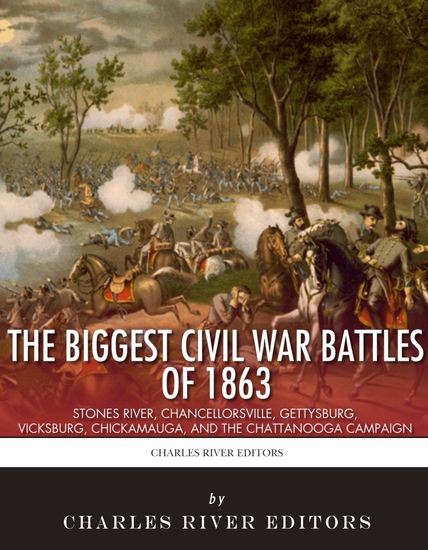
The Biggest Civil War Battles of 1863 - Stones River Chancellorsville Gettysburg Vicksburg Chickamauga and the Chattanooga Campaign - cover

The Biggest Civil War Battles of 1863 - Stones River Chancellorsville Gettysburg Vicksburg Chickamauga and the Chattanooga Campaign

Editors Charles River

Maison d'édition: Charles River Editors

  • 0
  • 0
  • 0

Synopsis

Americans have long been fascinated by the Civil War and its biggest battles, particularly Gettysburg, Antietam, and Shiloh, all of which involved Robert E. Lee or Ulysses S. Grant. But one of the 6 biggest battles of the war, and the one that took the heaviest toll by % on both armies was fought at the end of 1862 in Tennessee, and it involved neither of those generals.
 
In late December 1862, William Rosecrans’s Union Army of the Cumberland was contesting Middle Tennessee against Braxton Bragg’s Army of Tennessee, and for three days the two armies savaged each other as Bragg threw his army at Rosecrans in a series of desperate assaults. Bragg’s army was unable to dislodge the Union army, and he eventually withdrew his army after learning that Rosecrans was on the verge of receiving reinforcements. Though the battle was stalemated, the fact that the Union army was left in possession of the field allowed Rosecrans to declare victory and embarrassed Bragg.
 
Though Stones River is mostly overlooked as a Civil War battle today, it had a decisive impact on the war. The two armies had both suffered nearly 33% casualties, an astounding number in 1862 that also ensured Rosecrans would not start another offensive campaign in Tennessee until the following June.
 
Lee’s heavily outnumbered army won the most stunning victory of the war at Chancellorsville, but it cost them Stonewall Jackson. Moreover, the reorganization of the armies and the battle itself played an influential role in the way the Pennsylvania Campaign and the Battle of Gettysburg unfolded later that summer.
 
After the South had lost the war, the importance of Gettysburg as one of the “high tide” marks of the Confederacy became apparent to everyone, making the battle all the more important in the years after it had been fought. While former Confederate generals cast about for scapegoats, with various officers pointing fingers at Robert E. Lee, James Longstreet, and James Stuart, historians and avid Civil War fans became obsessed with studying and analyzing all the command decisions and army movements during the entire campaign. Despite the saturation of coverage, Americans refuse to grow tired of visiting the battlefield and reliving the biggest battle fought in North America.
 
At the start of 1863, Robert E. Lee’s Army of Northern Virginia had been frustrating the Union in the Eastern theater for several months, but the situation in the West was completely different. The Confederates had lost control of several important states throughout 1862, and after New Orleans was taken by the Union, the North controlled almost all of the Mississippi River, which Confederate general James Longstreet called “the lungs of the Confederacy”. By taking control of that vital river, the North would virtually cut the Confederacy in two, putting the South in a dire situation.
 
The only domino left to fall was the stronghold of Vicksburg, and both sides knew it. The Union Army of the Tennessee, led by Ulysses S. Grant, would spend months trying to encircle the army and eventually force John Pemberton’s Confederate army to surrender. Grant eventually succeeded on July 4, 1863, but since it came a day after the climactic finish of the Battle of Gettysburg, Vicksburg was (and still is) frequently overlooked as one of the turning points of the Civil War. In fact, had the Confederate’s military leadership listened to Longstreet, who advocated detaching soldiers from Lee’s army to head west and help the Confederates deal with Grant or Rosecrans in that theater, the Battle of Gettysburg might never have happened.
Disponible depuis: 02/05/2025.
Longueur d'impression: 289 pages.

D'autres livres qui pourraient vous intéresser

  • Hypochondria - cover

    Hypochondria

    Will Rees

    • 0
    • 0
    • 0
    A personal and literary examination of hypochondria.​
    		 
    A free-wheeling philosophical essay, Hypochondria is expansive in its range of references, from the writings of Franz Kafka to original yet accessible readings of theorists like Lauren Berlant. Whether he is discussing Seinfeld, John Donne, or his own hypochondriac past, Rees reveals himself to be a wry and perceptive critic, exploring the causes — and the costs — of our desire for certainty. With wit and erudition, Hypochondria demonstrates both the rewards and the perils of reading (too) closely the common but typically overlooked aspects of our everyday lives.
    Voir livre
  • Self Less - Lessons Learned from A Life Devoted to Servant Leadership in Five Acts - cover

    Self Less - Lessons Learned from...

    Len Jessup

    • 0
    • 0
    • 0
    One night, following a painful divorce, Len Jessup hit what he calls the “the lowest moment” of his life. He would go on to credit this moment as the start of his journey to selflessness. In Self Less, you’ll follow Len’s story of emotional vulnerability. Blending personal narrative with research, Jessup argues selfless leaders can maximize impact by guiding teams, not controlling them. He stresses the power of constant learning, surrounding yourself with people far smarter than you, and service to others. For leaders seeking to create meaningful change through personal growth, Jessup provides inspiration along with practical advice on inclusive leadership and securing stakeholder buy-in. Self Less offers a roadmap to lead change through humility, kindness, and care for employees and partners.
    Voir livre
  • PowerNomics - The National Plan to Empower Black America - cover

    PowerNomics - The National Plan...

    Dr. Claud Anderson

    • 0
    • 0
    • 0
    In PowerNomics: The National Plan to Empower Black America, Dr. Claud Anderson dismantles the myths and illusions surrounding Black progress. He exposes how racial monopolies and an unending influx of self-proclaimed minorities threaten to relegate Black Americans to a permanent underclass within a decade. The choice to prevent this looming crisis is yours: the cure or the placebo. 
    PowerNomics is a transformative, mind-altering guide that, for the first time, offers actionable solutions to turn impoverished and powerless Black communities into a truly competitive group. It teaches a revolutionary way to see, think, and act in racial matters. 
    The decision is clear: Will you take the "all-is-well" placebo and remain complacent, or will you embrace the PowerNomics cure, confront the truth, and take action to solve the nation's race problem? The choice is yours.
    Voir livre
  • Rooted in Scotland - Getting to the Heart of Your Scottish Heritage - cover

    Rooted in Scotland - Getting to...

    Cameron Taylor

    • 0
    • 0
    • 0
    The idea of home can be associated with the notion of an ancestral homeland, a place where something greather than any one individual began. It is difficult to underestimate just how powerful an experience visiting an ancestral homeland can be. There are several guides to tracing your Scottish ancestry and many serious historical studies of emigration. Rooted in Scotland takes a different perspective from most ancestry guides. Its starting point is that your sense of connection with Scotland has meaning and legitimacy, and that your journey of discovery helps you understand who you really are. The best places to start, tips on exploring ancestry and a guide to the best websites. Includes one man's emigration diary - a one-hundred-year-old first-hand account of what your own ancestors have gone through. Written by an ancestral research expert. Wherever you are in the world, your Scottish ancestry is worth exploring and celebrating. This book will help you do both. This book is a plea for restoring the role of emotion and imagination into all out dusty enquiries, and its warmth is inspiring. YOUR FAMILY TREE Will provide anyone with Scots ancestry with a wonderful insight into the significance of their heritage whilst inviting them to come and visit their homeland NATALIE MOFFAT, Ancestral Marketing Manager, Visit Scotland... a fresh and inspiring perspective on what it means to have Scottish ancestry, as well as providing creative ideas for bringing your own family history to life. THE HIGHLANDER
    Voir livre
  • The Hobo - A History of America's First Climate Migrants - cover

    The Hobo - A History of...

    Robert Suits

    • 0
    • 0
    • 0
    The Hobo: The Sociology Of The Homeless Man is a book written by Nels Anderson, which provides a comprehensive sociological study of the homeless population in America during the early 20th century. The book explores the lives and experiences of ""hobos"" - a term used to describe homeless men who traveled from place to place in search of work - and sheds light on the social and economic factors that led to their homelessness.Anderson's research is based on his own experiences living among the homeless population, as well as interviews with hundreds of hobos across the country. He examines the unique culture and social structures that developed within the hobo community, including their codes of conduct, language, and customs.The book also delves into the larger societal issues that contributed to the rise of homelessness during this time period, such as the Great Depression, industrialization, and the decline of traditional forms of work. Anderson argues that the hobo lifestyle was a response to these larger societal changes, and that understanding the hobo subculture is crucial to understanding the broader social and economic forces at play.Overall, The Hobo: The Sociology Of The Homeless Man is a groundbreaking work that provides a nuanced and empathetic look at the lives of homeless men during a tumultuous period in American history. It is a must-read for anyone interested in the sociology of homelessness, as well as anyone interested in the history of American society and culture.This scarce antiquarian book is a facsimile reprint of the old original and may contain some imperfections such as library marks and notations. Because we believe this work is culturally important, we have made it available as part of our commitment for protecting, preserving, and promoting the world's literature in affordable, high quality, modern editions, that are true to their original work.
    Voir livre
  • Nathaniel Hawthorne: A short biography - 5 Minutes: Short on time - long on info! - cover

    Nathaniel Hawthorne: A short...

    5 Minutes, 5 Minute Biographies,...

    • 0
    • 0
    • 0
    Nathaniel Hawthorne, American writer of the 19th century: Life and work in a short biography! Everything you need to know, brief and concise. Infotainment, education and entertainment at its best!
    Voir livre