Join us on a literary world trip!
Add this book to bookshelf
Grey
Write a new comment Default profile 50px
Grey
Subscribe to read the full book or read the first pages for free!
All characters reduced
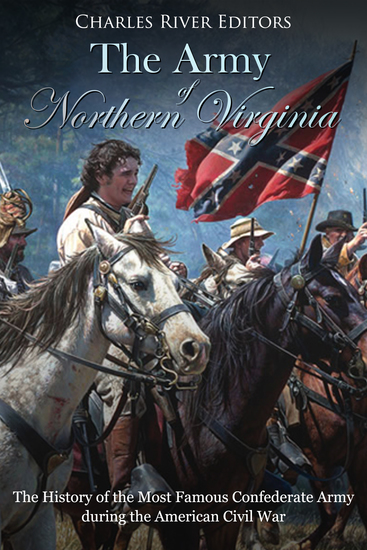
The Army of Northern Virginia - The History of the Most Famous Confederate Army during the American Civil War - cover

The Army of Northern Virginia - The History of the Most Famous Confederate Army during the American Civil War

Editors Charles River

Publisher: Charles River Editors

  • 0
  • 0
  • 0

Summary

Americans have long been fascinated by the Civil War, marveling at the size of the battles, the leadership of the generals, and the courage of the soldiers. Since the war's start over 150 years ago, the battles have been subjected to endless debate among historians and the generals themselves. The Civil War was the deadliest conflict in American history, and had the two sides realized it would take 4 years and inflict over a million casualties, it might not have been fought. Since it did, however, historians and history buffs alike have been studying and analyzing the biggest battles ever since.
 
Of course, the most famous battles of the war involved the Army of the Potomac facing off against Robert E. Lee’s Army of Northern Virginia at places like Antietam and Gettysburg.  Antietam was the bloodiest day of the war and forced Lee out of Maryland, allowing Lincoln to issue the Emancipation Proclamation. The following summer would see the biggest and most famous battle at Gettysburg. Lee would try and fail to dislodge the Union army with attacks on both of its flanks during the second day and Pickett’s Charge right down the center of the line on the third and final day. Meade’s stout defense held, barely, repulsing each attempted assault, handing the Union a desperately needed victory that ended up being one of the Civil War’s turning points.
 
Although the surrender of the Army of Northern Virginia to Grant and the Army of the Potomac at Appomattox Courthouse did not officially end the long and bloody Civil War, the surrender is often considered the final chapter of the war. For that reason, Appomattox has captured the popular imagination of Americans ever since Lee’s surrender there on April 9, 1865.
 
Lee is remembered today for constantly defeating the Union’s Army of the Potomac in the Eastern theater from 1862-1865, considerably frustrating Lincoln and his generals. His leadership of his army led to him being deified after the war by some of his former subordinates, especially Virginians, and he came to personify the Lost Cause’s ideal Southern soldier. His reputation was secured in the decades after the war as a general who brilliantly led his men to amazing victories against all odds. Despite his successes and his legacy, Lee wasn’t perfect. And of all the battles Lee fought in, he was most criticized for Gettysburg, particularly his order of Pickett’s Charge on the third and final day of the war.
 
The Army of Northern Virginia: The History of the Most Famous Confederate Army during the American Civil War chronicles the famous army’s campaigns and battles. Along with pictures and a bibliography, you will learn about the Army of Northern Virginia like never before.
Available since: 05/01/2025.
Print length: 415 pages.

Other books that might interest you

  • Passion & Provocation: Selected Poems - cover

    Passion & Provocation: Selected...

    Judith Partelow

    • 0
    • 0
    • 0
    “Here are poems for the people, reflections of deep sorrow and joy that cover the spectrum of a lifetime—a distillation of passion and pain. Judith Partelow speaks from the heart, shines a light into the soul, captures the fragility of life, and conveys complex emotional experiences with clarity. This collection is truly a treasure.” 
    – Lily Poritz Miller, author, former editor at The Macmillan Company and McGraw-Hill, senior editor at McClelland and Stewart. 
    "Judith Partelow’s poetry collection, Passion & Provocation, is a must-read for any woman who has lived and loved. Her voice will sound as familiar as your own with its yearnings, triumphs, regrets and humor, a voice that speaks from the 'inside out' about a woman’s life today."  
    - Nancy Rubin Stuart, author, POOR RICHARD’S WOMEN: Deborah Read Franklin and the Other Women Behind the Founding Father 
    "Passion and Provocation is a rich compilation of poems about the many phases of womanhood. Partelow uses musical language that sings her emotion: “Tropical ma-an/pulsates to a calypso beat.” In a tender moment, the author ponders the life of a mother: “an endless tune/we dance to all our lives.” She chronicles past relationships, old loves and new, while drawing the reader in with sensual images that celebrate her children and her own younger self. These are poems to savor for their astonishing beauty and contemplative vision."  
    —Robin Smith-Johnson, Author, Dream of the Antique Dealer’s Daughter, and Gale Warnings 
    Passion & Provocation is an invitation to explore the many colors of Judith Partelow’s poetry; a tapestry of threads woven through tender longings and joyful celebrations of love, friendships, marriages, family bonds, the soul, and other themes of a life well lived. 
    Show book
  • EPA 608 Secrets: Quick Tips for HVAC Mastery - "Boost your EPA 608 exam prep with dynamic audio lessons for HVAC mastery and top-notch performance!" - cover

    EPA 608 Secrets: Quick Tips for...

    Alistair Moonstone

    • 0
    • 0
    • 0
    EPA 608 Secrets: Quick Tips for HVAC Mastery 
    ⭐⭐ Simplified Guide & Explanations Included ⭐⭐ 
    Are you eager to advance in your career and strengthen your knowledge to successfully conquer the EPA 608 exam? 
    Searching for a detailed resource that encompasses all the essential tools to excel in the EPA 608 exam? 
    Look no further! 
    This guide is your ultimate companion for enhancing your understanding, applying your skills, and engaging in practical exercises. With this resource at your side, you are set for success. 
    Updated for the latest EPA 608 Exam Structure. 
    Key features of this enhanced guide: 
    - In-depth insights into the EPA 608 Certification  
    - Comprehensive explanations of HVAC concepts  
    - Effective strategies for exam preparation and tackling challenges  
    Our guide stands out through its thorough coverage, which is vital for your exam triumph. Concepts are explored in detail rather than glossed over. 
    Please note, this guide is an independent resource and is not affiliated with any official EPA entity. 
    Crafted with a clear layout and easy-to-follow language, our guide to mastering the EPA 608 exam ensures seamless transitions between topics. Say goodbye to complex jargon and embrace clear, precise, and technically accurate content. 
    So, why hesitate? Click the BUY NOW button, secure your guide, and embark on your journey to mastering the EPA 608 exam! 
    Take action today—invest in yourself and your future with this essential guide!
    Show book
  • Shifters in the Night - 4 Book Bundle - cover

    Shifters in the Night - 4 Book...

    Jane Fox

    • 0
    • 0
    • 0
    A bulging four book bundle of MM gay shape-shifting goodness!Hunted by Moonlight: Wolf shifter first time for a straight guy.Fight the Alpha: Omega gets moody and dominated!Entered by the Dragon: Dragon shifter first time for a straight guy.Mounted by the Alien Demon: Supernatural science fiction - gay men in space!
    Show book
  • The Roman Empire Uncovered - Secrets of a Superpower - cover

    The Roman Empire Uncovered -...

    Rogan Fish

    • 0
    • 0
    • 0
    The Roman Empire, one of history's most influential superpowers, traces its origins to a blend of myth, legend, and historical reality. Understanding the foundations of Rome requires examining the myths surrounding its birth, its early expansion as a republic, and the eventual transformation into a dominant empire. These formative stages laid the groundwork for centuries of imperial dominance, establishing Rome as a cultural and political epicenter. 
    The story of Rome's foundation begins with the legendary tale of Romulus and Remus. According to Roman mythology, the twin brothers were abandoned by the river Tiber, only to be rescued and nurtured by a she-wolf. Eventually, Romulus would go on to establish the city on Palatine Hill in 753 BCE, becoming its first king after a violent dispute with Remus. Though historians debate the factual accuracy of this tale, it symbolizes Rome’s resilience and its origins rooted in struggle and survival. This myth, coupled with archaeological evidence from early settlements on the hills of Rome, provides insight into how Romans viewed their beginnings as both divine and destined for greatness. 
    Following its legendary foundation, Rome gradually transformed from a small settlement into a robust city-state. Initially, it was ruled by a series of kings who laid the foundations of Roman society, including political and religious institutions. However, the overthrow of the monarchy in 509 BCE marked the beginning of the Roman Republic, a period characterized by shared power between elected officials and a complex system of checks and balances. The Republic's political structure, with the Senate as a central governing body, reflected a commitment to preventing any single ruler from holding excessive power. This early model of governance would profoundly influence later empires and modern political systems.
    Show book
  • Russian Nuclear Orthodoxy - Religion Politics and Strategy - cover

    Russian Nuclear Orthodoxy -...

    Dmitry Adamsky

    • 0
    • 0
    • 0
    A nuclear priesthood has arisen in Russia. From portable churches to the consecration of weapons systems, the Russian Orthodox Church has been integrated into every facet of the armed forces to become a vital part of Russian national security, politics, and identity. This extraordinary intertwining of church and military is nowhere more visible than in the nuclear weapons community, where the priesthood has penetrated all levels of command and the Church has positioned itself as a guardian of the state's nuclear potential. Russian Nuclear Orthodoxy considers how, since the Soviet collapse in 1991, the Church has worked its way into the nuclear forces, the most significant wing of one of the world's most powerful military organizations. 


    Dmitry Adamsky describes how the Orthodox faith has merged with Russian national identity as the Church continues to expand its influence on foreign and domestic politics. The Church both legitimizes and influences Moscow's assertive national security strategy in the twenty-first century. This book sheds light on the role of faith in modern militaries and highlights the implications of this phenomenon for international security. Ultimately, Russian Nuclear Orthodoxy interrogates the implications of the confluence of religion and security for other members of the nuclear club, beyond Russia.
    Show book
  • Ludwig Wittgenstein - Language Logic and the Limits of Philosophy - cover

    Ludwig Wittgenstein - Language...

    Hector Davidson

    • 0
    • 0
    • 0
    Ludwig Wittgenstein, one of the most influential philosophers of the 20th century, profoundly shaped modern thought, particularly in the realms of language, logic, and the philosophy of mind. His philosophy spans two distinct periods, marked by an evolution in his views on the relationship between language, meaning, and reality. Wittgenstein’s work challenges the way we think about and use language, positing that philosophical problems often arise from misunderstandings of language and its limitations. 
    Wittgenstein’s early philosophy, as presented in his landmark work Tractatus Logico-Philosophicus, was grounded in the belief that language could mirror the structure of reality. According to his "picture theory of meaning," words and sentences are pictures that represent facts in the world. He argued that the limits of language are also the limits of the world, and anything that could not be meaningfully expressed through language was simply beyond the scope of philosophy. This view led him to conclude that many traditional philosophical problems were nonsensical, arising from a misuse of language. 
    However, Wittgenstein underwent a significant philosophical transformation after his work on the Tractatus, largely due to his dissatisfaction with the results of his early approach. By the time of his later work, particularly in Philosophical Investigations, Wittgenstein had rejected the picture theory of meaning and developed the concept of "language games." He argued that meaning is not inherent in words themselves but is derived from their use in various social contexts. Language, for Wittgenstein, is a tool embedded in human practices and activities. He claimed that understanding language requires understanding the ways it functions in specific contexts, challenging the idea of a fixed, underlying structure of meaning.
    Show book