Begleiten Sie uns auf eine literarische Weltreise!
Buch zum Bücherregal hinzufügen
Grey
Einen neuen Kommentar schreiben Default profile 50px
Grey
Jetzt das ganze Buch im Abo oder die ersten Seiten gratis lesen!
All characters reduced
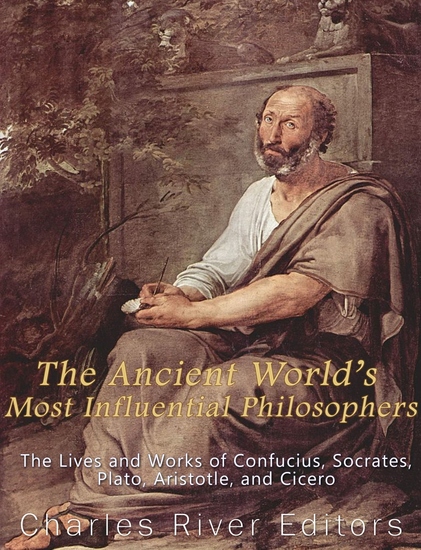
The Ancient World’s Most Influential Philosophers - The Lives and Works of Confucius Socrates Plato Aristotle and Cicero - cover

The Ancient World’s Most Influential Philosophers - The Lives and Works of Confucius Socrates Plato Aristotle and Cicero

Editors Charles River

Verlag: Charles River Editors

  • 0
  • 0
  • 0

Beschreibung

Many people argue that Confucius is the most influential person of all time, and if having a significant effect on the greatest number of people is the criterion, he may very well be. China is one of the largest and oldest civilizations on earth, and Confucius has been influential there from almost the beginning: the first Chinese dynasty was founded around 1600 BCE and Confucius lived from 551-479 BCE.
 
Although he is still one of history’s most famous philosophers, Confucius was in many respects an unremarkable man, and even his physical features were said to be unattractive. There is little evidence that he thought of himself as a harbinger of any kind, but shortly after his death, writings, sayings, and theories based on his life and ideas spread throughout China and even took hold of the imperial court of one of the most powerful and important dynasties, the Han (206 BCE-220 CE). It was during the Han Dynasty that Confucianism became closely tied to state affairs, and it would remain so until the fall of the last dynasty in 1912. Confucianism was closely tied to state religious and ritual practice, and naturally, it benefited greatly from this relationship and was able to subsequently exert influence on all aspects of society.[1] As a "state religion", it provided "religious sanction for policy-making, official sacrifices, court ceremonies, royal marriage, funeral and mourning rights" as well as several major sacrifices to gods and ancestors.[2] Confucianism continues to reverberate to the present day; the Chinese Communist Party still discusses Confucius in their official newspapers and references his thought when they think it will help promote a political or social stance.
 
In 427 B.C., the Ancient Greek city-state of Athens was flourishing.  Approximately 80 years earlier, the Athenians had formed the first self-representative democracy in history, the Peloponnesian War against Sparta had only just started, and Socrates was only beginning to lay the foundation of what would become Western philosophy. 
 
None of Socrates’ works survived antiquity, so most of what is known about him came from the writings of his followers, most notably Plato.  What is known about Socrates is that he seemed to make a career out of philosophy, and Plato was intent on following in his footsteps. Yet for all of the influence of Socrates’ life on his followers, it was Socrates’ death around 399 B.C. that truly shaped them.  Plato was so embittered by Socrates’ trial in Athens that he completely soured on Athenian democracy, and Aristotle would later criticize politicians who relied on rhetoric; when Aristotle’s own life was threatened, he fled Greece and allegedly remarked, “I will not allow the Athenians to sin twice against philosophy."
 
Since Socrates wrote nothing down, or at least nothing that survived antiquity, there has been a wealth of scholarship ever since attempting to determine the person to whom the philosophical positions of the various (and genuine) Socratic dialogues of Plato’s should be attributed. Even though Aristotle insisted that Socrates only cared about ethics and held no metaphysical theory of the kind that Plato propounded, the attempt to read the ugly but wise Socrates via the Platonic dialogues continued up to the 20th century. The change of tone, style and philosophical topics seemed to be a big argument that Socratic views are to be found in the early Platonic works, whereas later works bear the stamp of Plato’s personal views. The Platonic scholar Gregory Vlastos introduced a developmentalist position which has almost become an orthodoxy in Platonic studies, by moving the discussion from the historical Socrates to Plato as a philosopher. According to developmentalism, if the views in the dialogue are not spelled out only to be refuted afterward, then the person they should be attributed to is Plato and not Socrates. These philosophical views developed over time.
Verfügbar seit: 01.05.2025.
Drucklänge: 154 Seiten.
Weitere Bücher, die Sie mögen werden

  • Leading Through Change - Essential Skills and Strategies for the Future of Leadership - cover

    Leading Through Change -...

    Brian Gibson

    • 0
    • 0
    • 0
    Are you struggling to lead your team through uncertainty, rapid innovation, and constant disruption? 
    In a world where change is no longer an event but a constant, traditional leadership strategies are falling short. Leaders everywhere are grappling with how to inspire trust, maintain clarity, and deliver results—all while navigating unpredictable environments. If you've ever asked yourself how to lead confidently through chaos, Leading Through Change is your answer. 
    Discover a powerful, actionable framework for becoming the kind of leader today's fast-paced world demands. 
    This book delivers proven tools and essential skills that will help you: 
    ·        Build resilience and adaptability in yourself and your team 
    ·        Communicate with clarity during times of uncertainty 
    ·        Make decisive choices amid ambiguity and conflicting priorities 
    ·        Foster trust and collaboration—even during organizational upheaval 
    ·        Inspire innovation without sacrificing stability 
    ·        Navigate resistance, emotional responses, and fatigue during transitions 
    ·        Create a forward-focused culture ready for whatever comes next 
    If you're ready to become a future-ready leader who doesn't just react to change, but thrives in it. 
    Buy Leading Through Change today and start transforming the way you lead tomorrow.
    Zum Buch
  • Admiral Horatio Nelson’s Greatest Victories - cover

    Admiral Horatio Nelson’s...

    Editors Charles River

    • 0
    • 0
    • 0
    Over the course of its history, England has engaged in an uncountable number of battles, but none of her military heroes has had a greater military legacy than Admiral Lord Horatio Nelson, 1st Viscount Nelson, 1st Duke of Bronté. Whether traveling to Trafalgar Square or one of the hundreds of pubs named after him, seemingly it becomes easy to believe that no Briton has cast as long a shadow. Nelson is known across the world for his decisive victory at Trafalgar, made all the more legendary by the fact that he was mortally wounded at the height of his greatest feat. And it is understandable that any man who could thwart Napoleon’s ambitions as well as Nelson did would earn a place in the history books. But Nelson embodied every virtue of his homeland as a dashing, courageous military officer who was impeccably cultured, and the best at what he did. Indeed, as the personification of the supremacy of the Royal Navy, the man and his life had a powerful resonance well before his death. 
    Before Trafalgar, Nelson had already earned enduring fame for the British victory at the Battle of the Nile. In 1798, he was given command of a small squadron and sent ahead to Gibraltar, and eventually given instructions to hunt down and destroy Napoleon’s fleet. Indeed, the coming battle was the battle of annihilation Nelson had sought – of 13 French battleships engaged, 2 were destroyed and 9 were captured. British losses were negligible, with no ships lost and about 900 killed or wounded. French casualties were at least 2,000, with thousands more captured. The French Mediterranean fleet had been wiped out, and Napoleon’s expeditionary force was now stranded. 
    With Nelson’s decisive victory, the Royal Navy had once again asserted itself as the dominant power in the Mediterranean. At the same time, Nelson’s inability to intercept Napoleon at sea allowed the French transports and ground forces to survive unscathed, and they eventually made their way back to France.
    Zum Buch
  • This Is Not A Leadership Book - 20 Rules for Success - cover

    This Is Not A Leadership Book -...

    Emmanuel Gobillot

    • 0
    • 0
    • 0
    Part leadership book, part business book, and 100% true, this is like hearing a wise, honest, and humorous mentor finally tell you about the world of business as it is and how to find your place in it. 


    Many leadership books are either shallow (focusing on only one element of leadership), narrow (examining leadership out of context), or biased (selling an idealized model). This book seeks simplicity without being simplistic and focuses on the listener in their context rather than describing other people's leadership in theirs. It sets out twenty rules for success that draw on Emmanuel Gobillot's twenty years of experience advising high-performing leaders. Each rule is presented in an engaging, instantly recognizable true story that helps current and aspiring leaders to look differently at their own situation. 


    Best described as a leadership development program, this book takes you on a fast-paced, three-step journey from what it takes to be a leader, to why you can be one, via how to succeed.
    Zum Buch
  • A Reading of the Inaugural Address of President James K Polk - cover

    A Reading of the Inaugural...

    President James K. Polk

    • 0
    • 0
    • 0
    James Knox Polk (November 2, 1795 to June 15, 1849) was the 11th president of the United States, serving from 1845 to 1849, and former governor of Tennessee. A protégé of President Andrew Jackson and a member of the Democratic Party, he was an advocate of Jacksonian democracy and extending the territory of the United States. Polk led the U.S. into the Mexican–American War, and after winning the war he annexed the Republic of Texas, the Oregon Territory, and the Mexican Cession. The following is a reading of President Polk's inaugural address on March 4, 1845.
    Zum Buch
  • Byways of Blessedness - Exploring Hidden Paths to Inner Harmony - cover

    Byways of Blessedness -...

    James Allen, Tim Zengerink

    • 0
    • 0
    • 0
    What if you could discover serene, overlooked pathways to a richer and more harmonious life—simply by shifting your perspective? 
    James Allen’s contemplative work unravels the small but profound ways we can cultivate blessedness every day. Adapted for modern readers, this text highlights virtues like patience, kindness, and selflessness, revealing how they open the door to enduring happiness and spiritual fulfillment. 
    What You’ll Discover in This Modern Translation: 
    - Practical exercises for nurturing compassion and understanding 
    - The transformative impact of small acts of goodwill 
    - How to maintain serenity amid life’s daily pressures 
    - Uplifting wisdom to guide your personal and spiritual evolution 
    Imagine feeling a warm sense of contentment that no setback can dim, grounded in gentle virtues that sustain both you and those around you. Let James Allen show you the overlooked but ever-present routes to a blessed existence. 
    Embark on a journey of gentle transformation. Get your copy now and uncover the hidden pathways leading to inner harmony.
    Zum Buch
  • The weather and its phenomena - cover

    The weather and its phenomena

    KidsChoice

    • 0
    • 0
    • 0
    KidsChoice: World knowledge for Children is an engaging audiobook series that takes young listeners on a fascinating journey to explore and understand the world around them. Aimed at curious children aged 7 to 99, this series dives into a variety of topics in science, society, and culture, making complex ideas accessible and exciting.  Each episode brings a unique theme to life—whether exploring the mysteries of space, uncovering the secrets of the human body, or discovering the diversity of cultures and traditions worldwide. With lively narration, interesting facts, and interactive elements, the series guides young listeners on an adventure full of discovery, encouraging them to ask questions and expand their understanding in a fun way.  In the scientific world of KidsChoice, children learn about the wonders of nature and the universe. Concepts like the solar system, animal behavior, the human body, and Earth's various ecosystems are explained in a way that is easy for kids to grasp and find fascinating. Exciting analogies and vivid examples help spark curiosity, turning learning into an adventure.  Societal topics also have a special place in the series. KidsChoice introduces young listeners to the basics of community, compassion, and making a positive impact. Children learn what it means to be a good citizen and how they can make small, meaningful contributions to their communities.  Additionally, KidsChoice opens a window to the vibrant world of global cultures. Through a virtual journey around the globe, children discover how people in other countries live, the customs and traditions they follow, the languages they speak, and the foods they enjoy. This fosters understanding and respect for diverse ways of life, celebrating the richness of human experience as a beautiful, valuable part of the world.  With its vivid language and captivating soundscapes, "KidsChoice: World knowledge for Children" turns learning into an exciting experience, sparking a lifelong curiosity and a deeper understanding of the world around them.
    Zum Buch