Rejoignez-nous pour un voyage dans le monde des livres!
Ajouter ce livre à l'électronique
Grey
Ecrivez un nouveau commentaire Default profile 50px
Grey
Abonnez-vous pour lire le livre complet ou lisez les premières pages gratuitement!
All characters reduced
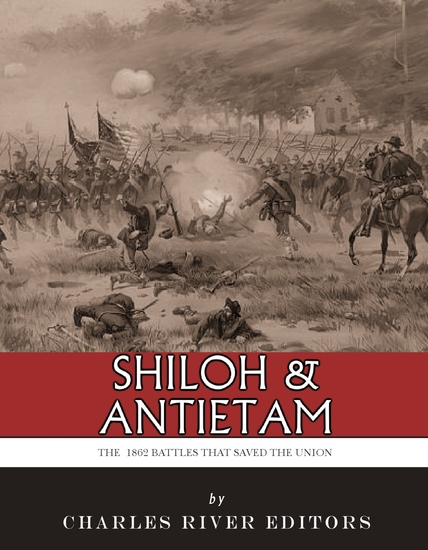
Shiloh & Antietam - The 1862 Battles That Saved the Union - cover

Shiloh & Antietam - The 1862 Battles That Saved the Union

Editors Charles River

Maison d'édition: Charles River Editors

  • 0
  • 0
  • 0

Synopsis

“The turning point of our fate." – Jefferson Davis on the death of Albert Sidney Johnston at Shiloh


“Probably no single battle of the war gave rise to such wild and damaging reports.” – William Tecumseh Sherman


After Union General Ulysses S. Grant captured Fort Henry and Fort Donelson in early 1862, Confederate General Albert Sidney Johnston, widely considered the Confederacy’s best general, concentrated his forces in northern Georgia and prepared for a major offensive that culminated with the biggest battle of the war to that point, the Battle of Shiloh. On the morning of April 6, Johnston directed an all out attack on Grant’s army around Shiloh Church, and though Grant’s men had been encamped there, they had failed to create defensive fortifications or earthworks. They were also badly caught by surprise. With nearly 45,000 Confederates attacking, Johnston’s army began to steadily push Grant’s men back toward the river.  


As fate would have it, the Confederates may have been undone by friendly fire at Shiloh. Johnston advanced out ahead of his men on horseback while directing a charge near a peach orchard when he was hit in the lower leg by a bullet that historians now widely believe was fired by his own men. Nobody thought the wound was serious, including Johnston, who continued to aggressively lead his men and even sent his personal physician to treat wounded Union soldiers taken captive. But the bullet had clipped an artery, and shortly after being wounded Johnston began to feel faint in the saddle. With blood filling up his boot, Johnston unwittingly bled to death. The delay caused by his death, and the transfer of command to subordinate P.G.T. Beauregard, bought the Union defenders critical time on April 6, and the following day Grant’s reinforced army struck back and pushed the Confederate army off the field.


The Battle of Shiloh lasted two days, but the battle over the battle had just begun. Grant’s army had just won the biggest battle in the history of North America, with nearly 24,000 combined casualties among the Union and Confederate forces. Usually the winner of a major battle is hailed as a hero, but Grant was hardly a winner at Shiloh. The Battle of Shiloh took place before costlier battles at places like Antietam and Gettysburg, so the extent of the casualties at Shiloh shocked the nation. Moreover, at Shiloh the casualties were viewed as needless; Grant was pilloried for allowing the Confederates to take his forces by surprise, as well as the failure to build defensive earthworks and fortifications, which nearly resulted in a rout of his army. Speculation again arose that Grant had a drinking problem, and some even assumed he was drunk during the battle. Though the Union won, it was largely viewed that their success owed to the heroics of General Sherman in rallying the men and Don Carlos Buell arriving with his army, and General Buell was happy to receive the credit at Grant’s expense.


As a result of the Battle of Shiloh, Grant was demoted to second-in-command of all armies in his department, an utterly powerless position. And when word of what many considered a “colossal blunder” reached Washington, several congressmen insisted that Lincoln replace Grant in the field. Lincoln famously defended Grant, telling critics, “I can’t spare this man. He fights.”


Shiloh & Antietam explains the campaign and events that led up to the decisive battle, what went right and wrong on both sides, and the aftermath of the battle. Accounts of the battle by important leaders like Sherman, Grant, and Braxton Bragg are included, along with analysis of the generals and fighting. Along with maps of the battle and pictures of important people, places, and events, you will learn about the Battle of Shiloh like you never have before.
Disponible depuis: 02/05/2025.
Longueur d'impression: 100 pages.


D'autres livres qui pourraient vous intéresser

  • Readings From The Garuda Purana - cover

    Readings From The Garuda Purana

    Veda Vyas

    • 0
    • 0
    • 0
    The Garuda Purana is primarily concerned with the issues of death and the afterlife and provides a detailed account of the journey of the soul after death. It also contains descriptions of various religious practices, customs, and rituals, as well as stories and legends about gods, sages, and holy places.Reincarnation, also known as transmigration of the soul, is an important concept in yogic philosophy and is mentioned extensively in the Garuda Purana. After a person dies, their soul is reborn into a new body. This cycle of birth, death, and rebirth is known as samsara. In the Garuda Purana, a conversation between Vishnu and Garuda, it is believed the nature of one's next birth is determined by their actions in their previous life. The text describes different types of karma, their consequences, and the methods of attaining liberation from the cycle of samsara. The work divides karma into three categories: good, bad, and mixed. Good karma is accumulated by performing virtuous deeds, such as charity, kindness, and devotion to God or bhakti.The book also describes various methods of attaining liberation. The most important method is devotion, which is believed to purify one's karma and lead to liberation. Other methods include performing good deeds, practicing yoga and meditation, and studying the Vedas The Garuda Purana is a valuable source of information on reincarnation and karma. The teachings on reincarnation in the Garuda Purana continue to be relevant today, providing insight into the nature of existence and the ultimate goal of life.A must-have audiobook for anyone interested in yoga and meditation. Narrated by Emmy-nominated actor Sripad Jagannatha Das.
    Voir livre
  • The Case of Wagner and selected aphorisms - cover

    The Case of Wagner and selected...

    Friedrich Nietzsche

    • 0
    • 0
    • 0
    "The Case of Wagner and Selected Aphorisms" is a collection of essays and aphorisms by the German philosopher Friedrich Nietzsche. In this book, Nietzsche critiques the works and ideas of the composer Richard Wagner, with whom he had a complicated relationship. He delves into themes such as aesthetics, culture, morality, and the nature of art, offering sharp and often controversial insights.
    Voir livre
  • Life in the UK Test 2026 - With 500 Official Style Practice Test Questions and Answers – To Ensure You Pass Quickly and Easily - cover

    Life in the UK Test 2026 - With...

    Freddie Ixworth

    • 0
    • 0
    • 0
    What the students who pass the Life in the UK Test on their first attempt know, that you don’t... 
    Maybe you’re worried about not passing your examination on the first attempt? 
    Or maybe you have no idea where to begin with preparing for the test? 
    If that’s you, then fortunately we’re here to help you. 
    We want to make sure that you pass your examination with confidence in 2026. 
    We’ve hand-picked 500 questions from the Official Life in the UK Resident’s Guide – so you can be sure that the questions and answers you’re practising are accurate and up-to-date. 
    The questions and answers are equally spread across History, Government, Law & Your Role in the UK. We’ve included a mix of multiple choice questions and true/false questions, just like you’ll get on the day of the real test. 
    Here’s what you’ll get inside this book:   
    • 500 Practice Questions 
    • Detailed answers at the back of the book 
    • Important information on how & where to book your test 
    • Revision lists of sports personalities 
    • Revision lists of cultural personalities and inventors 
    No matter where in the world you are from, this book will help you to pass your Life in the UK test faster, and with more confidence – on your first attempt.
    Voir livre
  • The Age of Elizabeth - cover

    The Age of Elizabeth

    MA Andrew Browning

    • 0
    • 0
    • 0
    From her accession through her impressive reign, this thorough biography of Elizabeth I details the life and rule of one of Britain/s most influential rulers. From diplomatic relations to military choices to the Wars of Religion, this book is extensive, detailed, and fascinating.
    Voir livre
  • The Wannabe Fascists - A Guide to Understanding the Greatest Threat to Democracy - cover

    The Wannabe Fascists - A Guide...

    Federico Finchelstein

    • 0
    • 0
    • 0
    Meet today's almost fascists and learn the warning signs to intercept them on the road from populism to dictatorship. 


    With The Wannabe Fascists, historian Federico Finchelstein offers a precise explanation of why Trumpism and similar movements across the world belong to a new political breed, the last outcome of the combined histories of fascism and populism: the wannabe fascists. This new type of populist politician is typically a legally elected leader who, unlike previous populists who were eager to distance themselves from fascism, turns to totalitarian lies, racism, and illegal means to destroy democracy from within. 


    Drawing on almost three decades of research on the histories of fascism and populism around the world, this book lays out in clear language what the author calls the "four pillars of fascism"—xenophobia, propaganda, political violence, and ultimately dictatorship. Finchelstein carefully explains how and why wannabe fascists like Trump, Bolsonaro, and Modi embrace the first three pillars but don't quite succeed in dictatorship and total suppression of the popular vote. The Wannabe Fascists stresses the importance of preventing despots from reaching this tipping point and offers a clear warning for what's at stake.
    Voir livre
  • Dramatic Rise and Fall of the Portuguese Empire The: The History and Legacy of Portugal’s Mercantile Empire across the World - cover

    Dramatic Rise and Fall of the...

    Editors Charles River

    • 0
    • 0
    • 0
    Trade was able to increase in Europe around the world due to more effective ships being introduced, and some of the improvements that were made to the ships were first introduced by the Chinese. The introduction of multiple mast ships and the sternpost rudders allowed the ships to travel quicker and be more maneuverable. By the start of the 15th century, ships were now much larger and able to support long distance travel with a minimum number of crew aboard.  
    	With that, the Portuguese started exploring the west coast of Africa and the Atlantic under orders from Prince Henry the Navigator. At this point, Europeans had not yet been capable of navigating completely around Africa since the ships being built were not yet fully capable of being able to sail very far from the coast and navigation in open waters was difficult, but the Portuguese continued pushing down the western African coast looking for ways to bypass the Ottomans and Muslims of Africa who had been making overland trade routes difficult. In 1451, Prince Henry the Navigator helped fund and develop a new type of ship, the caravel, that featured triangular lateen sails and would be able to travel in the open ocean and sail against the wind. In 1488, Bartholomew Diaz rounded the southern tip of Africa, named the Cape of Good Hope by King John of Portugal, and entered the Indian Ocean from the Atlantic.  
    	The Portuguese found access to the trade regions that they had been searching for, but sailing from Portugal to India and beyond would require too many resources to travel with at once. To remedy this problem, Portugal began establishing a number of forts and trading posts along the route. The Portuguese were able to establish a fort on the west coast of India, Fort Manuel, in 1500, and in 1505 a fort was erected off the coast of Tanzania, thus beginning a trend of European colonization in Africa and Asia that would last for the next 400 years. 
    Voir livre