Rejoignez-nous pour un voyage dans le monde des livres!
Ajouter ce livre à l'électronique
Grey
Ecrivez un nouveau commentaire Default profile 50px
Grey
Abonnez-vous pour lire le livre complet ou lisez les premières pages gratuitement!
All characters reduced
Robert E Lee’s Greatest Victories - cover

Robert E Lee’s Greatest Victories

Editors Charles River

Maison d'édition: Charles River Editors

  • 0
  • 0
  • 0

Synopsis

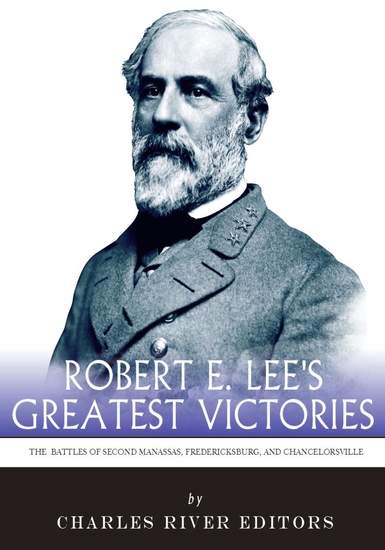
The Second Battle of Bull Run (August 28-30, 1862) was one of the most decisive battles fought during the Civil War, and it was also one of the most unlikely. Less than three months before the battle, Joseph E. Johnston’s Army of Northern Virginia had been pushed back nearly all the way to Richmond by George B. McClellan’s Army of the Potomac, so close that Union soldiers could see the church steeples of the Confederate capital. And yet, at the end of Second Manassas, Robert E. Lee’s Army of Northern Virginia found itself in the field unopposed about 20 miles away from the Union capital of Washington D.C. How could such a remarkable reversal of fortunes take place so quickly?
 
After Lee succeeded the wounded Johnston, he pushed McClellan’s Army of the Potomac away from Richmond and back up the Peninsula in late June, only to then swing his army north to face a second Union army, John Pope’s Army of Virginia. Needing to strike out before the Army of the Potomac successfully sailed back to Washington and linked up with Pope’s army, Lee daringly split his army to threaten Pope’s supply lines, forcing Pope to fall back to Manassas to protect his flank and maintain his lines of communication. At the same time, it left half of Lee’s army (under Stonewall Jackson) potentially exposed against the larger Union army until the other wing (under James Longstreet) linked back up. Thus, in late August 1862, the Army of Northern Virginia and the Army of Virginia found themselves fighting over nearly the exact same land the South and North fought over in the First Battle of Bull Run 13 months earlier.
 
When Pope’s army fell back to Manassas to confront Jackson, his wing of Lee’s army dug in along a railroad trench and took a defensive stance. The battle began with the Union army throwing itself at Jackson the first two days. But the concentration on Stonewall’s men opened up the Union army’s left flank for Longstreet’s wing, which marched 30 miles in 24 hours to reach the battlefield by the late afternoon of August 29. Lee used Longstreet’s wing on August 30 to deliver a devastating flank attack before enough reinforcements from the retreating Army of the Potomac reached the field, sweeping Pope’s Army from Manassas and forcing the Union soldiers into yet another disorderly retreat from Manassas to Washington D.C., a scene all too reminiscent of the First Battle of Bull Run.
 
With Washington urging Burnside to advance against Lee, Burnside launched an ill fated operation across the Rappahannock River near Fredericksburg in December 1862. From December 12-13, Burnside struggled to get his army across the river while it was under fire from Confederates in Fredericksburg, and things only got worse when they did. Although the Union almost broke the Confederate lines in the south on December 13, they were ultimately repulsed, and the battle is mostly remembered for the piecemeal attacks the Union army made on heavily fortified positions Longstreet’s men took up on Marye’s Heights. As they threw themselves at Longstreet’s heavily fortified position along the high ground, the Northern soldiers were mowed down again and again. General Longstreet compared the near continuous fall of soldiers on the battlefield to “the steady dripping of rain from the eaves of a house.” During the battle, Lee turned to Longstreet and commented, “It is well that war is so terrible, otherwise we should grow too fond of it.”
 
The Battle of Chancellorsville is one of the most famous of the Civil War, and the most famous part of the battle was Stonewall Jackson’s daring march across the Army of the Potomac’s flank, surprising the XI Corps with an attack on May 2, 1863. Having ignored warnings of Jackson’s march, the XI Corps was quickly routed. The surprise was a costly success, however, as Jackson was mortally wounded after being mistakenly fired upon by his own men.
Disponible depuis: 02/05/2025.
Longueur d'impression: 137 pages.

D'autres livres qui pourraient vous intéresser

  • Deschooling Society - Why we must disestablish school - cover

    Deschooling Society - Why we...

    Iván Illich

    • 0
    • 0
    • 0
    This recording has been digitally produced by DeepZen Limited, using a synthesized version of an audiobook narrator’s voice under license. DeepZen uses Emotive Speech Technology to create digital narrations that offer a similar listening experience to human narration.  
     
    Schools and universities support misleading notions of 'progress' and development, fostered by the belief that ever-increasing production, consumption and profit are proper yardsticks for measuring the quality of human life. Our universities are the recruitment centres for the personnel of the consumer society, certifying citizens for service, while at the same time disposing of those judged unfit for the competitive rat race. In this bold and provocative book, Illich suggests some radical and exciting reforms for the education system.
    Voir livre
  • Sahih Muslim English Audio Book 5-11 (Vol 2) Hadith number 1161-2262 of 7563 - Most Authentic Hadith Audio Collection (English Translation) - cover

    Sahih Muslim English Audio Book...

    Imam Muslim,...

    • 0
    • 0
    • 0
    Sahih Muslim is a collection of hadith compiled by Imam Muslim. His collection is considered to be one of the most authentic collections of the Sunnah of the Prophet (peace be upon him), and along with Sahih Al-Bukhari. It contains roughly 7500 hadith (with repetitions) in 54 books. The translation provided here is by Nasiruddin Al-Khattab. 
    Volume 2 contains hadith 1161-2262 of 7563 in books 5-11: 
    5 Book of Masajid & Places Of Prayer Hadith 1161-1559 of 7563 English 
    6 Book Of The Travellers' Prayer & Shortening Thereof Hadith 1570-1836 of 7563 English 
    6A The book of the virtues of the Quran Hadith 1837-1950 English 
    7 The Book Of Jumuah (Friday) Prayer Hadith 1951-2043 English 
    8 Book Of The Two id Prayers Hadith 2044-2069 of 7563 English 
    9 Prayer Seeking Rain (Al-Istisqâ') Hadith 2070-2088 English 
    10 The Book Of Eclipses Hadith 2089-2122 of 7563 English 
    11 The Book Of Funerals Hadith 2123-2262 of 7563 English 
    Contact: For any feedback or correction please feel free to contact at qnsacademy@outlook.com
    Voir livre
  • The Rise of a New Left - How Young Radicals Are Shaping the Future of American Politics - cover

    The Rise of a New Left - How...

    Raina Lipsitz

    • 0
    • 0
    • 0
    A new progressive generation is on the rise in the United States, reflected in the mushrooming rolls of the Democratic Socialists of America (90,000 mostly twentysomething members), Marxist explainers in Teen Vogue, and perhaps most famously of all, the youngest woman ever elected to Congress, Alexandria Ocasio-Cortez. 


    The Rise of a New American Left is the first book to look closely at this new politics. Propelled by interviews with AOC and the other key figures and organizations that have shaken up American politics, the book includes portraits of groups like Democratic Socialists of America, the Sunrise Movement, and Justice Democrats, explaining who they are, where they come from, and what they want. Investigating the panoply of strategies employed by the new movements and their relationships to politicians from Bernie Sanders to Nancy Pelosi, the book describes how the generational focus on insurgent electoral campaigns both aims to transform the Democratic Party and threatens to be captured by it. 


    Written with panache by a member of this rising generation, this book immerses the listener in a youth culture the likes of which hasn't been seen since the Sixties.
    Voir livre
  • The Great Schism - How the Catholic Church Split up - cover

    The Great Schism - How the...

    Kelly Mass

    • 0
    • 0
    • 0
    The East–West Schism, also called the Great Schism or the Schism of 1054, was a profound and enduring rupture in communion between the Catholic Church and the Eastern Orthodox Church that took place during the 11th century. This division marked one of the most significant splits in Christian history, fundamentally shaping the religious landscape of Europe and beyond. At the time, Eastern Christianity likely accounted for a narrow majority of Christians globally, with the remainder adhering to Catholicism. The schism was the culmination of centuries of doctrinal, cultural, and political differences between the Greek-speaking East and the Latin-speaking West. 
    The definitive break in 1054 did not emerge in isolation but was preceded by a long history of ecclesiastical conflicts and theological disputes. Among the central issues were the *Filioque* clause—an addition to the Nicene Creed by the Western Church asserting that the Holy Spirit proceeds from both the Father and the Son—the use of leavened versus unleavened bread in the Eucharist, the bishop of Rome’s assertion of universal jurisdiction, and the status of the See of Constantinople in relation to the pentarchy (the five major episcopal sees of the early Church). These disagreements highlighted fundamental differences in theological perspectives, liturgical practices, and ecclesiastical authority. 
    The formal steps toward the schism began in 1053 when Greek churches in southern Italy were ordered to conform to Latin traditions, under the threat of closure if they refused. In retaliation, Michael I Cerularius, the Patriarch of Constantinople, ordered the closure of all Latin churches in Constantinople. This act escalated tensions and set the stage for the events of 1054.
    Voir livre
  • Kemal Ataturk: A short biography - 5 Minutes: Short on time – long on info! - cover

    Kemal Ataturk: A short biography...

    5 Minutes, 5 Minute Biographies,...

    • 0
    • 0
    • 0
    Kemal Ataturk, founder of modern Turkey: Life and work in a short biography! Everything you need to know, brief and concise. Infotainment, education and entertainment at its best!
    Voir livre
  • How History Keeps Repeating Itself - cover

    How History Keeps Repeating Itself

    Owen Blackwood

    • 0
    • 0
    • 0
    This audiobook is narrated by an AI Voice.   
    Unravel the mysterious patterns governing human civilization across millennia. This mind-expanding journey explores how historical events repeat in predictable cycles that seem impossible to break. From information revolutions to civilizational collapse, discover why humanity seems trapped in eternal loops of rise and fall. Learn from ancient philosophers who understood eternal return, modern historians who identified patterns in twenty-one civilizations, and consciousness researchers exploring how awareness itself might be cyclical. Discover the Library of Alexandria burning then and burning now through digital fragmentation. Understand Arnold Toynbee's creative minorities, Nietzsche's eternal return, and Pierre Teilhard de Chardin's noosphere. This exploration suggests we're not doomed to repetition but invited to consciously participate in evolution's next phase through awareness of the patterns themselves.
    Voir livre