Join us on a literary world trip!
Add this book to bookshelf
Grey
Write a new comment Default profile 50px
Grey
Subscribe to read the full book or read the first pages for free!
All characters reduced
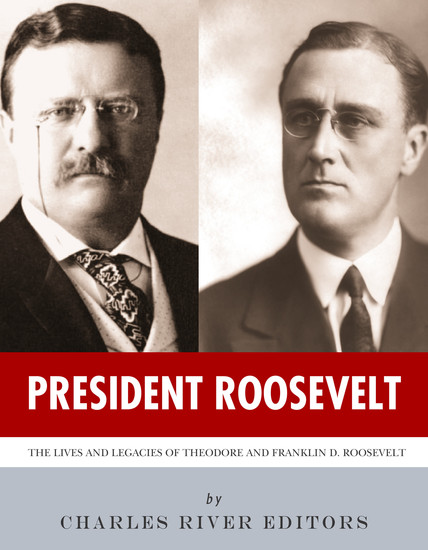
President Roosevelt - The Lives and Legacies of Theodore and Franklin D Roosevelt - cover

President Roosevelt - The Lives and Legacies of Theodore and Franklin D Roosevelt

Editors Charles River

Publisher: Charles River Editors

  • 0
  • 0
  • 0

Summary

For a man who grew up to become the “Bull Moose”, Theodore Roosevelt was a sickly child, suffering from asthma and other maladies. But his physical weakness actually drove him to be more active, which also fostered an interest in nature. It also helped that Teddy’s family was wealthy, allowing him privileges including home school and the ability to attend Harvard, where he was an athlete and took an interest in naval affairs. After finishing at Harvard, Teddy entered politics, but it didn’t stop him from writing The Naval War of 1812 in 1882, establishing himself as a professional writer and historian.
 
 In the 1890s, it was Teddy’s turn to make history, leading the Rough Riders during the Spanish-American War and being decorated for his service with a Medal of Honor. He parlayed his glory into the governorship of New York and then the Vice Presidency under William McKinley. When McKinley was assassinated in 1901, young Teddy was thrust into the presidency, one that would earn him a place on Mount Rushmore, Roosevelt’s “Square Deal” domestic policies favored average citizens while busting trusts and monopolies. Roosevelt also promoted conservation as an environmental stance, while his “speak softly and carry a big stick” foreign policy is still an oft used phrase today. Roosevelt even earned a Nobel Prize during his presidency. 
 
 By the time Roosevelt died in 1919, he was an American icon. Today, Teddy is remembered for being an explorer, hunter, author, soldier, president, and safari adventurer, all of which combine into one unique reputation.
 
Franklin Delano Roosevelt might be America’s greatest 20th century president, but there’s no question that he was the most unique. A well-connected relative of Theodore Roosevelt, FDR was groomed for greatness until he was struck down by what was widely believed to be polio at the time. Nevertheless, he persevered, rising through New York politics to reach the White House just as the country faced its greatest challenge since the Civil War, beginning his presidency with one of the most iconic lines ever spoken during an inaugural address.  
 
For over a decade, President Roosevelt threw everything he had at the Great Depression, and then threw everything the country had at the Axis powers during World War II. Ultimately, he succumbed to illness in the middle of his fourth term, just before the Allies won the war.
 
President Roosevelt covers all the well known highlights of Roosevelt’s life and presidency, but it also humanizes the nation’s longest serving president, covering Roosevelt’s family and famous wife, the philosophical shift Roosevelt led the country through with the New Deal, and the tenacious figher who battled illnesses and Adolf Hitler.
Available since: 05/05/2025.
Print length: 84 pages.

Other books that might interest you

  • Transcendentalism and the Cultivation of the Soul - cover

    Transcendentalism and the...

    Barry M. Andrews

    • 0
    • 0
    • 0
    A study of the spiritual practices developed by the nineteenth-century American Transcendentalist movement and a case for their necessity today. 


    "The stern old faiths have all pulverized," Ralph Waldo Emerson wrote in 1860. "'Tis a whole population of gentlemen and ladies out in search of religions." Often seen as a mainspring of the nineteenth-century literary tradition and the preserve of New England intellectuals in retreat from society, American Transcendentalism is more accurately described as a religious movement. In Transcendentalism and the Cultivation of the Soul, Barry M. Andrews shows how Transcendentalists developed rich spiritual practices, nurtured their souls, and discovered the divine. The practices they adopted are common and simple—among them, keeping journals, contemplation, walking, reading, simple living, and conversation. As Emerson, Thoreau, Fuller, and others pursued meaningful and rewarding spiritual lives, they were inspired to fight for abolition, women's rights, and education reform. In approachable and accessible prose, Andrews uncovers a wealth of spiritual practices that are of particular value for today's spiritual seekers and religious liberals.
    Show book
  • White Lies - cover

    White Lies

    Rudolph Bader

    • 0
    • 0
    • 0
    In Nazi Germany, young Manfred is hardly aware of the influence that draws him into the existing political system. After the War he changes his name and builds up a new career, starting a family, first in the States, later in Britain. While his friends and family have no idea of his activities during the War, his daughter Nora and his grandson Andrew, being interested in recent history, begin to suspect their (grand-) father’s dark secret.How far does moral responsibility go? Can really heavy guilt ever be expiated in Dostoyevsky’s sense or is there no hope for atonement by later generations? Is it ever too late to learn fundamental lessons from political developments?
    Show book
  • Pepper - A History of the World's Most Influential Spice - cover

    Pepper - A History of the...

    Marjorie Shaffer

    • 0
    • 0
    • 0
    “This is more than the story of a spice . . . Get ready for a sweeping ride through history.” ―David Oshinsky, Pulitzer Prize–winning authorThe perfect companion to Mark Kurlansky's Salt: A World History, Pepper illuminates the rich history of pepper for a popular audience. Vivid and entertaining, it describes the part pepper played in bringing the Europeans, and later the Americans, to Asia and details the fascinating encounters they had there. As Mark Pendergrast, author of Uncommon Grounds, said, “After reading Marjorie Shaffer's Pepper, you'll reconsider the significance of that grinder or shaker on your dining room table. The pursuit of this wizened berry with the bite changed history in ways you've never dreamed, involving extraordinary voyages, international trade, exotic locales, exploitation, brutality, disease, extinctions, and rebellions, and featuring a set of remarkable characters.”From the abundance of wildlife on the islands of the Indian Ocean, which the Europeans used as stepping stones to India and the East Indies, to colorful accounts of the sultan of Banda Aceh entertaining his European visitors with great banquets and elephant fights, this fascinating book reveals the often surprising story behind one of mankind's most common spices.“Using first-person accounts from journals and ships' logs, Shaffer crafts a textured story of exploration, danger, wealth and greed. Readers will find adventures on the high seas, pirates, ambitious Jesuits, sultans living in opulence and the plunder of what was once considered a ‘Garden of Eden’ . . . A vividly told story of a common spice’s uncommon history.” —Kirkus Reviews“A delightful history of the Indian Ocean and the South Seas.” ―Robert D. Kaplan, New York Times–bestselling author
    Show book
  • Ancient Egypt’s Most Important Cult Centers: The History of the Sacred Sites that Shaped Egyptian Mythology - cover

    Ancient Egypt’s Most Important...

    Charles River Editors

    • 0
    • 0
    • 0
    Perhaps the most intriguing aspect of ancient Egyptian civilization was its inception from the ground up, as the ancient Egyptians had no prior civilization which they could use as a template. In fact, ancient Egypt itself became a template for the civilizations that followed.  
    One of the primary reasons why modern scholars know so much about Egyptian history is due to many monuments found up and down the Nile. Although some of the tombs built on the west bank of the Nile River have suffered a fair amount of wind damage and all of the great monuments have endured the ravages of time, they are amazingly well-preserved, thanks both to Egypt’s arid climate and good workmanship. The Egyptian monument builders were truly a class above their contemporaries in terms of their trade, which was helped by the fact that they worked with the more permanent materials of sandstone and limestone, unlike Mesopotamian builders who were forced to primarily work with mud and brick.  
    In ancient Egypt, cities held political and religious significance, which meant that if the political or religious tides changed, so too could the fortunes of particular cities. Memphis is perhaps the best known of ancient Egypt’s cities because it was fortunate enough to be the political capital of the Egyptian state for most of its history. Hundreds of miles to Memphis’ south, Thebes became an important city during the Middle Kingdom and its stature grew during the New Kingdom when many of the pharaohs came from there and the national god, Amun, had its cult center in the city. Other cities, such as Tanis and Sais, were important for much shorter periods in Egyptian history. The city of Abju, which was known as Abydus to the Greeks, and later became known simply as “Abydos” had a history that was as long as Memphis’, and although its influence on pharaonic culture may not have been as apparent, it was no less profound.
    Show book
  • Hardy Women: Mother Sisters Wives Muses - cover

    Hardy Women: Mother Sisters...

    Paula Byrne

    • 0
    • 0
    • 0
    A Book of the Year in The Times, Guardian, Independent, New Statesman, Bookseller and at Waterstones 
    'He understands only the women he invents – the others not at all' 
    Thomas Hardy is one of the most beloved and most-read British authors. His influence on literature and the minds of his readers is singular. But how is it that the novelist who created some of the most memorable and modern female characters in literature had such troubled relationships with real women? 
    In this highly innovative book, acclaimed biographer Paula Byrne re-examines Hardy’s life through the eyes of the women who made him – mother, sisters, girlfriends, wives, muses. The story veers from shocking scenes such as his obsession with the sight of a woman hanged, to poignant vignettes of unfulfilled passion, to fascinating details of working women’s lives in the nineteenth century. 
    Hardy Women is the story of how the magnificent fictional women he invented would not have been possible without the hardship and hardiness of the real ones who shaped his passions and his imagination. It is only through understanding and witnessing these hardy women that we can truly enter the heart of this great novelist and poet. 
    Byrne, the Sunday Times bestselling author, delves into the social history of Britain, exploring the lives of the hardy women who shaped Hardy's life and work. She presents a literary criticism of Hardy's work, focusing on his portrayal of women, and how his real-life relationships influenced his writing. 
    For fans of Lucy Worsley (Jane Austen at Home), Anne De Courcy (Snowdon), Olivia Laing (The Lonely City), Colm Tóibín (A Guest at the Feast), and Devoney Looser (The Making of Jane Austen). 
    HarperCollins 2024
    Show book
  • Fascism - What It Is and How to Fight It - cover

    Fascism - What It Is and How to...

    Leon Trotsky

    • 0
    • 0
    • 0
    Fascism: What It Is and How to Fight It, written by Leon Trotsky in 1933, is a critical analysis of the rise of fascist movements in Europe, particularly focusing on Nazi Germany under Adolf Hitler. Trotsky argues that fascism is not a sudden, irrational outburst of violence but rather the result of deep structural crises in capitalist society, which the ruling class seeks to resolve through authoritarian means. He explains that fascism arises when the traditional political establishment is unable to suppress revolutionary movements from below (such as workers' uprisings or socialist revolutions) and when the capitalist system is threatened by economic collapse. 
    Trotsky highlights that fascism is a tool of the bourgeoisie, aimed at preserving the existing social order through terror, militarism, and the suppression of democratic freedoms. However, it is not simply a reactionary force; it has its own set of internal contradictions, as fascists simultaneously defend capitalist interests while attacking the political establishment and the working class. 
    Trotsky warns of the dangers of fascism's rise and stresses the importance of building a united front of the working class and the Left to prevent its spread. He critiques both Stalinism and social democracy for their failures to adequately respond to the fascist threat, emphasizing the need for a revolutionary approach to combat the fascist menace.
    Show book