Begleiten Sie uns auf eine literarische Weltreise!
Buch zum Bücherregal hinzufügen
Grey
Einen neuen Kommentar schreiben Default profile 50px
Grey
Jetzt das ganze Buch im Abo oder die ersten Seiten gratis lesen!
All characters reduced
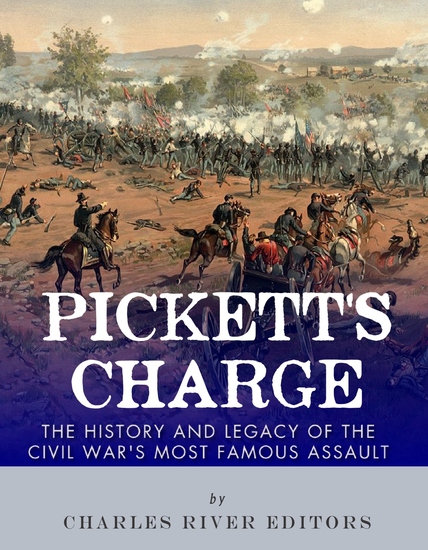
Pickett’s Charge - cover

Pickett’s Charge

Editors Charles River

Verlag: Charles River Editors

  • 0
  • 0
  • 0

Beschreibung

Despite the fact that the Civil War began over 150 years ago, it remains one of the most widely discussed topics in America today, with Americans arguing over its causes, reenacting its famous battles, and debating which general was better than others. Americans continue to be fascinated by the Civil War icons who made the difference between victory and defeat in the war's great battles.
 
The most famous attack of the Civil War was also one of its most fateful and fatal. Pickett’s Charge, the climactic assault on the final day of the Battle of Gettysburg, has become the American version of the Charge of the Light Brigade, and it is one of the most famous events of the entire Civil War.
 
Having been unable to break the Army of the Potomac’s lines on the left and right flank during Day 2 of the Battle of Gettysburg, Confederate Army of Northern Virginia commander Robert E. Lee decided to make a thrust at the center of the Union’s line with about 15,000 men spread out over three divisions. The charge required marching across an open field for about a mile, with the Union artillery holding high ground on all sides of the incoming Confederates.
 
Though it is now known as Pickett’s Charge, named after division commander George Pickett, the assignment for the charge was given to General James Longstreet, whose 1st Corps included Pickett’s division. Longstreet had serious misgivings about Lee’s plan and tried futilely to talk him out of it. Longstreet later wrote that he said to his commander, “General Lee, I have been a soldier all my life.  It is my opinion that no fifteen thousand men ever arrayed for battle can take that position.”
 
Aware of the insanity of sending 15,000 men hurtling into all the Union artillery, Lee planned to use the Confederate artillery to try to knock out the Union artillery ahead of time. Although old friend William Pendleton was the artillery chief, the artillery cannonade would be supervised by Edward Porter Alexander, Longstreet’s chief artillerist, who would have to give the go-ahead to the charging infantry because they were falling under Longstreet’s command. Alexander later noted that Longstreet was so disturbed and dejected about ordering the attack that at one point he tried to make Alexander order the infantry forward, essentially doing Longstreet’s dirty work for him.
 
Unfortunately for Porter Alexander and the Confederates, the sheer number of cannons belched so much smoke that they had trouble gauging how effective the shells were. As it turned out, most of the artillery was overshooting the target, landing in the rear of the Union line. Reluctant to order the charge, Longstreet commanded Porter Alexander to order the timing for the charge. As Longstreet and Alexander anticipated, the charge was an utter disaster, incurring a nearly 50% casualty rate and failing to break the Union line.
 
Pickett’s Charge: The History and Legacy of the Civil War’s Most Famous Assault profiles the history, context, and command decisions that all culminated in the most famous charge in American history. It also includes analysis of what went right and wrong, as well as what the major participants wrote about the charge. Along with maps and pictures of important people and places, you will learn about Pickett’s Charge like you never have before, in no time at all.
Verfügbar seit: 02.05.2025.
Drucklänge: 69 Seiten.

Weitere Bücher, die Sie mögen werden

  • Atomic Habits Evolved - The Neuroscience of Habit Loops and Proven Strategies to Break Bad Routines Build Positive Change and Master Your Daily Life - cover

    Atomic Habits Evolved - The...

    Dr. Aris Thorne

    • 0
    • 0
    • 0
    Unlock the science of lasting change and take control of your daily life with Atomic Habits, Evolved. 
    Dr. Aris Thorne delves into the fascinating neuroscience of habit loops, revealing how these neurological pathways dictate our routines. This groundbreaking book goes beyond simple tips, offering proven, science-backed strategies to break free from negative habits and build positive ones that stick. Imagine mastering your mornings, boosting your productivity, and achieving your goals, all by understanding the hidden power of your habits. 
    Perfect for readers of Atomic Habits and anyone seeking practical, neuroscience-based self-improvement, this book provides the roadmap to re-engineer your routines and master your daily life. 
     
    Zum Buch
  • BLEED - Destroying Myths and Misogyny in Endometriosis Care - cover

    BLEED - Destroying Myths and...

    Tracey Lindeman

    • 0
    • 0
    • 0
    “A brilliant, blistering read.” — Heather O’Neill, author of When We Lost Our Heads
    		 
    A scorching examination of how we treat endometriosis today 
    		 
    Have you ever been told that your pain is imaginary? That feeling better just takes yoga, CBD oil, and the blood of a unicorn on a full moon? That’s the reality of the more than 190 million people suffering the excruciating condition known as endometriosis. This disease affecting one in ten cis women and uncounted numbers of others is chronically overlooked, underfunded, and misunderstood — and improperly treated across the medical system. Discrimination and medical gaslighting are rife in endo care, often leaving patients worse off than when they arrived. 
    		 
    Journalist Tracey Lindeman knows it all too well. Decades of suffering from endometriosis propelled the creation of BLEED — part memoir, part investigative journalism, and all scathing indictment of how the medical system fails patients. Through extensive interviews and research, BLEED tracks the modern endo experience to the origins of medicine and how the system gained its power by marginalizing women. Using an intersectional lens, BLEED dives into how the system perpetuates misogyny, racism, classism, ageism, transphobia, fatphobia, and other prejudices to this day.
    		 
    BLEED isn’t a self-help book. It’s an evidence file and an eye-opening, enraging read. It will validate those who have been gaslit, mistreated, or ignored by medicine and spur readers to fight for nothing short of revolution.
    Zum Buch
  • Native Americans’ Forgotten Victories The: The History and Legacy of Early Battles Won by Indigenous Groups Before the Indian Wars - cover

    Native Americans’ Forgotten...

    Editors Charles River

    • 0
    • 0
    • 0
    Most Americans have heard of the Little Bighorn, the 1876 battle in which a band of Lakota Sioux and their allies wiped out most of the 7th U.S. Cavalry under the command of George Armstrong Custer. The movie images are of fierce warriors in long eagle feather headdresses flowing behind them as they gallop across the plains on nimble Indian ponies. In fact, many Americans know the names of the commanders who beat Custer, most notably Sitting Bull and Crazy Horse, and there are famous photographs of the stolid looking, copper-skinned Sitting Bull participating in Buffalo Bill’s “Wild West Show.” 
    	Children in schools also learn that there were more battles in the coming years as American settlers pushed west, and names like Geronimo are instantly famous after the U.S. Army’s tough fight with the Apache. A few may even have learned of the formidable Comanches in the Texas Panhandle, and maybe even events like the Fetterman Massacre or the fights at Adobe Wells. 
    	Today, far fewer people are familiar with the conflicts that took place east of the Mississippi before the Indian Wars of the late 19th century, fought in the forests and woodlands rather than on the prairies. The names of a few of the tribes involved are well known - the Cherokee, Iroquois and Seminole and Choctaw – while other formidable groups like the Yamasee, Miamis, Delaware, Powhatan, and Shawnee are less known. As whites pushed west from the East Coast, there were fights against the Abenaki, and during the French & Indian War, two regiments of Redcoats and colonial militia were decimated near what is now Pittsburgh. An alliance under Chief Pontiac threw the British and Americans out of the Great Lakes country for a time in the mid-18th century and had much to do with the fracture between colonies and the mother country. And tribal leaders like Blue Jacket and Little Turtle waged bitter wars in the Old Northwest, including inflicting the worst defeat ever of the U.S. Army.
    Zum Buch
  • Enquiry Concerning Human Understanding An - cover

    Enquiry Concerning Human...

    David Hume

    • 0
    • 0
    • 0
    David Hume's 'An Enquiry Concerning Human Understanding' explores the foundations of human knowledge. Written with philosophical precision, it challenges conventional thinking on causation, scepticism, and the limits of human understanding. Hume delves into the nature of belief, empiricism, and the intricacies of human cognition. A seminal work in epistemology, this inquiry invites readers to critically examine the basis of their beliefs, making it a timeless exploration of the human mind and the nature of knowledge. Read in English, unabridged.
    Zum Buch
  • Semicolon - The Past Present and Future of a Misunderstood Mark - cover

    Semicolon - The Past Present and...

    Anonym

    • 0
    • 0
    • 0
    A page-turning, existential romp through the life and times of the world’s most polarizing punctuation mark 
     
    The semicolon. Stephen King, Hemingway, Vonnegut, and Orwell detest it. Herman Melville, Henry James, and Rebecca Solnit love it. But why? When is it effective? Have we been misusing it? Should we even care? 
    In Semicolon, Cecelia Watson charts the rise and fall of this infamous punctuation mark, which for years was the trendiest one in the world of letters. But in the nineteenth century, as grammar books became all the rage, the rules of how we use language became both stricter and more confusing, with the semicolon a prime victim. Taking us on a breezy journey through a range of examples—from Milton’s manuscripts to Martin Luther King Jr.’s “Letters from Birmingham Jail” to Raymond Chandler’s The Big Sleep—Watson reveals how traditional grammar rules make us less successful at communicating with each other than we’d think. Even the most die-hard grammar fanatics would be better served by tossing the rule books and learning a better way to engage with language. 
    Through her rollicking biography of the semicolon, Watson writes a guide to grammar that explains why we don’t need guides at all, and refocuses our attention on the deepest, most primary value of language: true communication.
    Zum Buch
  • Basic Alchemical Meditation - How the Alchemists Meditated - cover

    Basic Alchemical Meditation -...

    Dennis William Hauck

    • 0
    • 0
    • 0
    This is a Basic Alchemical Meditation compounded from meditative techniques used by alchemists such as Paracelsus, Basil Valintine, and Jakob Boehme. There are three general steps in the full meditation that correspond to the three phases of alchemy. The first phase is the Nigredo (darkening, death, and putrefaction of the ego), which consists of two operations in which one attempts to Disengage Physically and Disengage Mentally from the world. The second phase is the Albedo (whitening and purification) in which one achieves original innocence or Zero-state Consciousness. The third phase is Rubedo (reddening or empowered integration into a new level of being) that is found in continued Meditation in the Pure Light. 
         Overall, the first two phases represent a progressive resurrection and purification of the light of consciousness to prepare for the transformative, one-pointed “Meditation in the Pure Light” phase. In that phase, alchemists feel they are working with the logoic light to transform reality in not only the inner lab or soul but also in the objective material reality of their “laboratory” or outer world. 
         Whether you are a novice meditator or experienced, the following instructions should be helpful in achieving Meditation in the Pure Light. But feel free to follow your own path in meditation or customize these steps to fit your regimen. The most important lesson is to grasp is the dual nature of our reality—the spiritual and material realms in which we exist. The bridge between those two realms can only be found in the Pure Light—in what Paracelsus called the “True Imagination.”
    Zum Buch