Junte-se a nós em uma viagem ao mundo dos livros!
Adicionar este livro à prateleira
Grey
Deixe um novo comentário Default profile 50px
Grey
Assine para ler o livro completo ou leia as primeiras páginas de graça!
All characters reduced
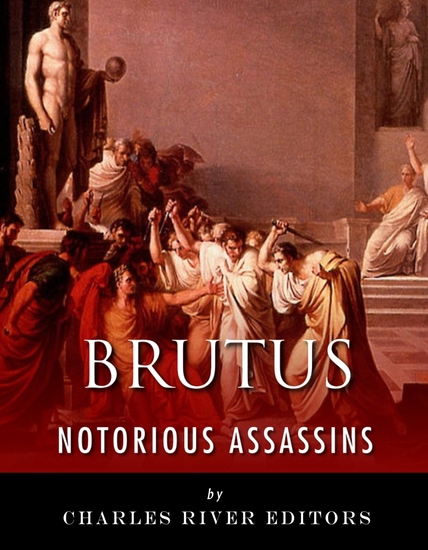
Notorious Assassins - The Life and Legacy of Marcus Brutus - cover
LER

Notorious Assassins - The Life and Legacy of Marcus Brutus

Editors Charles River

Editora: Charles River Editors

  • 0
  • 0
  • 0

Sinopse

“Sic semper tyrannis!” (“Thus, always, to tyrants!”) – attributed to Brutus
 
Throughout the annals of history, there have been few men as reviled as Marcus Junius Brutus the Younger. To this day, he is associated with murder, betrayal, violence and infamy, so much so that in modern English his name provides the root for the words “brute” and “brutal”, as it does in several other Romance languages. Indeed, Brutus’s reputation was so infamous that when Dante composed his timeless Divine Comedy, he relegated Brutus to the very nethermost depths of Hell. In the Inferno, Dante reaches the pit of the Ninth Circle of Hell, where he finds the Fallen Angel, Lucifer, himself. Lucifer is described as a giant, three-faced demon whose three mouths are perpetually gnashing upon three sinners, widely regarded as being the three most despicable individuals in history. According to Dante, the deepest circle of Hell is reserved for traitors, including Traitors against Kin, Traitors against Homeland, Traitors against Guests, and Traitors against Benefactors. The three men being devoured by Satan in Dante’s Inferno are Judas, the greatest traitor of all, and the two conspirators whose knives cut down Julius Caesar: Gaius Cassius Longinus and Brutus.
 
By Dante’s logic, Brutus had betrayed both his kin and benefactor, because Caesar had been as a father to him and always treated him with leniency and benevolence. Similarly, he also betrayed his homeland, because his actions helped bring about the downfall of the Republic. Since his appearance in the Inferno, Brutus has proven himself to be a resilient fictional character, naturally appearing as the main antagonist in Shakespeare’s Julius Caesar, as well as turning up in places as diverse as contemporary novels, the Asterix comic books, and video games. This is hardly surprising, since Brutus was said to be the orchestrator and main perpetrator of the plot against Caesar, and legend had it that it was Brutus himself who dealt the final blow that struck Caesar down. Shakespeare’s “Et tu, brute?” (“And you, Brutus?”) is widely recognized as one of the most iconic lines in theatre, further cementing Brutus’s lurid notoriety, although most of the chronicles dispute whether Caesar actually said anything at all as he died.
 
Brutus has been history’s most notorious assassin since the Ides of March in 44 B.C., but aside from his conspiracy, the rest of his life is often overlooked, especially his role in the subsequent civil war. In fact, forces loyal to Brutus and the other main conspirator, Cassius, fought one of the biggest battles in Roman history against Octavian and Antony, and it was one that they very nearly won. However, by the end of the decisive battle, Brutus and Cassius had lost, and Brutus had taken his own life. After Octavian rose to power by defeating Antony in yet another civil war, he was able to establish himself as Caesar Augustus, and the Republic that Brutus had hoped to save was truly finished.
 
Naturally, Augustus ensured that Brutus was universally despised during his reign, and Brutus’s negative reputation mostly persevered over the centuries. But in more modern times, Brutus has undergone something of a rehabilitation. As Western political thought shifted away from the Divine Right of Kings and towards democracy, Brutus began to be viewed in a far more sympathetic light. In Shakespeare’s Julius Caesar itself, Brutus is praised as the best of the conspirators, because his motives were described not as being for personal gain but a genuine desire to act for the good of the Republic, however misguided. Later, he became viewed as something of a populist hero, the man who had stood up in defense of a democratic government against a tyrant who wished to seize power for himself alone. Brutus achieved a particularly positive public portrayal in the fledgling United States.
Disponível desde: 02/05/2025.
Comprimento de impressão: 32 páginas.

Outros livros que poderiam interessá-lo

  • Plutarco Elías Calles and the Mexican Revolution - cover

    Plutarco Elías Calles and the...

    Jürgen Buchenau

    • 0
    • 0
    • 0
    This biography of the Mexican revolutionary examines his rise from soldier to president to his continued influence as Jefe Maximo. Hailing from the border state of Sonora, Plutarco Elías Calles found his calling in the early years of the revolution, quickly rising to national prominence. As president from 1924 to 1928, Calles undertook an ambitious reform program, modernized the financial system, and defended national sovereignty against an interventionist U.S. government. Yet these reforms failed to eradicate underdevelopment, corruption, and social injustice. Moreover, his unyielding campaigns against political enemies and the Catholic Church earned him a reputation as a repressive strongman. After his term as president, Calles continued to exert broad influence as his country's foremost political figure while three weaker presidents succeeded each other in an atmosphere of constant political crisis. He played a significant role in founding a ruling party that reined in power-hungry military leaders and helped workers attain better living conditions. This dynastic party and its successors, including the present-day Partido Revolucionario Institucional (Party of the Institutional Revolution), remained in power until 2000. Through this comprehensive assessment of a quintessential Mexican politician, Buchenau opens an illuminating window into both the Mexican Revolution and contemporary Mexico.
    Ver livro
  • East Asia - History of China and Japan - cover

    East Asia - History of China and...

    Kelly Mass

    • 0
    • 0
    • 0
    This book contains several titles, which are: 
    Shinto of Ancient Japan - The Shinto religion is a mystery to many. There is no real founder, there are many gods and deities that are worshipped, and something about spiritualism and spirits in nature that most people can’t quite put their finger on. 
    Ancient China - It’s hard to cover all of China’s vast history in a short book, but for the sake of leaving out details, we will still give it a try. In this guide, you will be able to learn more about the most important turning events, eras, dynasties, leaders, wars, and cultural aspects of ancient China. 
    Ninjas of Ancient Japan - The ancient Ninjas in Japan have fueled stories, movies, books and other media to go on and on about the sneaky assassins that terrorized their country. Today, you and I will go in-depth into this topic and find out more about the truth. 
    Samurai of Ancient Japan - What did the samurai in Japan do? How did they begin? And what was so typical or different about them? These and many other questions will be answered in this quick guide that will cover all the basics of the famous samurai warriors in ancient Japan. 
    Confucius - Confucius was a Chinese thinker and political leader who was considered as the apotheosis of Chinese sages. Confucius' theories and philosophy, commonly seen as one of the most essential and prominent individuals in human history, created the structure of East Asian civilization and civilization, and stay appropriate across China and East Asia today. 
    Chinese Mythology You've probably heard about Greek or Roman folklore, and even of Egyptian gods and goddesses, but have you heard about Chinese folklore? Let's explore this subject in quick, in this succinct book.
    Ver livro
  • How America Worksand Why It Doesn't - A Brief Guide to the US Political System - cover

    How America Worksand Why It...

    William Cooper

    • 0
    • 0
    • 0
    Twenty-first-century America isn’t working the way it’s supposed to. 
    This book explains why. 
    Americans in the twenty-first century are becoming increasingly untethered from both reality and the essential principles and traditions that have shaped the nation’s historic success. A big part of why America isn’t working is because far too many Americans neither know nor care how it’s supposed to work. 
    “William Cooper presents an insightful, sensitive, and accessible account of the trials that face American democracy in the twenty-first century. This fair- and broad-minded volume makes compelling reading for those who are looking to build a better democracy.” Alexander Yen, Department of Politics and International Relations, University of Oxford 
    “Partisanship fuels personal convictions more than ever in our society, and convictions fuel mysided thinking and other cognitive biases. At no time have we needed this discussion of bias and partisan thinking more than now.” Keith E. Stanovich, author of The Bias That Divides Us 
    “William Cooper logically and authoritatively takes you step by step through all the reasons a President Trump couldn’t imprison his enemies, pardon his friends, overrule judges, weaponize the Department of Justice, prosecute Joe Biden, or order the military to enforce his unconstitutional actions” Cleveland Plain Dealer 
    “William Cooper is an insightful and thought-provoking writer about US politics. He deserves to be widely read.” Thomas Plate, former Editorial Page Editor, Los Angeles Times 
    "In How America Works . . . and Why It Doesn’t, William Cooper gives a thoughtful, readable guide to what ails American democracy. Required reading for any student of political science.” Uri Kaufman, author of Eighteen Days in October 
    "A must-read. His well-written and brief book covers a lot of important ground in a learned but accessible manner. Probably most noteworthy, though, is his astute and fair judgment―the book is not a polemic for the left or the right, but rather a fair appraisal of the strengths and weaknesses of both. I highly recommend reading it―it is an enjoyable tour of key aspects of history (as well as current events), ethics, political philosophy, constitutional law, environmental science, and cognitive psychology―all told in a lucid, efficient way." William O'Donohue, PhD, Professor, University of Nevada, Reno
    Ver livro
  • The History of the Balkans Hungary and Romania - 3-in-1 Bundle - cover

    The History of the Balkans...

    Will Forrest

    • 0
    • 0
    • 0
    Explore the Intriguing History of the Balkans, Hungary, and Romania in This Comprehensive 3-In-1 Bundle! 
    This book will provide you with a deep understanding of the events, struggles, and triumphs that have shaped these captivating regions. Uncover the unique stories, cultural heritage, and influential figures that have left an indelible mark on their nations' pasts. 
    What You'll Discover:The Balkans: This region of southeastern Europe has a long and complex history, with influences from the ancient Greeks, Romans, and Ottomans. This book covers everything from the rise and fall of the Byzantine Empire to the modern-day challenges faced by the region.Hungary: As a country at the crossroads of Europe, Hungary has a fascinating history that spans from the Roman Empire to the modern-day. This book covers the country's medieval kingdoms, the Ottoman occupation, and the struggle for democracy in the 20th century.Romania: With its rich mix of cultures and traditions, Romania has a unique history that reflects its position at the crossroads of Eastern and Western Europe. This book explores the country's remarkable achievements and struggles. 
      
    Be amazed by the wealth of information and insights provided, ensuring a deep understanding of these regions and their histories. 
    Don't miss this opportunity to explore the enchanting world of the Balkans, Hungary, and Romania. Immerse yourself in the captivating stories, struggles, and triumphs that have forever changed the course of history in these fascinating regions. 
    Order your copy today and embark on a journey through time to discover the stories of these remarkable countries.
    Ver livro
  • The First Atomic Bomb - The Trinity Site in New Mexico - cover

    The First Atomic Bomb - The...

    Janet Farrell Brodie

    • 0
    • 0
    • 0
    On July 16, 1945, just weeks before the atomic bombing of Hiroshima and Nagasaki that brought about the surrender of Japan and the end of WWII, the US unleashed the world's first atomic bomb at the Trinity testing site located in the remote Tularosa Valley in New Mexico. 


    In The First Atomic Bomb Janet Farrell Brodie explores the history of the Trinity test and those whose contributions have rarely been discussed—the men and women who constructed, served, and witnessed the first test—as well as the downwinders who suffered the consequences of radiation. Concentrating on these ordinary people, laborers, ranchers, and Indigenous peoples who lived in the region and participated in the testing, Brodie corrects the lack of coverage in existing scholarship on the essential details and everyday experiences of this globally significant event. This book also covers the environmental preservation of the Trinity test site and compares it with the wide range of atomic sites now preserved independently or as part of the new Manhattan Project National Historical Park. Although the Trinity site became a significant node for testing the new weapons of the postwar US, it is known today as an officially designated National Historic Landmark. Brodie presents a timely, important, and innovative study of an explosion that carries special historical weight in American memory.
    Ver livro
  • Agency and Cognitive Development - cover

    Agency and Cognitive Development

    Michael Tomasello

    • 0
    • 0
    • 0
    Children of different ages live in different worlds. This is partly due to learning: as children learn more and more about the world they experience it in different ways. But learning cannot be the whole story or else children could learn anything at any age—which they cannot. 


    Michael Tomasello argues that children of different ages live and learn in different worlds because their capacities to cognitively represent and operate on their experience change in significant ways over the first years of life. These capacities change because they are elements in a maturing cognitive architecture evolved for agentive decision making and action, including in shared agencies in which individuals must mentally coordinate with others. The developmental proposal is that from birth infants are goal-directed agents who cognitively represent and learn about actualities; at 9-12 months toddlers become intentional (and joint) agents who also imaginatively and perspectively represent and learn about possibilities; and at 3-4 years children become metacognitive (and collective) agents who also metacognitively represent and learn about objective/normative necessities. These developing agentive architectures—originally evolved in humans' evolutionary ancestors for particular types of decision making and action—help to explain why children learn what they do when they do.
    Ver livro