Rejoignez-nous pour un voyage dans le monde des livres!
Ajouter ce livre à l'électronique
Grey
Ecrivez un nouveau commentaire Default profile 50px
Grey
Abonnez-vous pour lire le livre complet ou lisez les premières pages gratuitement!
All characters reduced
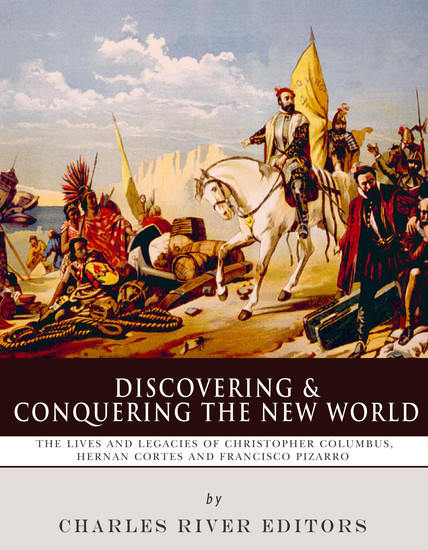
Discovering and Conquering the New World - The Lives and Legacies of Christopher Columbus Hernán Cortés and Francisco Pizarro - cover

Discovering and Conquering the New World - The Lives and Legacies of Christopher Columbus Hernán Cortés and Francisco Pizarro

Editors Charles River

Maison d'édition: Charles River Editors

  • 0
  • 0
  • 0

Synopsis

The most seminal event of the last millennium might also be its most controversial. As schoolchildren have been taught for over 500 years, “In 1492 Columbus sailed the ocean blue.” In October of that year, the Italian Christopher Columbus immortalized himself by landing in the New World and beginning the process of European settlement in the Americas for Spain, bringing the Age of Exploration to a new hemisphere with him. Ironically, the Italian had led a Spanish expedition, in part because the Portugese rejected his offers in the belief that sailing west to Asia would take too long.
 
Columbus had better luck with the Spanish royalty, successfully persuading Queen Isabella to commission his expedition. In August 1492, Columbus set west for India at the helm of the Nina, Pinta and Santa Maria. Befitting a legendary trip, the journey was star-crossed from the beginning. The Pinta’s rudder broke early on, and just days into the journey Columbus’ compass stopped pointing due north and started pointing to the Earth’s magnetic north pole, something the Europeans knew nothing about. Columbus knew that the uncertainty of the expedition’s destination made his crew nervous, so he hid his compass’ “malfunction” from his crew.  Additionally, after 30 days of sailing, the expedition still had not sighted land, so Columbus started lying to his crew about the distance they sailed each day, telling them they had sailed fewer miles than they actually had so as not to scare them even more. 
 
On October 7, 1492, the three ships spotted flocks of birds, suggesting land was nearby, so Columbus followed the direction in which the birds flew. On the night of October 11, the expedition sighted land, and when Columbus came ashore the following day in the Bahamas, he thought he was in Japan, but the natives he came into contact with belied the descriptions of the people and lands of Asia as wealthy and resourceful. Instead, the bewildered Columbus would note in his journal that the natives painted their bodies, wore no clothes and had primitive weapons, leading him to the conclusion they would be easily converted to Catholicism. When he set sail for home in January 1493, he brought several imprisoned natives back to Spain with him.
 
During the Age of Exploration, some of the most famous and infamous individuals were Spain’s best known conquistadors. Naturally, as the best known conquistador, Hernán Cortés (1485-1547) is also the most controversial. Like Christopher Columbus before him, Cortés was lionized for his successes for centuries without questioning his tactics or motives, while indigenous views of the man have been overwhelmingly negative for the consequences his conquests had on the Aztecs and other natives in the region. Just about the only thing everyone agrees upon is that Cortés had a profound impact on the history of North America.
 
If Columbus and Cortés were the pioneers of Spain’s new global empire, Pizarro consolidated its immense power and riches, and his successes inspired a further generation to expand Spain’s dominions to unheard of dimensions.  Furthermore, he participated in the forging of a new culture: like Cortés, he took an indigenous mistress with whom he had two mixed-race children, and yet the woman has none of the lasting fame of Cortés’s Doña Marina.  With all of this in mind, it is again remarkable that Pizarro remains one of the less well-known and less written about of the explorers of his age.
 
On the other hand, there are certain factors that may account for the conqueror of Peru’s relative lack of lasting glory.  For one, he was a latecomer in more than one sense.  Cortés’s reputation was built on being the first to overthrow a great empire, so Pizarro’s similar feat, even if it bore even greater fruit in the long run, would always be overshadowed by his predecessor’s precedent. 
Disponible depuis: 20/06/2025.
Longueur d'impression: 110 pages.

D'autres livres qui pourraient vous intéresser

  • The Sociology of Education - How Schools and Education Systems Influence Society - cover

    The Sociology of Education - How...

    Fred Grandsen

    • 0
    • 0
    • 0
    Education is more than just a means of acquiring knowledge; it is a fundamental institution that shapes societies, influences social structures, and reinforces cultural norms. From a sociological perspective, education is not only about individual development but also about the reproduction of societal values, the maintenance of social order, and the facilitation of social mobility. By analyzing education through a sociological lens, we can better understand its role in shaping human interactions, economic opportunities, and power dynamics within a society. 
    Sociologists view education as both a social institution and a socializing agent. It transmits knowledge, skills, and values that prepare individuals to participate in society. However, education is not a neutral entity. The way it is structured, the content it delivers, and the access it provides can reinforce existing inequalities or serve as a tool for social change. Theories within the sociology of education, such as functionalism, conflict theory, and symbolic interactionism, offer different perspectives on how education operates in society. 
    Functionalists argue that education serves a critical role in maintaining social cohesion. It provides individuals with the necessary knowledge and skills to contribute to the economy while also instilling shared values that create a sense of unity. From this perspective, schools function as meritocratic institutions, rewarding effort and ability regardless of social background. However, critics argue that this perspective overlooks the ways in which education can reproduce social inequalities.
    Voir livre
  • Unraveling the Secrets to Nations' Success and Collapse - "Unlock the secrets of nations' rise and fall with immersive audio lessons for your listening pleasure!" - cover

    Unraveling the Secrets to...

    Cyrus Treadway

    • 0
    • 0
    • 0
    Unraveling the Secrets to Nations' Success and Collapse 
    ⭐⭐ Simplified Guide & Explanations Included ⭐⭐ 
    Are you eager to enhance your career while mastering the knowledge needed to understand how nations thrive and fail? 
    Looking for an all-encompassing resource that covers everything you need to grasp the intricacies of successful societies and the pitfalls that lead to their downfall? 
    Your quest ends here! 
    This guide acts as your ultimate resource for diving deep into the principles of prosperous nations, honing your analytical skills, and engaging with practical exercises. With this guide in hand, you're set for success. 
    Updated for the 2024-2025 framework of success and collapse analysis. 
    Key features of this enriched guide: 
    - In-depth insights regarding the foundations of thriving societies and the factors contributing to their failures. 
    - Comprehensive explanations of the underlying concepts related to societal success and collapse. 
    - Effective strategies for analyzing and preparing for discussions on these crucial topics. 
    Our guide stands out through its thorough exploration, which is vital for your understanding and analysis of civilizational dynamics. Concepts are explored in detail, ensuring clarity and depth. 
    Crafted with a logical structure and accessible language, our guide to understanding the secrets of nations ensures smooth transitions throughout the material. Say goodbye to complicated jargon and embrace clear, precise, and technically sound content. 
    So, why delay? Click the BUY NOW button, secure your guide, and embark on your journey to mastering the secrets of nations' success and collapse!
    Voir livre
  • Dark Psychology - Mind-Control Body Language and Persuasion Techniques - cover

    Dark Psychology - Mind-Control...

    Valerie Glossner

    • 0
    • 0
    • 0
    Abuse. It’s wrong. It’s terrible no matter what form it takes. When most of you hear the word abuse you think of one of the physical kinds of abuse. For others, they think of a different kind of abuse, verbal, emotional, psychological, and mental; there are others, but this book focuses on verbal abuse. This book will help you to know what some of the signs of verbal abuse are, so that you may help keep your friends and family safe. Listen to why people, men and women, abuse each other. 
    Discover what influence verbal abuse has on a person’s life, and how to help them. 
    Sociopath and psychopath, words that describe someone no one would knowingly choose to be around, but do we really understand what the difference is, and what they mean? This book will teach you the difference, and how to identify a true sociopath or psychopath. Hear about the different ways they manipulate people, learn of the power of persuasion. Find out how to be careful with crazed children and how to properly handle the situation. 
    Within this book, you will also hear about the mental disorder of paranoia and an explanation of The Barnum Effect.
    Voir livre
  • Gender History - A Very Short Introduction - cover

    Gender History - A Very Short...

    Antoinette Burton

    • 0
    • 0
    • 0
    This volume introduces the field of gender history—its origins, development, reception, recalibrations, and frictions. It offers a set of working definitions of gender as a descriptive category and as a category of historical analysis, tracing the emergence, usage, and applicability of these entwined subjects. 


    Inevitably political, gender history has taken aim at the broader field of historical narrative by asking who counts as a historical subject, what difference gender makes, and how attention to it subverts reigning assumptions of what power, culture, economics, and identity have been in the past—and what they are today. The book explores how gender analysis has changed interpretations of the histories of slavery, capitalism, migration, and empire. 


    As a field, gender history has been extraordinarily influential in shaping several generations of scholars and students. And, as part of the movement toward gender equality that is key to modern western progress, gender history has been caught up in the culture wars that continue to shape post-global society. The practice of gender history has always run up against the forces of race, class, and sexuality that challenge the singularity of gender itself as an explanatory category of historical analysis. That powerful, unruly tension is at the heart of this Very Short Introduction.
    Voir livre
  • The Urban Poor - Socioeconomic Challenges and Solutions - cover

    The Urban Poor - Socioeconomic...

    Lyric Vale

    • 0
    • 0
    • 0
    Urban poverty has emerged as one of the most pressing social and economic issues of the modern world. As the global population increasingly shifts toward urban centers, the face of poverty is no longer limited to rural areas. Cities, which were once seen as hubs of opportunity, now grapple with growing disparities between the rich and the poor. The urban poor live in environments that offer limited access to basic services such as housing, healthcare, education, and employment opportunities, making it difficult for them to escape the cycle of poverty. 
    The rapid pace of urbanization, especially in developing countries, has led to the creation of sprawling slums and informal settlements where millions of people struggle to survive. These areas are often characterized by overcrowded living conditions, inadequate infrastructure, and limited access to clean water and sanitation. As cities expand, they fail to provide adequate housing for their increasing populations, and the urban poor are forced to live in substandard conditions with few opportunities for upward mobility. 
    Urban poverty is not just about a lack of income; it is about a lack of access to the resources and services that are essential for a decent quality of life. The urban poor are often marginalized and excluded from the formal economy, finding themselves in low-wage, insecure jobs or relying on informal employment. This lack of stable income exacerbates their poverty and limits their ability to meet basic needs such as food, healthcare, and education.
    Voir livre
  • Sophocles - A Very Short Introduction - cover

    Sophocles - A Very Short...

    Edith Hall

    • 0
    • 0
    • 0
    This Very Short Introduction introduces the life, work, and influence of one of the greatest dramatists of all time, Sophocles the Athenian. 


    Placing his plays within their historical context, and explaining the conventions of ancient Greek tragic theatre, Edith Hall spotlights their distinctive features—tight plots, titanic personalities, lucid style, sympathetic women, exquisite poetry, and stagecraft. This analysis is followed by an account of how and why Sophoclean dramas have survived to be read and widely performed into the twenty-first century.
    Voir livre