Begleiten Sie uns auf eine literarische Weltreise!
Buch zum Bücherregal hinzufügen
Grey
Einen neuen Kommentar schreiben Default profile 50px
Grey
Jetzt das ganze Buch im Abo oder die ersten Seiten gratis lesen!
All characters reduced
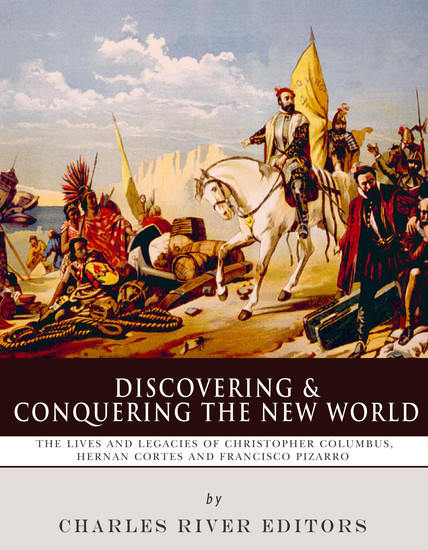
Discovering and Conquering the New World - The Lives and Legacies of Christopher Columbus Hernán Cortés and Francisco Pizarro - cover

Discovering and Conquering the New World - The Lives and Legacies of Christopher Columbus Hernán Cortés and Francisco Pizarro

Editors Charles River

Verlag: Charles River Editors

  • 0
  • 0
  • 0

Beschreibung

The most seminal event of the last millennium might also be its most controversial. As schoolchildren have been taught for over 500 years, “In 1492 Columbus sailed the ocean blue.” In October of that year, the Italian Christopher Columbus immortalized himself by landing in the New World and beginning the process of European settlement in the Americas for Spain, bringing the Age of Exploration to a new hemisphere with him. Ironically, the Italian had led a Spanish expedition, in part because the Portugese rejected his offers in the belief that sailing west to Asia would take too long.
 
Columbus had better luck with the Spanish royalty, successfully persuading Queen Isabella to commission his expedition. In August 1492, Columbus set west for India at the helm of the Nina, Pinta and Santa Maria. Befitting a legendary trip, the journey was star-crossed from the beginning. The Pinta’s rudder broke early on, and just days into the journey Columbus’ compass stopped pointing due north and started pointing to the Earth’s magnetic north pole, something the Europeans knew nothing about. Columbus knew that the uncertainty of the expedition’s destination made his crew nervous, so he hid his compass’ “malfunction” from his crew.  Additionally, after 30 days of sailing, the expedition still had not sighted land, so Columbus started lying to his crew about the distance they sailed each day, telling them they had sailed fewer miles than they actually had so as not to scare them even more. 
 
On October 7, 1492, the three ships spotted flocks of birds, suggesting land was nearby, so Columbus followed the direction in which the birds flew. On the night of October 11, the expedition sighted land, and when Columbus came ashore the following day in the Bahamas, he thought he was in Japan, but the natives he came into contact with belied the descriptions of the people and lands of Asia as wealthy and resourceful. Instead, the bewildered Columbus would note in his journal that the natives painted their bodies, wore no clothes and had primitive weapons, leading him to the conclusion they would be easily converted to Catholicism. When he set sail for home in January 1493, he brought several imprisoned natives back to Spain with him.
 
During the Age of Exploration, some of the most famous and infamous individuals were Spain’s best known conquistadors. Naturally, as the best known conquistador, Hernán Cortés (1485-1547) is also the most controversial. Like Christopher Columbus before him, Cortés was lionized for his successes for centuries without questioning his tactics or motives, while indigenous views of the man have been overwhelmingly negative for the consequences his conquests had on the Aztecs and other natives in the region. Just about the only thing everyone agrees upon is that Cortés had a profound impact on the history of North America.
 
If Columbus and Cortés were the pioneers of Spain’s new global empire, Pizarro consolidated its immense power and riches, and his successes inspired a further generation to expand Spain’s dominions to unheard of dimensions.  Furthermore, he participated in the forging of a new culture: like Cortés, he took an indigenous mistress with whom he had two mixed-race children, and yet the woman has none of the lasting fame of Cortés’s Doña Marina.  With all of this in mind, it is again remarkable that Pizarro remains one of the less well-known and less written about of the explorers of his age.
 
On the other hand, there are certain factors that may account for the conqueror of Peru’s relative lack of lasting glory.  For one, he was a latecomer in more than one sense.  Cortés’s reputation was built on being the first to overthrow a great empire, so Pizarro’s similar feat, even if it bore even greater fruit in the long run, would always be overshadowed by his predecessor’s precedent. 
Verfügbar seit: 20.06.2025.
Drucklänge: 110 Seiten.

Weitere Bücher, die Sie mögen werden

  • Her Lover - From their pens to your ears genius in every story - cover

    Her Lover - From their pens to...

    Maxim Gorky

    • 0
    • 0
    • 0
    Alexei Maximovich Peshkov was born on 28th March 1868, in Nizhny Novgorod, Russia. 
    Better known as Maxim Gorky he was orphaned at 11 and ran away from home at 12.  At 19 he had already attempted suicide and thereafter travelled, by foot, across the Russian Empire for 5 years. 
    His first book ‘Essays & Stories’ in 1898 was a sensation and so began a long career as an author of short stories, novels and plays.  Gorky saw writing as a moral and political act that would help to change the unjust world around him.  He was an ardent early advocate of the emerging Marxist movement and publicly opposed the Tsarist regime leading several times to his arrest.  
    In 1904 he began his own theatre but the censor banned every play and Gorky was forced to abandon the project. 
    But Gorky was a financially successful author, editor, and playwright and gave monies to political parties as well as for civil rights and social reform.  The brutal shooting of workers, which set in motion the Revolution of 1905, pushed Gorky more decisively toward radical solutions.  
    In 1906 he went to the United States to raise funds for the Bolsheviks. Those experiences including a scandal over travelling with his lover and not his wife deepened his contempt for the ‘bourgeois soul.’ 
    Gorky now moved to Capri in Italy, both for health reasons and to escape the increasingly repressive times in Russia.  
    An amnesty for the 300th anniversary of the Romanov dynasty saw him return to Russia in 1914. His politics remained close to the Bolshevik cause.  But soon, after the 1918 revolution, his essays referred to Lenin as a tyrant for his senseless arrests and repression.  He was soon appealing to the outside world for food aid after the catastrophic crop failure. 
    In October 1921 Gorky returned to Italy, now in Fascist hands, and settled in Sorrento until 1932.  His health worsened with the onset of tuberculosis. 
    He wrote several successful books there but now decided to find an understanding with the communist regime. Stalin invited him home and his return was hailed as a major propaganda victory.  He was decorated with the Order of Lenin, and a province, a park, and various streets re-named in his honour. 
    But he had his faults too.  In 1933, Gorky co-edited a book on the White Sea-Baltic Canal and denied even a single prisoner died during its construction, but thousands had. As well, knowing that some Nazis were homosexual, a phrase was attributed to him that said ‘exterminate all homosexuals and fascism will vanish’.  Although he was himself was quoting another he was decidedly homophobic. 
    With the increase of Stalinist repression in 1935 Gorky was placed under unannounced house arrest. 
    Maxim Gorky died on the 18th June 1936 from pneumonia.  He was 68. 
    Stalin and Molotov were among those who carried Gorky's urn of ashes at his funeral.
    Zum Buch
  • Fly Fishing Small Streams - cover

    Fly Fishing Small Streams

    John Gierach

    • 0
    • 0
    • 0
    Small-stream fishing wisdom with the same insight and pungent humor that has become Gierach's trademark. Advice on tackle selecting, reading water, and scouting.
    Zum Buch
  • Lest We Forget - A Doctor’s Experience with Life and Death During the Ebola Outbreak - cover

    Lest We Forget - A Doctor’s...

    Kwan Kew Lai

    • 0
    • 0
    • 0
    In 2014 after fighting through yards of bureaucratic red tape, leaving her family, and putting her own health at risk in order to help suffering strangers, Kwan Kew Lai finally arrived in Africa to volunteer as an infectious disease specialist in the heart of the largest Ebola outbreak in history. What she found was not only blistering heat, inhospitable working conditions, and deadly, unrelenting illness, but hope, resilience, and incredible courage. 


    Lest We Forget chronicles the harrowing and inspiring time spent serving on the front lines of the ongoing Ebola outbreak—the complicated Personal Protective Equipment, the chlorine-scented air, the tropical heat, and the heartbreaking difficulties of treating patients she could not touch. Dr. Lai interweaves original diary entries to create a gripping narrative about life, death, and human relationships that will leave no listener unmoved. 


    Lest We Forget exposes the raw brutality of Ebola, as well as the chaotic nature of the undersupplied and understaffed health infrastructure in the developing world. At once a memoir of triumphs and failures and a memorial, this book will ensure that the victims of Ebola and the fighters who sought to heal them will not be forgotten.
    Zum Buch
  • Death by Talons - Did An Owl 'Murder' Kathleen Peterson? - cover

    Death by Talons - Did An Owl...

    Tiddy Smith

    • 0
    • 0
    • 0
    A re-examination of the infamous 2001 North Carolina “Staircase murder” through the outrageous theory that an owl was the killer—and not Michael Peterson. 
     
    On December 9, 2001, Kathleen Peterson was found dead at the bottom of a staircase in her Durham, North Carolina, home. Her scalp was laced with deep incisions, and her blood was strewn from outside to inside the house. 
     
    The sinister truth of that night turned her murder into North Carolina’s most enigmatic criminal case, capturing media attention across the globe. 
     
    Police zeroed in on Kathleen’s husband, Michael Peterson, and charged him with murder. But was it the truth? 
     
    A neighbor, Larry Pollard, came up with an alternative “killer.” He claimed an owl attacked Kathleen outside her house. He said it sliced her scalp with its fierce talons and caused her to run inside, collapsing at the stairwell, and bleeding to death. 
     
    When the media heard about his theory, Larry was mocked. And Michael was convicted. Now, twenty years later, author Tiddy Smith explores Pollard’s theory and questions whether law enforcement ignored, or even hid, evidence to convict Michael Peterson. And was an owl, in fact, the real killer? In Death by Talons, Tiddy Smith gives insight into the “Staircase” and the conspiracy behind the Michael Peterson trial.
    Zum Buch
  • Chivalry - From their pens to your ears genius in every story - cover

    Chivalry - From their pens to...

    Ricardo Fernandez Garcia

    • 0
    • 0
    • 0
    The bookshelves of World literature are incredible collections that have gathered together centuries of very talented authors.  From their countries and continents their fame spread and whilst among their number many are now forgotten or neglected their talents endure.  Among them is Ricardo Fernandez Garcia.
    Zum Buch
  • Lowside Of The Road - A Life of Tom Waits - cover

    Lowside Of The Road - A Life of...

    Barney Hoskyns

    • 0
    • 0
    • 0
    With a career spanning over fifty years, Tom Waits remains one of rock’s great enigmas; a chameleon-like survivor who, like Bob Dylan and Neil Young, has achieved long-term success while retaining cult credibility and outsider mystique.  Lowside of the Road, by Barney Hoskyns, offers a unique, affectionate and penetrating portrait of Waits spanning from Closing Time to Orphans, and beyond.  Based on extensive research and deep critical insight, Hoskyns' definitive account of Waits' life and work is an outstanding exploration of this notoriously private artist and performer.
    Zum Buch