Join us on a literary world trip!
Add this book to bookshelf
Grey
Write a new comment Default profile 50px
Grey
Subscribe to read the full book or read the first pages for free!
All characters reduced
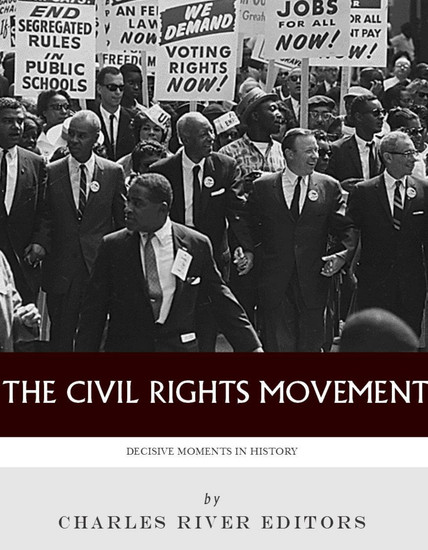
Decisive Moments in History - The Civil Rights Movement - cover

Decisive Moments in History - The Civil Rights Movement

Editors Charles River

Publisher: Charles River Editors

  • 0
  • 0
  • 0

Summary

“Find out just what any people will quietly submit to and you have the exact measure of the injustice and wrong which will be imposed on them.” – Frederick Douglass
 
"Our objective is complete freedom, justice and equality by any means necessary." – Malcolm X
 
“I've seen the Promised Land.  I may not get there with you.  But I want you to know tonight, that we, as a people, will get to the Promised Land.” – Dr. Martin Luther King Jr.
 
In the 19th century, the Scottish writer Thomas Carlyle famously wrote, "The history of the world is but the biography of great men", popularizing the “Great Man” theory that the course of history is shaped by a select few heroic individuals. While historians and others continue to debate the accuracy of the Great Man theory of history, there is no question that the course of history is permanently altered by decisive moments in time, where a different result would have produced drastically different outcomes. Charles River Editors’ Decisive Moments in History examines the events that changed history forever and set the world down the path it finds itself on today.
 
When famous political philosopher Alexis de Tocqueville toured the new United States of America, he was impressed by the representative government set up by the Founders. At the same time, he ominously predicted, “If there ever are great revolutions there, they will be caused by the presence of the blacks upon American soil. That is to say, it will not be the equality of social conditions but rather their inequality which may give rise thereto.” 
 
De Tocqueville was prescient, because the longest battle fought in the history of the United States has been the Civil Rights Movement. The framers of the Constitution kicked the problem down the road, over half a million died during the Civil War to end slavery, and then many more fought and died to dismantle segregation and legalized racism in the 100 years after.


Today every American is taught about watershed moments in the history of minorities’ struggles for civil rights over the course of American history: the Civil War, Brown v. Board of Education, Rosa Parks’ refusal to give up her seat, Dr. Martin Luther King Jr.’s “I Have a Dream” speech, and the passage of the Civil Rights Act of 1964. Indeed, the use of the phrase “Civil Rights Movement” in America today almost invariably refers to the period of time from 1954-1964.
 
However, the American Civil Rights Movement actually came into existence long before it is presumed to have done so. The Movement's primary work was slow, evolving, gradual and long-term. Its more glamorous moments, such as the Montgomery Bus Boycott (1955–1956), the Selma to Montgomery March (1965), and the March on Washington (1963), mainly were supplemental to the all-important grassroots work already going on in communities, churches, legislatures and courts. The nascent stages of the Movement actually began far earlier, among abolitionists and the the writings and activism of Frederick Douglass and others.
 
The Civil Rights Movement also included counternarratives led by activists like Malcolm X, who pointed out that Brown v. Board may have demanded integration, but it did not implement it. Insisting that politely asking the government for civil rights was futile, Malcolm X represented the face of the civil rights movement that demanded stronger words and action than nonviolent protest.  
 
Decisive Moments in History: The Civil Rights Movement comprehensively covers the struggle for civil rights in the United States, remembering its most famous and memorable events but also highlighting its lesser known ups and downs on the path to equality. Along with pictures of the important people, places, and events, you will learn about the Civil Rights Movement like you never have before, in no time at all.  
Available since: 05/05/2025.
Print length: 50 pages.

Other books that might interest you

  • The Forgotten Slave Trade - The White European Slaves of Islam - cover

    The Forgotten Slave Trade - The...

    Simon Webb

    • 0
    • 0
    • 0
    Everybody knows about the transatlantic slave trade. A century before Britain became involved in this terrible business, whole villages and towns in England, Ireland, Italy, Spain, and other European countries were being depopulated by slavers, who transported the men, women, and children to Africa where they were sold. This is the forgotten slave trade; one which saw over a million Christians forced into captivity in the Muslim world. 


    Starting with the practice of slavery in the ancient world, Simon Webb traces the history of slavery in Europe, showing that the numbers involved were vast and that the victims were often treated far more cruelly than black slaves in America and the Caribbean. Castration, used very occasionally against black slaves taken across the Atlantic, was routinely carried out on an industrial scale on European boys who were exported to Africa and the Middle East. Most people are aware that the English city of Bristol was a major center for the transatlantic slave trade in the eighteenth century, but hardly anyone knows that 1,000 years earlier it had been an important staging-post for the transfer of English slaves to Africa. 


    This book will forever change how you view the slave trade and show that many commonly held beliefs about this controversial subject are almost wholly inaccurate and mistaken.
    Show book
  • On the Origin of Species - cover

    On the Origin of Species

    Charles Darwin

    • 0
    • 0
    • 0
    What if the greatest mystery on Earth—life itself—could be explained by a single, transformative idea?
    In On the Origin of Species, Charles Darwin unveils the revolutionary theory of evolution by natural selection, forever changing how we understand nature, biology, and humanity's place in the world. With clear logic, remarkable observations, and elegant scientific reasoning, Darwin reveals how countless species evolved over time—not by miracle, but by adaptation, struggle, and survival.
    
    Celebrated as "one of the most important books ever written," this work remains essential for anyone curious about science, history, or the story of life. Its impact reaches far beyond biology, influencing philosophy, culture, and modern thought for more than 150 years.
    
    If you crave deep insight, clear scientific storytelling, and a book that reshaped the world, this masterpiece belongs on your shelf.
    
    Open the pages—and witness the moment science stepped into a new era.
    Show book
  • 7 Steps to Mental Toughness - Train Your Mind Conquer Adversity and Stay Focused - cover

    7 Steps to Mental Toughness -...

    Joseph Marc Lalonde

    • 0
    • 0
    • 0
    What if mental toughness was the key to handling anything life throws at you?
     
    Life will test you—unexpected challenges, setbacks, pressure. Most people crumble. They let fear, doubt, and adversity break them. But the mentally tough? They thrive under pressure, push past pain, and keep moving forward when others quit.
     
    The truth? Mental toughness isn’t something you’re born with. It’s something you build.
     
    In 7 Steps to Mental Toughness, entrepreneur and strategist Joseph Marc Lalonde reveals a battle-tested framework to develop resilience, discipline, and focus so you can dominate any challenge.
     
    This isn’t theory—it’s a step-by-step system to forge an unbreakable mind:
    
     
    Master Your Inner Dialogue – Eliminate self-doubt and rewire negative thoughts.
    
     
    Control Emotions Under Pressure – Stay calm when chaos hits.
    
     
    Turn Pain into Power – Transform adversity into fuel for growth.
    
     
    Build Unstoppable Discipline – Create habits that make toughness automatic.
    
     
    Train for High-Stress Situations – Thrive when others break.
    
     
    Detach from Outcomes – Focus on execution, not fear of results.
    
     
    Stay in the Fight – Push past breaking points and outlast any challenge.


    If you’ve ever struggled with pressure, setbacks, or staying strong when it matters most, this audiobook is your blueprint for resilience. No fluff. No hype. Just practical strategies to develop the one skill that separates the weak from the unstoppable: Mental Toughness.
     
    Forge an unbreakable mind. Master resilience. Dominate every challenge.
    Show book
  • The Transplantable Roots of Catherine Huw Nagashima - Encounters with the Welsh in Japan - cover

    The Transplantable Roots of...

    Susan Karen Burton

    • 0
    • 0
    • 0
    Since the first 'Welch' sailor set foot on Japanese shores in the seventeenth century to the present-day presence of high-tech Japanese companies in the Valleys, Wales and Japan are two nations with deeply entwined roots.
    
    Captured in this groundbreaking book is a chorus of modern-day Welsh migrants to Japan. There is Catharine who, in 1965, followed her Japanese husband to an 'out of kilter' house in the seaside town of Zushi; Jac, the 'capitalist ski bum', who guides tourists through the bear-infested wilds of snowy Hokkaidō, while on a volcanic island in the Seto Inland Sea, Simon clears jungle vines to develop his vegan farm.
    
    There are also actors, writers, teachers, an ex-bouncer turned martial artist, a filmmaker, a games localiser, and many more. There are even Japanese fans who promote Welsh culture in their homeland. Together they form a polyphonic group portrait based on oral-history techniques, mixing travel writing, character study and reportage, while proving an ear for natural speech.
    
    Fresh, engaging, with a strong sense of space and place, but above all, a knack for crafting a life story, this volume of documentary literature presents universal themes of work, adventure, reinvention and survival. Here are people discovering and negotiating the land, the life and the culture of Japan, and putting down 'transplantable roots'.
    
    INCLUDES 45 B&W IMAGES
    Show book
  • Everyday Jews - Why The Jewish People Are Not Who You Think They Are - cover

    Everyday Jews - Why The Jewish...

    Keith Kahn-Harris

    • 0
    • 0
    • 0
    Can Jews be allowed to become boring?
    
    
    With Israel and antisemitism constantly in the news, it seems as though the Jewish people - a fraction of a percentage of the world's population - have become synonymous with controversy, drama and anxiety. But what if there was another side to this persistently interesting people; one that non-Jews often don't know about and Jews rarely talk about? This is the stuff of 'everyday' Jewishness; the capacity to be ordinary, mundane and sometimes just plain dull.
    
    
    Keith Kahn-Harris lifts the lid on this surprising world in a book for Jews and non-Jews alike. Arguing that his people's extraordinary public visibility today is harming their ability to live everyday Jewish lives, he celebrates the mundanity and mediocrity of a people before it vanishes completely.
    Show book
  • Passionate Work - Endurance after the Good Life - cover

    Passionate Work - Endurance...

    Renyi Hong

    • 0
    • 0
    • 0
    In Passionate Work, Renyi Hong theorizes the notion of being "passionate about your work" as an affective project that encourages people to endure economically trying situations like unemployment, job change, repetitive and menial labor, and freelancing. Not simply a subject of aspiration, passion has been deployed as a means to build resilience and mend disappointments with our experiences of work. Tracking the rise of passion in nineteenth-century management to trends like gamification, coworking, and unemployment insurance, Hong demonstrates how passion can emerge in instances that would not typically be understood as passionate. Gamification numbs crippling boredom by keeping call center workers in an unthinking, suspensive state, pursuing even the most banal tasks in hope of career advancement. Coworking spaces marketed toward freelancers combat loneliness and disconnection at the precise moment when middle-class sureties are profoundly threatened. Ultimately, Hong argues, the ideal of passionate work sustains a condition of cruel optimism in which passion is offered as the solution for the injustices of contemporary capitalism.
    Show book