Rejoignez-nous pour un voyage dans le monde des livres!
Ajouter ce livre à l'électronique
Grey
Ecrivez un nouveau commentaire Default profile 50px
Grey
Abonnez-vous pour lire le livre complet ou lisez les premières pages gratuitement!
All characters reduced
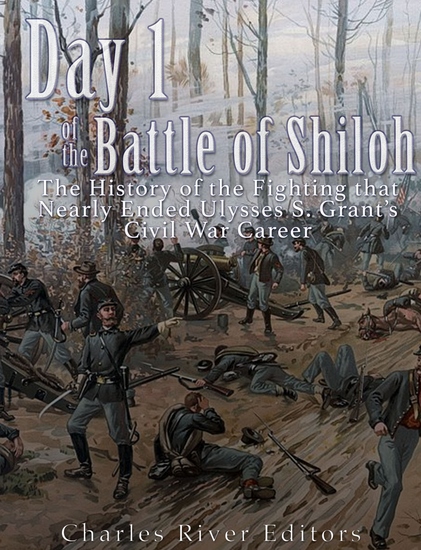
Day 1 of the Battle of Shiloh - The History of the Fighting that Nearly Ended Ulysses S Grant’s Civil War Career - cover

Day 1 of the Battle of Shiloh - The History of the Fighting that Nearly Ended Ulysses S Grant’s Civil War Career

Editors Charles River

Maison d'édition: Charles River Editors

  • 0
  • 0
  • 0

Synopsis

“The turning point of our fate." – Jefferson Davis on the death of Albert Sidney Johnston at Shiloh


“Probably no single battle of the war gave rise to such wild and damaging reports.” – William Tecumseh Sherman


After Union General Ulysses S. Grant captured Fort Henry and Fort Donelson in early 1862, Confederate General Albert Sidney Johnston, widely considered the Confederacy’s best general, concentrated his forces in northern Georgia and prepared for a major offensive that culminated with the biggest battle of the war to that point, the Battle of Shiloh. On the morning of April 6, Johnston directed an all out attack on Grant’s army around Shiloh Church, and though Grant’s men had been encamped there, they had failed to create defensive fortifications or earthworks. They were also badly caught by surprise. With nearly 45,000 Confederates attacking, Johnston’s army began to steadily push Grant’s men back toward the river.  


As fate would have it, the Confederates may have been undone by friendly fire at Shiloh. Johnston advanced out ahead of his men on horseback while directing a charge near a peach orchard when he was hit in the lower leg by a bullet that historians now widely believe was fired by his own men. Nobody thought the wound was serious, including Johnston, who continued to aggressively lead his men and even sent his personal physician to treat wounded Union soldiers taken captive. But the bullet had clipped an artery, and shortly after being wounded Johnston began to feel faint in the saddle. With blood filling up his boot, Johnston unwittingly bled to death. The delay caused by his death, and the transfer of command to subordinate P.G.T. Beauregard, bought the Union defenders critical time on April 6, and the following day Grant’s reinforced army struck back and pushed the Confederate army off the field.


The Battle of Shiloh lasted two days, but the battle over the battle had just begun. Grant’s army had just won the biggest battle in the history of North America, with nearly 24,000 combined casualties among the Union and Confederate forces. Usually the winner of a major battle is hailed as a hero, but Grant was hardly a winner at Shiloh. The Battle of Shiloh took place before costlier battles at places like Antietam and Gettysburg, so the extent of the casualties at Shiloh shocked the nation. Moreover, at Shiloh the casualties were viewed as needless; Grant was pilloried for allowing the Confederates to take his forces by surprise, as well as the failure to build defensive earthworks and fortifications, which nearly resulted in a rout of his army. Speculation again arose that Grant had a drinking problem, and some even assumed he was drunk during the battle. Though the Union won, it was largely viewed that their success owed to the heroics of General Sherman in rallying the men and Don Carlos Buell arriving with his army, and General Buell was happy to receive the credit at Grant’s expense.


As a result of the Battle of Shiloh, Grant was demoted to second-in-command of all armies in his department, an utterly powerless position. And when word of what many considered a “colossal blunder” reached Washington, several congressmen insisted that Lincoln replace Grant in the field. Lincoln famously defended Grant, telling critics, “I can’t spare this man. He fights.”


Day 1 of the Battle of Shiloh: The History of the Fighting that Nearly Ended Ulysses S. Grant’s Civil War Career explains the campaign and events that led up to the controversial first day of the battle, and how the fighting that day affected the careers of the major generals involved. Accounts of the battle by important leaders like Sherman, Grant, and Braxton Bragg are included, along with analysis of the generals and fighting. 
 
 
Disponible depuis: 01/05/2025.
Longueur d'impression: 49 pages.
D'autres livres qui pourraient vous intéresser

  • Albert Einstein – The Genius Who Redefined Physics - The Life Discoveries and Legacy of the World’s Most Influential Scientist - cover

    Albert Einstein – The Genius Who...

    Jake Rose

    • 0
    • 0
    • 0
    Albert Einstein was not just a scientist—he was a revolutionary thinker who changed the way we understand the universe. From his groundbreaking theory of relativity to his contributions in quantum mechanics, Einstein’s genius reshaped modern physics and left a lasting impact on science and humanity. 
    This audiobook takes you through his early struggles, scientific breakthroughs, and personal life, revealing the man behind the equations. How did Einstein’s ideas influence everything from atomic energy to space exploration? What made him one of history’s most recognizable and influential figures? 
    Albert Einstein – The Genius Who Redefined Physics is a must-listen for science lovers, history enthusiasts, and those fascinated by brilliant minds that changed the world.
    Voir livre
  • How to Cope - An Ancient Guide to Enduring Hardship - cover

    How to Cope - An Ancient Guide...

    Boethius

    • 0
    • 0
    • 0
    A vivid and accessible new translation of essential selections from Boethius's Consolation of PhilosophyWhat do you do when your life has fallen apart? Fifteen hundred years ago, a Roman nobleman named Boethius asked this question as he was sitting in a prison cell waiting to die, accused—probably unjustly—of treason. Boethius had been a rich and powerful man with all a person could want in life, but now he had lost everything. Shaken, he wondered how such terrible misfortune could have happened to him and why life was so unfair. When Philosophy herself appears in his cell and confronts Boethius, the conversation that follows between the two on the nature of evil and why humans suffer is as powerful and inspiring today as it was to its first readers. In How to Cope, Philip Freeman presents a lively modern translation of essential selections from Boethius's classic.This translation vividly captures Boethius's journey from bitterness and anger to reconciliation and peace, showing how ancient philosophy, especially Stoicism, can help listeners deal with adversity in their own lives. The book reveals the qualities that have made The Consolation of Philosophy one of the most popular and influential works of classical and world literature, and an inspiration to countless writers, including Thomas Aquinas, Dante, and Chaucer.
    Voir livre
  • Intimidation - Using Fear or Threats to Control or Influence Others - cover

    Intimidation - Using Fear or...

    Cito Harder

    • 0
    • 0
    • 0
    Intimidation is a powerful tool used to control, manipulate, or influence others through fear, coercion, or the threat of consequences. It is a fundamental aspect of power dynamics in human interactions, appearing in personal relationships, workplaces, politics, and even entire societies. While often associated with overt threats and aggressive behavior, intimidation can also be subtle, manifesting through psychological pressure, social exclusion, or implied consequences rather than direct violence. Regardless of its form, intimidation serves as a means of asserting dominance and shaping the behavior of individuals or groups. 
    Throughout history, intimidation has played a crucial role in maintaining authority and enforcing societal norms. Rulers, military leaders, and institutions have long relied on fear to deter opposition and ensure obedience. From ancient empires using public punishments to instill fear in the masses to modern governments leveraging surveillance and propaganda, intimidation remains a key strategy for those in power. However, it is not limited to large-scale societal control—intimidation also operates at the personal level, where individuals use fear to manipulate or silence others in personal, professional, and social settings. 
    The effectiveness of intimidation lies in its ability to exploit human psychology. Fear is a primal emotion, hardwired into the brain as a survival mechanism. When people perceive a threat—whether physical, emotional, or social—they often become more compliant, seeking to avoid harm or conflict. This reaction can be seen in various contexts, such as an employee hesitating to speak out against an abusive manager, a student fearing retaliation from a school bully, or a population complying with oppressive laws due to the threat of punishment.
    Voir livre
  • The Cholera Years - The United States in 1832 1849 and 1866 - cover

    The Cholera Years - The United...

    Charles E. Rosenberg

    • 0
    • 0
    • 0
    Cholera was the classic epidemic disease of the nineteenth century, as the plague had been for the fourteenth. Its defeat was a reflection not only of progress in medical knowledge but of enduring changes in American social thought. Rosenberg has focused his study on New York City, the most highly developed center of this new society. Carefully documented, full of descriptive detail, yet written with an urgent sense of the drama of the epidemic years, this narrative is as absorbing for general audiences as it is for the medical historian. In a new Afterword, Rosenberg discusses changes in historical method and concerns since the original publication of The Cholera Years. 
     
    “A major work of interpretation of medical and social thought . . . this volume is also to be commended for its skillful, absorbing presentation of the background and the effects of this dread disease.”—I.B. Cohen, New York Times 
     
    ”The Cholera Years is a masterful analysis of the moral and social interest attached to epidemic disease, providing generally applicable insights into how the connections between social change, changes in knowledge and changes in technical practice may be conceived.”—Steven Shapin, Times Literary Supplement 
     
    ”In a way that is all too rarely done, Rosenberg has skillfully interwoven medical, social, and intellectual history to show how medicine and society interacted and changed during the 19th century. The history of medicine here takes its rightful place in the tapestry of human history.”—John B. Blake, Science
    Voir livre
  • How We Think - cover

    How We Think

    John Dewey

    • 0
    • 0
    • 0
    "How We Think" is a seminal work by John Dewey, an influential American philosopher, psychologist, and educational reformer. Published in 1910, the book explores the nature of thought, inquiry, and problem-solving, particularly within the context of education and learning. Dewey argues that thinking is an active process involving inquiry, reflection, and experimentation rather than a passive absorption of knowledge. He emphasizes the importance of critical thinking, creative problem-solving, and the integration of experiences in shaping one's understanding of the world.
    Voir livre
  • GRE Tips: Elevate Your Score With Unbeatable Strategies! - "Boost your GRE preparation with dynamic audio lessons crafted to maximize your success!" - cover

    GRE Tips: Elevate Your Score...

    Jasper Velton

    • 0
    • 0
    • 0
    Audiobook Description for 'GRE Tips: Elevate Your Score With Unbeatable Strategies!' 
    Are you eager to advance in your career and solidify your knowledge by successfully conquering the GRE Exam? 
    In search of a comprehensive guide that encompasses everything you need to excel in the GRE? 
    Your quest ends here! 
    This guide is your ultimate resource for enhancing your understanding, applying effective strategies, and engaging in practical exercises. With this audiobook, you’ll be fully equipped for success. 
    Now updated for the GRE 2024 Exam Structure. 
    Key features of this enhanced guide: 
    - In-depth insights about the GRE Certification 
    - Detailed explanation of the GRE exam format and content 
    - Proven strategies for exam preparation and problem-solving 
    Our guide stands out with its thorough coverage, crucial for your success on the exam. Concepts are not just briefly touched upon; they are explored in detail. 
    Please note that this guide operates independently and is not affiliated with any official GRE entity. 
    Crafted with a clear structure and accessible language, our GRE Exam Guide ensures smooth transitions between topics. Say goodbye to complex jargon and embrace clear, precise, and technically accurate information. 
    So, why hesitate? Click the BUY NOW button, secure your guide, and embark on your journey to GRE Exam success! 
    Get ready to elevate your score with unbeatable strategies!
    Voir livre