¡Acompáñanos a viajar por el mundo de los libros!
Añadir este libro a la estantería
Grey
Escribe un nuevo comentario Default profile 50px
Grey
Suscríbete para leer el libro completo o lee las primeras páginas gratis.
All characters reduced
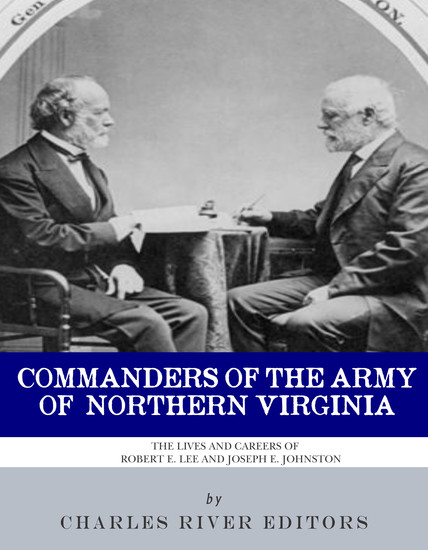
Commanders of the Army of Northern Virginia - The Lives and Careers of Robert E Lee and Joseph E Johnston - cover

Commanders of the Army of Northern Virginia - The Lives and Careers of Robert E Lee and Joseph E Johnston

Editors Charles River

Editorial: Charles River Editors

  • 0
  • 0
  • 0

Sinopsis

With the exception of George Washington, perhaps the most famous general in American history is Robert E. Lee (January 19, 1807 – October 12, 1870), despite the fact he led the Confederate Army of Northern Virginia against the Union in the Civil War. As the son of U.S. Revolutionary War hero Henry "Light Horse Harry" Lee III, and a relative of Martha Custis Washington, Lee was imbued with a strong sense of honor and duty from the beginning. And as a top graduate of West Point, Lee had distinguished himself so well before the Civil War that President Lincoln asked him to command the entire Union Army. Lee famously declined, serving his home state of Virginia instead after it seceded.
 
Lee is remembered today for constantly defeating the Union’s Army of the Potomac in the Eastern theater from 1862-1865, considerably frustrating Lincoln and his generals. His leadership of his army led to him being deified after the war by some of his former subordinates, especially Virginians, and he came to personify the Lost Cause’s ideal Southern soldier. His reputation was secured in the decades after the war as a general who brilliantly led his men to amazing victories against all odds.
 
Despite his successes and his legacy, Lee wasn’t perfect. And of all the battles Lee fought in, he was most criticized for Gettysburg, particularly his order of Pickett’s Charge on the third and final day of the war. Despite the fact his principle subordinate and corps leader, General James Longstreet, advised against the charge, Lee went ahead with it, ending the army’s defeat at Gettysburg with a violent climax that left half of the men who charged killed or wounded.
 
During the Civil War, one of the tales that was often told among Confederate soldiers was that Joseph E. Johnston was a crack shot who was a better bird hunter than just about everyone else in the South. However, as the story went, Johnston would never take the shot when asked to, complaining that something was wrong with the situation that prevented him from being able to shoot the bird when it was time.
 
 The story is almost certainly apocryphal, but it was aptly used to demonstrate the Confederates’ frustration with a man who everyone regarded as a capable general. Johnston began the Civil War as one of the South’s senior commanders, leading the ironically named Army of the Potomac to victory in the Battle of First Bull Run over Irvin McDowell’s Union Army. But Johnston would become known more for losing by not winning. Johnston was never badly beaten in battle, but he had a habit of strategically withdrawing until he had nowhere left to retreat. When Johnston had retreated in the face of McClellan’s army before Richmond in 1862, he finally launched a complex attack that not only failed but left him severely wounded, forcing him to turn over command of the Army of Northern Virginia to Robert E. Lee.
 
 Johnston and Confederate President Jefferson Davis had a volatile relationship throughout the war, but Johnston was too valuable to leave out of service and at the beginning of 1864 he was given command of the Army of Tennessee. When Johnston gradually retreated in the face of Sherman’s massive army (which outnumbered his 2-1) before Atlanta in 1864, Davis removed Johnston from command of the Army of Tennessee and gave it to John Bell Hood.
 
 Johnston has never received the plaudits of many of the South’s other generals; in fact, there are only a couple of monuments commemorating his service in the South. Yet Johnston was a competent general who fought in some of the most important campaigns of the Civil War, and it’s often forgotten that it was his surrender to Sherman weeks after Appomattox that truly ended the Civil War. Johnston did so over Davis’s command to keep fighting, incurring his wrath once more.  
Disponible desde: 20/06/2025.
Longitud de impresión: 132 páginas.

Otros libros que te pueden interesar

  • The Prince and the Pauper - cover

    The Prince and the Pauper

    Mark Twain

    • 0
    • 0
    • 0
    The Prince and the Pauper is a novel by American author Mark Twain. It was first published in 1881 in Canada, before its 1882 publication in the United States. The novel represents Twain's first attempt at historical fiction. Set in 1547, it tells the story of two young boys who were born on the same day and are identical in appearance: Tom Canty, a pauper who lives with his abusive, alcoholic father in Offal Court off Pudding Lane in London, and Edward VI of England, son of Henry VIII of England.
    Ver libro
  • I'll Never Be French (no matter what I do) - Living in a Small Village in Brittany - cover

    I'll Never Be French (no matter...

    Mark Greenside

    • 0
    • 0
    • 0
    When Mark Greenside—a native New Yorker living in California, political lefty, writer, and lifelong skeptic—is dragged by his girlfriend to a tiny Celtic village in Brittany at the westernmost edge of France in Finistère, or what he describes as "the end of the world," his life begins to change. 


    In a playful, headlong style, and with enormous affection for the Bretons, Greenside shares how he makes a life for himself in a country where he doesn't speak the language or understand the culture. He gradually places his trust in the villagers he encounters—neighbors, workers, acquaintances—and he's consistently won over and surprised as he manages to survive day-to-day trials. 


    Until he came to this town, Greenside was lost, moving through life without a plan, already in his 40s with little money and no house. So when he settles into the rhythm of this new French culture not only does he find a home and meaningful relationships in this French countryside, he finds himself. 


    I'll Never Be French (no matter what I do) is both a new beginning and a homecoming for Greenside. He has never regretted his journey and, as he advises to those searching for their next adventure, neither will you.
    Ver libro
  • A Thousand Deaths - From their pens to your ears genius in every story - cover

    A Thousand Deaths - From their...

    Jack London

    • 0
    • 0
    • 0
    John Griffith Chaney was born on January 12th, 1876 in San Francisco.   
    His father, William Chaney, was living with Flora Wellman when she became pregnant.  Chaney insisted she have an abortion.  Flora's response was to turn a gun on herself.  Although her wounds were not severe the trauma made her temporarily deranged. 
    In late 1876 his mother married John London and the young child was brought to live with them as they moved around the Bay area, eventually settling in Oakland where now, calling himself Jack, he completed grade school. 
    Jack worked hard at several jobs, sometimes 12-18 hours a day, but his dream was university.  He studied hard and borrowed the money to enrol in the summer of 1896 at the University of California in Berkeley. 
    In 1897, at 21, Jack searched out newspaper accounts of his mother's suicide attempt and for the name of his biological father. He wrote to Chaney, then living in Chicago, who claimed he could not be Jack’s father because he was impotent and casually asserted that London's mother had relations with other men.  Jack, devastated by the response, quit Berkeley and went to the Klondike. Other accounts suggest that his dire finances presented Jack with the excuse he needed to leave. 
    In the Klondike Jack began to gather material for his writing but also accumulated many health problems, including scurvy, which together with hip and leg problems he would carry for the rest of his life. 
    During the late 1890's Jack was regularly publishing short stories and by the turn of the century full blown novels. 
    By 1904 Jack had married, fathered two children and was now in the process of divorcing.  A stint as a reporter on the Russo-Japanese war of 1904 was equal amounts trouble and experience. But that experience was always put to good use in a continuing and remarkable output of work. 
    In 1905 he married Charmian Kittredge who at last was a soul and companion who brought him some semblance of peace despite his advancing alcoholism and his incurable wanderlust. 
    Twelve years later Jack had amassed both wealth and a literary reputation through such classics as ‘The Call of the Wild’, ‘White Fang’ and many others. He had a reputation as a social activist and was a tireless friend of the workers.   
    Jack London died suffering from dysentery, late-stage alcoholism and uremia, aged only 40, on November 22nd 1916 at his property in Glen Elen in California.
    Ver libro
  • The Shattered Glass - cover

    The Shattered Glass

    Valerie Conner

    • 0
    • 0
    • 0
    “The Shattered Glass” is a powerful journey through Valerie Conner's life, filled with raw emotion, resilience, and the fight to survive. Growing up in 1970s Vienna, Virginia, Valerie faced challenges that would break most people. From the tragic loss of her sister Katrina to the stormy relationship with her parents, Valerie's story is one of heartbreak, survival, and self-discovery. This memoir takes you through the ups and downs of Valerie’s life, from the early years filled with family struggles to the moments that made her stronger. With a unique blend of personal memories and reflections on American society, “The Shattered Glass” offers a window into a world where love, loss, and the desire to belong are at the forefront. Valerie’s journey is about finding light in the darkest moments and learning to pick up the pieces. “The Shattered Glass” is a story of hope, family, and the lasting strength of the human spirit.
    Ver libro
  • Thomas Jefferson An Autobiography - The Lost Manuscript - cover

    Thomas Jefferson An...

    Thomas Jefferson

    • 0
    • 0
    • 0
    “I cannot live without books.” 
     
    “Do you want to know who you are? Don't ask. Act! Action will delineate and define you.” 
     
    “I predict future happiness for Americans, if they can prevent the government from wasting the labors of the people under the pretense of taking care of them.” 
    ― Thomas Jefferson 
     
    Thomas Jefferson was an American statesman, diplomat, lawyer, architect, philosopher, and Founding Father who served as the third president of the United States from 1801 to 1809. He had previously served as the second vice president of the United States under John Adams and as the first United States secretary of state under George Washington. The principal author of the Declaration of Independence, Jefferson was a proponent of democracy, republicanism, and individual rights, motivating American colonists to break from the Kingdom of Great Britain and form a new nation; he produced formative documents and decisions at both the state and national levels. 
     
    During the American Revolution, Jefferson represented Virginia in the Continental Congress that adopted the Declaration of Independence. As a Virginia legislator, he drafted a state law for religious freedom. He served as the second Governor of Virginia from 1779 to 1781, during the American Revolutionary War. In 1785, Jefferson was appointed the United States Minister to France, and subsequently, the nation's first secretary of state under President George Washington from 1790 to 1793. Jefferson and James Madison organized the Democratic-Republican Party to oppose the Federalist Party during the formation of the First Party System. With Madison, he anonymously wrote the provocative Kentucky and Virginia Resolutions in 1798 and 1799, which sought to strengthen states' rights by nullifying the federal Alien and Sedition Acts.
    Ver libro
  • A Fish Rots from the Head Down - Exposing HPCSA Corruption - cover

    A Fish Rots from the Head Down -...

    Dr. Luke Gordon

    • 0
    • 0
    • 0
    In A Fish Rots from the Head Down - exposing HPCSA corruption - Dr Luke Gordon describes the dysfunctional and corrupt Health Professions Council of South Africa. The HPCSA is the medical board which oversees  complaints against doctors practising in South Africa. With its draconian stance on treating doctors charged with unprofessional conduct - contrary to common law principles - doctors are deemed guilty until proven innocent.  In this, the second in the series, the reader encounters the first bad actor in the story - Dr Lesley Berkowitz - a psychopath loathed by his peers because he  will stop at nothing to destroy anyone who dares to cross him. Many a plastic surgeon’s career has been destroyed by him. His egregious hypocrisy is apparent in a lecture he gave on being a mensch. The author describes the rampant corruption within the HPCSA which starts at CEO and permeates most employees on the take from doctors wishing to escape the clutches of the monster.The reader will read of the horrifying story of  Gershon Mosiane, the  corrupt prosecutor  who hijacked the hearing of a patient who developed a catastrophic complication as a result of her failure to comply with post operative instructions. His objective was  to enrich himself by hijacking the process.  However, Dr Gordon wasn’t prepared to compromise his moral compass and went to the authorities. A Lebanese couple who were both operated on by Dr Gordon have a verbal altercation with his receptionist. They run to the ombudsman of the Association of Plastic Surgeons of South Africa, Dr Lesley Berkowitz to “tell on” the receptionist. Berkowitz, the bully, challenges Dr Gordon and comes off second best. In his rage, Berkowitz  hatches a diabolical  plan to exact revenge.
    Ver libro