Begleiten Sie uns auf eine literarische Weltreise!
Buch zum Bücherregal hinzufügen
Grey
Einen neuen Kommentar schreiben Default profile 50px
Grey
Jetzt das ganze Buch im Abo oder die ersten Seiten gratis lesen!
All characters reduced
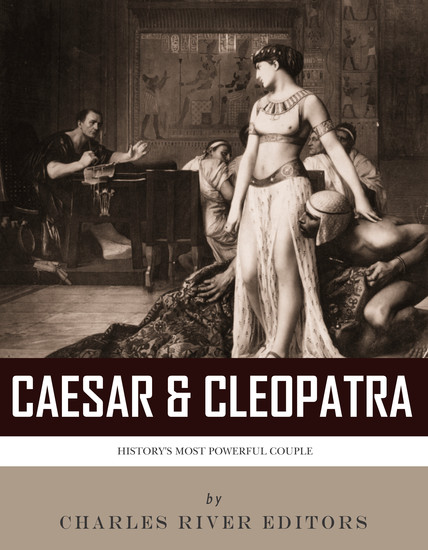
Caesar & Cleopatra - History's Most Powerful Couple - cover

Caesar & Cleopatra - History's Most Powerful Couple

Editors Charles River

Verlag: Charles River Editors

  • 0
  • 0
  • 0

Beschreibung

Possibly the most important man of antiquity, and even all of history, was Julius Caesar. Alexander Hamilton, the famous American patriot, once remarked that “the greatest man who ever lived was Julius Caesar”. Such a tribute, coming from one of the Founding Fathers of the quintessential modern democracy in reference to a man who destroyed the Roman Republic, is testament to the enduring mark that Caesar left upon the world. The ultimate conqueror, statesman, dictator, visionary, and opportunist, during his time in power Caesar expanded the borders of Rome to almost twice their previous size, revolutionized the infrastructure of the Roman state, and destroyed the Roman Republic for good, leaving a line of emperors in its place. His legacy is so strong that his name has become, in many languages, synonymous with power: the Emperors of Austria and Germany bore the title Kaiser, and the Czars of Russia also owe the etymology of their title to Caesar. His name also crept further eastward out of Europe, even cropping up in Hindi and Urdu, where the term for “Emperor” is Kaisar.
 
Even in his time, Caesar was in many ways larger than life, and because of his legacy as virtual founder of the Roman Empire, much of what was written about – and by – him during his life and immediately after his assassination was politically motivated. His successor, Octavian Augustus, had a strong interest in ensuring that Caesar’s life be painted in a favorable light, while Caesar’s political enemies attempted to paint him as a corrupt, undemocratic dictator who was destroying the old order of the Republic. This makes it exceedingly difficult to separate historical fact from apocryphal interjection, as the writings of Cicero (a rival of Caesar’s) and the later biographies of Suetonius and Plutarch can be misleading. Nonetheless, along with Caesar’s De Bello Gallico, his famous notes on his campaign against the Gauls, they remain our chief sources for Caesar’s life – a life everyone agreed was nothing short of remarkable and changed the course of history forever.
 
During one of the most turbulent periods in the history of Rome, men like Julius Caesar, Mark Antony, and Octavian participated in two civil wars that would spell the end of the Roman Republic and determine who would become the Roman emperor. In the middle of it all was history’s most famous woman, the Egyptian pharaoh Cleopatra (69-30 B.C.), who famously seduced both Caesar and Antony and thereby positioned herself as one of the most influential people in a world of powerful men.
 
Cleopatra was a legendary figure even to contemporary Romans and the ancient world, as Plutarch’s quote suggests, and she was a controversial figure who was equally reviled and praised through the years, depicted as a benevolent ruler and an evil seductress, sometimes at the same time. Over 2,000 years after her death, everything about Cleopatra continues to fascinate people around the world, from her lineage as a Ptolemaic pharaoh, her physical features, the manner in which she seduced Caesar, her departure during the Battle of Actium, and her famous suicide. And despite being one of the most famous figures in history, there is still much mystery surrounding her, leading historians and archaeologists scouring Alexandria, Egypt for clues about her life and the whereabouts of her royal palace and tomb.
Verfügbar seit: 05.05.2025.
Drucklänge: 47 Seiten.

Weitere Bücher, die Sie mögen werden

  • A Middle-Sized Artist - From their pens to your ears genius in every story - cover

    A Middle-Sized Artist - From...

    Charlotte Perkins Gilman

    • 0
    • 0
    • 0
    Charlotte Perkins Gilman was born on 3rd July 1860 in Hartford, Connecticut, to an unaffectionate mother and a father who abandoned her and her older brother to a life of poverty. 
    Inevitably her schooling was limited and by 15 she had attended seven different schools but received only four years education.  However Charlotte was resourceful and did spend time with her father’s aunts – the suffragist Isabella Beecher Hooker and the ‘Uncle Tom Cabin’s’ author, Harriet Beecher Stowe as well as many hours at the public library studying ancient civilisations. 
    In 1878, she enrolled in classes at the Rhode Island School of Design where she met Martha Luther and they developed a close relationship until Luther married in 1881. Charlotte was devastated and detested romance and love until she met and married the artist Charles Walter Stetson.  
    Their only child, Katharine Beecher Stetson, was born in 1885 but left Charlotte with post-natal depression, then often dismissed as a case of hysteria or nerves.  Unsuited to domestic life she ruptured her life and moved to California with Katherine.  She divorced in 1894 and then sent Katharine east to live with her father and his second wife confirming that his paternal rights be acknowledged and that Katherine establish a relationship with her father. 
    After her mother died in 1893, Charlotte moved back east and became involved with her first cousin, Wall Street attorney, Houghton Gilman who she married in 1900. After his death she moved back to California, where Katherine now lived.   
    Her most popular story is ‘The Yellow Wallpaper’ which touched on her own post-partum depression and underlined the need for women to be responsible for their mental and physical well-being, as the narrator is ordered by her husband/doctor to take compete rest in her room where she is isolated and becomes obsessed with the revolting yellow wallpaper.   
    She wrote other notable short stories the best of which we also include.   
    Charlotte lectured widely for social reform, wrote important non-fiction works that questioned our patriarchal system and left a legacy as a leading and positive spokesperson for feminism.  
    She was diagnosed with incurable breast cancer in 1932 and, as she wrote in her suicide note and autobiography, she ‘chose chloroform over cancer’    
    Charlotte Perkins Gilman took her own life on 17th August 1935, aged 75, in Pasadena, California.
    Zum Buch
  • Bad Girls from History - Wicked or Misunderstood? - cover

    Bad Girls from History - Wicked...

    Dee Gordon

    • 0
    • 0
    • 0
    You wont be familiar with every one of the huge array of women featured in this book, but all, familiar or not, leave unanswered questions behind them. The range is extensive, as was the research, with its insight into the lives and minds of women in different centuries, different countries, with diverse cultures and backgrounds, from the poverty stricken to royalty. Mistresses, murderers, smugglers, pirates, prostitutes, and fanatics with hearts and souls that feature every shade of black (and grey!). From Cleopatra to Ruth Ellis, from Boudicca to Bonnie Parker, from Lady Caroline Lamb to Moll Cutpurse, from Jezebel to Ava Gardner. Less familiar names include Mary Jeffries, the Victorian brothel-keeper, Belle Starr, the American gambler and horse thief, La Voisin, the seventeenth-century Queen of all Witches in France but these are random names, to illustrate the variety of the content in store for all those interested in women who defy law and order, for whatever reason. The risque, the adventurous and the outrageous, the downright nasty and the downright desperate all human (female!) life is here. From the lower strata of society to the aristocracy, class is not a common denominator. Wicked? Misunderstood? Nave? Foolish? Predatory? Manipulative? Or just out of their time? Listen and decide.
    Zum Buch
  • Beyond the Castle - A Guide to Discovering Your Happily Ever After - cover

    Beyond the Castle - A Guide to...

    Jody Jean Dreyer, Stacy L....

    • 0
    • 0
    • 0
    When the credits roll and you've left the park, when your Disney day is over, how do you take the magic with you into your everyday work and life? 
    Jody Jean Dreyer worked for the Walt Disney Company for 30 years and in Beyond the Castle she shares one-of-a-kind stories and insights into what sets the Disney experience apart, as well as secrets to help readers discover their own “happily ever after.” 
    Beginning with her first position as a summer intern at Walt Disney World, through her role leading synergy and special projects for Disney (reporting to former CEO Michael Eisner), to her work with top leadership at Walt Disney Motion Pictures sharing the magic of Disney films around the world, Jody unpacks secrets that can change the way we understand ourselves, our work and relationships, and how we can find our own path to happiness. You will read her stories about working with Walt’s nephew, Roy E. Disney, her front-line role in the opening of theme parks around the world and her own journey to discovering how to bring some Disney magic into every day. 
    The wish for happy endings is written in our hearts. Every park guest or movie watcher is looking for their own “happily ever after,” as they ask the questions: What’s my story? Does it matter? Will the story end well for me? Jody’s personal experiences and her underpinning faith help her to offer practical and sometimes unexpected principles to better appreciate and navigate our own stories. 
    Jody’s entertaining storytelling will satisfy a reader's desire to open the doors and peek inside the castle – and more, to unlock and illuminate life’s true treasure.
    Zum Buch
  • Spanish Romance - cover

    Spanish Romance

    Washington Irving

    • 0
    • 0
    • 0
    Washington Irving was the first American writer who became world-famous. He was a pioneer, who had an impact on the American literature.   In the essay "Spanish Romance", Washington Irving speculates on the specifics of the Spain culture. The author has enough experience to describe Spain. He spent some years there. In Spain he studied manuscripts relating to the era of America's discovery. Washington Irving was also the American ambassador at the Spanish yard. The author begins with the history of Spain and states that its culture was influenced by the Arabs. Washington Irving skillfully uses in his works folklore, historical documents, sketches, legends, national fairy tales, biographic memoirs and descriptions. Enjoy the brilliant language and original thoughts of the author. Let the great person speak to you.A SmartTouch Media production.
    Zum Buch
  • Browdean Farm - From their pens to your ears genius in every story - cover

    Browdean Farm - From their pens...

    A M Burrage

    • 0
    • 0
    • 0
    Alfred McLelland Burrage was born in Hillingdon, Middlesex on 1st July, 1889. His father and uncle were both writers, primarily of boy’s fiction, and by age 16 AM Burrage had joined them.  The young man had ambitions to write for the adult market too.  The money was better and so was his writing. 
    From 1890 to 1914, prior to the mainstream appeal of cinema and radio the printed word, mainly in magazines, was the foremost mass entertainment.  AM Burrage quickly became a master of the market publishing his stories regularly across a number of publications. 
    By the start of the Great War Burrage was well established but in 1916 he was conscripted to fight on the Western Front. He continued to write during these years documenting his experiences in the classic book War is War by Ex-Private X. 
    For the remainder of his life Burrage was rarely printed in book form but continued to write and be published on a prodigious scale in magazines and newspapers.  In this volume we concentrate on his supernatural stories which are, by common consent, some of the best ever written.  Succinct yet full of character each reveals a twist and a flavour that is unsettling…..sometimes menacing….always disturbing.
    Zum Buch
  • Alcibiades: The Life and Legacy of Ancient Greece’s Most Controversial General - cover

    Alcibiades: The Life and Legacy...

    Charles River Editors

    • 0
    • 0
    • 0
    The Peloponnesian War, as the great historian Thucydides wrote in the introduction to his eponymous book, which has become one of the greatest historical treatises of antiquity, was an event of such calamitous magnitude that Greece had never witnessed its like in all of recorded history. Not the Trojan War, not the Dorian Invasion, not even the recent Persian invasions – which had devastated mainland Greece and seen Athens herself evacuated and put to the flame, the buildings on her Acropolis razed into dust – could compare to the scale of the devastation that engulfed all of Greece for almost three decades, causing tens of thousands of deaths, if not hundreds of thousands.  
    	No individual was in the center of the maelstrom more than Alcibiades, and few people in history walked a finer line between brilliance and instability. Born around 450 BCE into an elite family in Athens, just as the city-state reached its zenith, he came of age at a time when ambition could elevate a man to greatness or destroy him just as easily. If the age of his guardian, Pericles, represented the height of Athenian confidence, then the life of Alcibiades symbolized its unpredictable and restless spirit.  
    	Throughout his life, Alcibiades donned many masks. To some, he was a fearless general, and for others he was an effective diplomat. But to those who knew him the longest, he was a political chameleon who would stop at nothing to get what he desired, and this particular form of reckless ambition and ego ultimately endangered the very city that gave him so many opportunities and an affluent life. Alcibiades was a figure who thrived on risk and reinvention, seen through his decisions in the Peloponnesian War, where he not only fought for his native Athens, but also for its enemy, Sparta. His shifting loyalties not only shocked contemporaries, but continue to fascinate modern historians. 
    Zum Buch