Begleiten Sie uns auf eine literarische Weltreise!
Buch zum Bücherregal hinzufügen
Grey
Einen neuen Kommentar schreiben Default profile 50px
Grey
Jetzt das ganze Buch im Abo oder die ersten Seiten gratis lesen!
All characters reduced
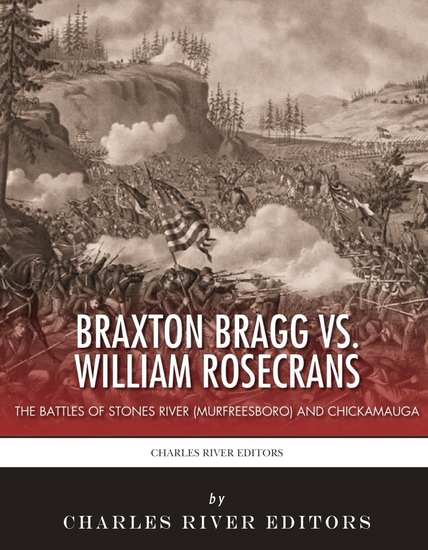
Braxton Bragg vs William Rosecrans - The Battles of Stones River and Chickamauga - cover

Braxton Bragg vs William Rosecrans - The Battles of Stones River and Chickamauga

Editors Charles River

Verlag: Charles River Editors

  • 0
  • 0
  • 0

Beschreibung

Americans have long been fascinated by the Civil War and its biggest battles, particularly Gettysburg, Antietam, and Shiloh, all of which involved Robert E. Lee or Ulysses S. Grant. But one of the 6 biggest battles of the war, and the one that took the heaviest toll by % on both armies was fought at the end of 1862 in Tennessee, and it involved neither of those generals.
 
In late December 1862, William Rosecrans’s Union Army of the Cumberland was contesting Middle Tennessee against Braxton Bragg’s Army of Tennessee, and for three days the two armies savaged each other as Bragg threw his army at Rosecrans in a series of desperate assaults. Bragg’s army was unable to dislodge the Union army, and he eventually withdrew his army after learning that Rosecrans was on the verge of receiving reinforcements. Though the battle was stalemated, the fact that the Union army was left in possession of the field allowed Rosecrans to declare victory and embarrassed Bragg.
 
Though Stones River is mostly overlooked as a Civil War battle today, it had a decisive impact on the war. The two armies had both suffered nearly 33% casualties, an astounding number in 1862 that also ensured Rosecrans would not start another offensive campaign in Tennessee until the following June. The Union victory also ensured control of Nashville, Middle Tennessee, and Kentucky for the rest of the war, prompting Lincoln to tell Rosecrans, “You gave us a hard-earned victory, which had there been a defeat instead, the nation could scarcely have lived over."
 
Americans have long been fascinated by the Civil War and its biggest battles, particularly Gettysburg, Antietam, and Shiloh, all of which involved Robert E. Lee or Ulysses S. Grant. But the second biggest battle of the entire war mostly gets overlooked among casual readers, despite the fact it represented the last great chance for the Confederates to salvage the Western theater.
 
In mid-September, the Union Army of the Cumberland under General William Rosecrans had taken Chattanooga, but rather than be pushed out of the action, Army of Tennessee commander Braxton Bragg decided to stop with his 60,000 men and prepare a counterattack south of Chattanooga at a creek named Chickamauga.  To bolster his fire-power, Confederate President Jefferson Davis sent 12,000 additional troops under the command of Lieutenant General James Longstreet, whose corps had just recently fought at Gettysburg in July.   
 
On the morning of September 19, 1863, Bragg's men assaulted the Union line, which was established in a wooded area thick with underbrush along the river.  That day and the morning of the next, Bragg continue to pummel Union forces, with the battle devolving from an organized succession of coordinated assaults into what one Union soldier described as “a mad, irregular battle, very much resembling guerrilla warfare on a vast scale in which one army was bushwhacking the other, and wherein all the science and the art of war went for nothing.”
 
Late that second morning, Rosecrans was misinformed that a gap was forming in his front line, so he responded by moving several units forward to shore it up.  What Rosecrans didn’t realize, however, was that in doing so he accidentally created a quarter-mile gap in the Union center, directly in the path of Longstreet’s men.  Described by one of Rosecrans’ own men as “an angry flood,” Longstreet's attack was successful in driving one-third of the Union Army off the field, with Rosecrans himself running all the way to Chattanooga, where he was later found weeping and seeking solace from a staff priest. 
 
In the aftermath of the Battle of Chickamauga, several Confederate generals blamed the number of men lost during what would be the bloodiest battle of the Western Theater on Bragg’s incompetence, also criticizing him for refusing to pursue the escaping Union army.
Verfügbar seit: 02.05.2025.
Drucklänge: 80 Seiten.
Weitere Bücher, die Sie mögen werden

  • Why AI Undermines Democracy and What to Do About It - cover

    Why AI Undermines Democracy and...

    Mark Coeckelbergh

    • 0
    • 0
    • 0
    Across the world, AI is used as a tool for political manipulation and totalitarian repression. Stories about AI are often stories of polarization, discrimination, surveillance, and oppression. Is democracy in danger? And can we do anything about it? 


    In this compelling and balanced book, Mark Coeckelbergh reveals the key risks posed by AI for democracy. He argues that AI, as currently used and developed, undermines fundamental principles on which liberal democracies are founded, such as freedom and equality. How can we make democracy more resilient in the face of AI? And, more positively, what can AI do for democracy? Coeckelbergh advocates not only for more democratic technologies, but also for new political institutions and a renewal of education to ensure that AI promotes, rather than hinders, the common good for the twenty-first century. 


    Why AI Undermines Democracy and What to Do About It is a must-listen for anyone who is concerned about the fate of democracy.
    Zum Buch
  • Sahih Muslim English Audio Book 46-54 (Vol 7) Hadith number 6723-7563 of 7563 - Most Authentic Hadith Audio Collection (English Translation) - cover

    Sahih Muslim English Audio Book...

    Imam Muslim,...

    • 0
    • 0
    • 0
    Sahih Muslim is a collection of hadith compiled by Imam Muslim. His collection is considered to be one of the most authentic collections of the Sunnah of the Prophet (peace be upon him), and along with Sahih Al-Bukhari. It contains roughly 7500 hadith (with repetitions) in 54 books. The translation provided here is by Nasiruddin Al-Khattab. 
    Volume 7 contains books 46-54 of hadith 6723-7563 of 7563: 
    46 The Book Of Al-Qadr (The Divine Decree) Hadith 6723-6774 of 7563 English 
    47 The Book Of Knowledge Hadith 6775-6804 of 7563 English 
    48 Remembrance, Supplication, Repentance & Praying For Forgiveness Hadith 6805-6951 English 
    49 The Book Of Repentance Hadith 6952-7023 of 7563 English 
    50 The Attributes Of The Hypocrites & The Rulings Concerning Them Hadith 7024-7129 English 
    51 The Book Of Paradise & Description Of Its Delights & Its People Hadith 7130-7234 English 
    52 The Book Of Tribulations & The Portents Of The Hour Hadith 7235-7416 of7563 English 
    53 The Book Of Asceticism (Az-Zuhd) & Heart Softening Reports Hadith 7417-7522of 7563 English 
    54 The Book Of Tafsir (Explanation Of Quran) Hadith 7523-7563 of 7563 English 
    Contact: For any feedback or correction please feel free to contact at qnsacademy@outlook.com
    Zum Buch
  • The Heart Sutra - Becoming a Buddha Through Meditation - cover

    The Heart Sutra - Becoming a...

    Osho

    • 0
    • 0
    • 0
    The Heart Sutra , originally a very short set of verses, was given in privacy as a message to one of Buddha's close disciples, Sariputra, specifically addressed to him. Over time the Heart Sutra became one of Buddhism's core teachings.
    In these 10 talks, Osho presents the powerful message of these ancient words and brings them to a modern audience - one with different minds and needs than the original audiences of Buddha more than 2,500 years ago. Osho's message is not about Buddha the historical figure; instead he addresses his listeners and encourages them to discover their own inner realities, their own buddhahood. Like Buddha's, Osho's message is about meditation and meditation alone - "rely only on your meditation and nothing else".
    Osho also speaks on the seven chakras, the energy centers of the human body, and their corresponding relationships to the physical, psychosomatic, psychological, psychospiritual, spiritual, spiritual-transcendental, and transcendental aspects of human growth and consciousness.
    1. The Buddha Within
    2. Surrender Is Understanding
    3. Negation of Knowledge
    4. Understanding: The Only Law
    5. The Fragrance of Nothingness
    6. Don't Be Too Sane
    7. Full Emptiness
    8. The Path of Intelligence
    9. Gone, Gone, Gone Beyond!
    10. Truth Is a Presence
    
    ©1977 OSHO International Foundation ℗ 2025 OSHO International Foundation
    Zum Buch
  • The Story of Philosophy Immanuel Kant and German Idealism - cover

    The Story of Philosophy Immanuel...

    Will Durant

    • 0
    • 0
    • 0
    "Will Durant's The Story of Philosophy: Immanuel Kant and German Idealism" provides an insightful exploration into the profound ideas of Immanuel Kant and the subsequent development of German Idealism. This volume examines Kant's revolutionary contributions to metaphysics, epistemology, and ethics, alongside the works of key figures like Fichte, Schelling, and Hegel. Durant's accessible prose illuminates the complex theories and enduring impact of these philosophers. Ideal for readers seeking a deeper understanding of Kantian philosophy and its influence on Western thought.
    Zum Buch
  • Unbroken: The Trauma Response Is Never Wrong - And Other Things You Need to Know to Take Back Your Life - cover

    Unbroken: The Trauma Response Is...

    PhD MaryCatherine McDonald

    • 0
    • 0
    • 0
    A profound new approach to healing trauma, grounded in a radical reframing of how we understand this nearly universal experienceFor centuries, we’ve been taught that being traumatized means we are somehow broken—and that trauma only happens to people who are too fragile or flawed to deal with hardship. But as a researcher, teacher, and survivor, Dr. MaryCatherine McDonald has learned that the only thing broken is our society’s understanding of trauma. “The body’s trauma response is designed to save our lives—and it does,” she says. “It’s not a sign of weakness, but of our function, strength, and amazing resilience.”With Unbroken: The Trauma Response Is Never Wrong, Dr. McDonald overturns the misconceptions about trauma with the latest evidence from neuroscience and psychology—and shares tested practices and tools to help you work with your body’s coping mechanisms to accelerate healing. Here, you’ll explore:• What is trauma? The latest science that undoes the stigmas of shame, blame, and humiliation• Moral injury—having our basic sense of how the world should work overturned• The truth about triggers—what they really are and how they can guide the healing journey• Traumatic patterns—new findings to help break free from recurring habits and toxic dynamics• Why we can always rewrite our inner narratives, no matter how much time has passed• Finding a “relational home” for trauma—how we can help each other return to wholenessDr. McDonald’s case studies reveal the many ways trauma can manifest and persist in our lives, yet there’s one factor every case has in common: the trauma response itself reveals the path to healing. “Our traumatic experiences reveal that we can be bent, dented, or bruised,” she says, “but we cannot be broken.” For anyone who has gone through trauma or wants to help others who are struggling, here is an empowering resource for finding our way home to our bodies, rebuilding our relationships, and returning to full engagement with life.
    Zum Buch
  • Waiting for Mister Rogers - Teaching with Attachment Attunement and Intention - cover

    Waiting for Mister Rogers -...

    Wysteria Edwards

    • 0
    • 0
    • 0
    Every day children enter classrooms crying out for love and relief. Waiting for Mister Rogers reveals a Kindergarten teacher's journey to find answers for the broken children entering her classroom—and the wounds in her own heart—through the personal notes, speeches, and writings of Fred Rogers.  Many moments of adversity, violence, and suffering can be traced back to broken attachments in childhood. These early attachment wounds follow children into adulthood, often damaging their interpersonal relationships.  Where the world offers shallow and complex solutions, the gentle work of Mister Rogers models simple and deep ways to heal insecure attachment. Waiting for Mister Rogers, answers questions of personal development and connection for anyone seeking support, such as:  What do children need to be securely attached?  How can teachers heal their wounds to be fully present, intentional, and effective with their students?  Could student be triggering a teacher's childhood trauma?  Can teachers go deeper while doing less?  It's time to remember childhood, return to the Neighborhood and teach with attachment, attunement, and intention. Mister Rogers was right all along!
    Zum Buch