Rejoignez-nous pour un voyage dans le monde des livres!
Ajouter ce livre à l'électronique
Grey
Ecrivez un nouveau commentaire Default profile 50px
Grey
Abonnez-vous pour lire le livre complet ou lisez les premières pages gratuitement!
All characters reduced
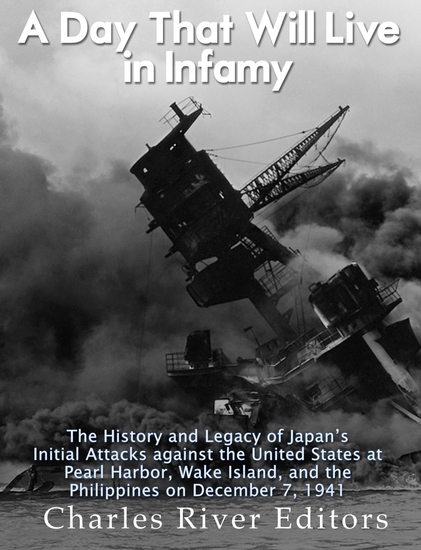
A Day That Will Live in Infamy - The History and Legacy of Japan’s Initial Attacks against the United States at Pearl Harbor Wake Island and the Philippines on December 7 1941 - cover

A Day That Will Live in Infamy - The History and Legacy of Japan’s Initial Attacks against the United States at Pearl Harbor Wake Island and the Philippines on December 7 1941

Editors Charles River

Maison d'édition: Charles River Editors

  • 0
  • 0
  • 0

Synopsis

All Americans are familiar with the “day that will live in infamy.” At 9:30 a.m. on Sunday, December 7, 1941, Pearl Harbor, the advanced base of the United States Navy’s Pacific Fleet, was ablaze. It had been smashed by aircraft launched by the carriers of the Imperial Japanese Navy. All eight battleships had been sunk or badly damaged, 350 aircraft had been knocked out, and over 2,000 Americans lay dead. Indelible images of the USS Arizona exploding and the USS Oklahoma capsizing and floating upside down have been ingrained in the American conscience ever since. In less than an hour and a half the Japanese had almost wiped out America’s entire naval presence in the Pacific.
 
Less than 24 hours earlier, Japanese and American negotiators had been continuing their diplomatic efforts to stave off conflict in the region, but as they did, President Roosevelt and his inner circle had seen intelligence reports strongly suggesting an imminent attack - though they did not know where. The U.S. rightly believed that Japan would take action to prevent the Americans from interfering with their military activities in Southeast Asia, and American military forces in the Philippines were already bracing for a potential attack. However, as the negotiations were ongoing, the powerful Japanese carrier fleet had been surging southwards through the Pacific while maintaining radio silence, preparing to strike the blow that would ignite war in an area spanning half the globe. Navy Commander-in-Chief Isoroku Yamamoto, whose code of honor demanded that the Japanese only engage enemies after a formal declaration of war, had been given assurances that his nation would be formally at war with the United States prior to the arrival of his planes over Pearl Harbor.
 
As it turned out, those assurances were worth nothing, and Yamamoto had been misled by extremists in his government just as the Americans were misled. In fact, the Japanese would infamously deliver documents formally cutting off negotiations with the American government after the attack on Pearl Harbor had already been conducted. Far from a formal declaration of war, America was attacked without warning, plunging the world’s largest democracy into history’s deadliest conflict.
 
Posted on the other side of the world, it was early on the morning of December 8 in the Philippines when American general Douglas MacArthur received news of the Japanese attack on Pearl Harbor hours earlier. With that, it could only be a matter of time before the Japanese attacked the Philippines.
 
Although MacArthur and Allied forces tried to hold out, they could only fight a delaying action, and the Japanese managed to subdue all resistance by the spring of 1942. However, in the aftermath of Japan’s successful invasion, as the nation’s military strategists began preparations for the next phase of military actions in the theater, their forces had to deal with a critical logistical problem they had not foreseen. The Japanese had to deal with large numbers of Filipino and American soldiers who had surrendered after a lengthy defense in the Bataan peninsula, but they were not prepared for so many prisoners of war because their own military philosophy emphasized rigid discipline and fighting until the end. They could not imagine a situation in which Japanese soldiers would willingly surrender, so they assumed that no other combatants would do so either. On the night of March 12, 1942, MacArthur, his family and closest advisors were smuggled out of Corregidor on PT boats. From there they surged across the black ocean to Mindanao and were picked up by American B-17 bombers. They stealthily flew to northern Australia, a dangerous flight over Japanese-held territory, during which MacArthur casually remarked to General Sutherland, “It was close; but that's the way it is in war. You win or lose, live or die, and the difference is just an eyelash.”  
Disponible depuis: 01/05/2025.
Longueur d'impression: 59 pages.

D'autres livres qui pourraient vous intéresser

  • Keeping Family Secrets - Shame and Silence in Memoirs from the 1950s - cover

    Keeping Family Secrets - Shame...

    Margaret K. Nelson

    • 0
    • 0
    • 0
    All families have secrets but the facts requiring secrecy change with time. Nowadays a lesbian partnership, a "bastard" son, or a criminal grandfather might be of little or no consequence but could have unraveled a family at an earlier moment in history. Margaret K. Nelson is interested in how families keep secrets from each other and from outsiders when to do otherwise would risk eliciting not only embarrassment or discomfort, but profound shame and, in some cases, danger. Drawing on over 150 memoirs describing childhoods in the period between the aftermath of World War II and the 1960s, Nelson highlights the importance of history in creating family secrets and demonstrates the use of personal stories to understand how people make sense of themselves and their social worlds. 


    Keeping Family Secrets uncovers hidden stories of same-sex attraction among boys, unwed pregnancies among teenage girls, the institutionalization of children with mental and physical disabilities, participation in left-wing political activities, adoption, and Jewish ancestry. The members of ordinary families kept these issues secret to hide the disconnect between the reality of their own family and the prevailing ideals of what a family should be. Keeping Family Secrets sheds light not only on decades-old secrets but pushes us to confront what secrets our families keep today.
    Voir livre
  • Emotional Abuse - Tactics That Break You from Within (3 in 1) - cover

    Emotional Abuse - Tactics That...

    Cito Harder

    • 0
    • 0
    • 0
    This book reveals the subtle, yet devastating strategies that are used to control, hurt, and dominate individuals emotionally. In this powerful 3-in-1 collection, Emotional Abuse, Emotional Exploitation, and Emotional Manipulation, readers are taken deep into the psychological tactics that can break down an individual's sense of self-worth, autonomy, and emotional health. 
    This book uncovers the hidden ways in which emotional abuse can manifest – from emotional exploitation, where vulnerability is used against someone, to emotional manipulation, where feelings are distorted to gain control. The deceptive tactics of abusive individuals are dissected, showing how they prey on their victim's emotions to instill doubt, fear, guilt, and insecurity. Through gaslighting, silent treatment, and emotional blackmail, emotional abuse leaves invisible scars that can have lasting effects on one's mental well-being. 
    With insightful explanations, real-life examples, and strategies for healing, Emotional Abuse offers a crucial guide for recognizing and escaping emotionally exploitative relationships. Whether you're seeking to understand the dynamics of emotional manipulation or looking for ways to rebuild your emotional resilience, this book is an essential resource for regaining control over your emotional life and breaking free from toxic influences.
    Voir livre
  • Judeophobia - A History - cover

    Judeophobia - A History

    Shlomo Sand

    • 0
    • 0
    • 0
    Throughout the history of the Western world, Jews have suffered various forms of exclusion, stigmatization, and discrimination that have forced them always to be aware of their particular situation. The Jews became a community under siege and, as Shlomo Sand argues, Judaism was shaped by the hostile gaze of Christian civilization. While the forms of hostility endured by the Jews have varied over the centuries, it is impossible to understand twentieth century anti-Judaism, or Jewish identity itself, without taking account of the sediments of mental hatred, fueled by religious belief, which have survived the passage of time. 
     
    While antisemitism is the term commonly used today, Sand prefers 'Judeophobia', which predates the appearance of 'antisemitism' and is more precise. Looking back over the centuries, he seeks to identify some of the stages in the age-old, incandescent hatred of the Jews and tries to understand what remains today of this trenchant hostility. He also questions whether Zionism, born as a distressed response to modern Judeophobia, has ended up mirroring it. To what extent has Zionism inherited the ideological foundations that have always been characteristic of the persecutors of the Jews? This history of anti-Jewish hatred will be of interest to anyone concerned with one of the most insidious and persistent features of Western civilization.
    Voir livre
  • Stories on lord Ganesh series - 19 - From various sources of Ganesh purana - cover

    Stories on lord Ganesh series -...

    Anusha HS

    • 0
    • 0
    • 0
    Lord Ganesh is the son of Goddess Parvati and Lord Shiva. He is the first one to get worshipped before worshipping any other god. We can say in short that there is no Hindu who doesn't perform Lord Ganesh’s worship. In Ramayana Lord Rama had worshipped Lord Ganesh. 
    In Mahabharata Lord Krishna had also worshipped Lord Ganesh. They have become the role models to the whole world. Before the beginning of any work it is common to worship Lord Ganesh. There are many Holy hymns on Lord Ganesh. Lord Ganesh’s favorite food is modak. 
    He gets pleased if we offer Durva grass to him. He also loves red Hibiscus flower. He is called the vighnaharta because he wards off all the obstacles in our life. He is also called vighnaraja. There are infinite names to Lord Ganesh which we cannot explain. He ties a snake around his waist. 
    The vehicle of Lord Ganesh is mouse in Hindu culture. Lord Ganesh is worshipped all over India. His miracles have been described in all of the 18 Puranas. There are many forms of Lord Ganesh. 
    He has got two wives one is riddhi and the other is siddhi.Lord Ganesh has got 32 forms of incarnations. The modak which you offer to Lord Ganesh will give you good results. Lord Ganesh does not bias among his devotees. He is specially worshipped on sankashti days. On Ganesh Chaturthi people fast and perform vrath.On this day it is forbidden to see Chandra the moon.
    Voir livre
  • Special Education Teacher Career Planning Audio Book Bundle - 3 in 1 Career Development Plan Box Set - cover

    Special Education Teacher Career...

    Brian Mahoney

    • 0
    • 0
    • 0
    End Money Worries! 
    Special Education Teacher Career Planning Audio Book Bundle Career Planning Audio Book Bundle 
    Discover... 
    * What a Special Education Teacher does  * How to Become a Special Education Teacher  * What is the salary of a Special Education Teacher  
    * What is the Special Education Teacher Work Environment like * What is the future Job outlook for a Special Education Teacher  
    * how long does it take to become a Special Education Teacher * How to Prepare for Your Job Interview 
    * Tips the pros use to Ace their Job Interview  * You'll be confident with the best answers for the toughest job interview questions 
    The knowledge & ability to change your life all for less than the cost of 1 movie ticket! 
     If you are ready to get started & want the knowledge, help & motivation to change your life now!... 
    How to start a YouTube Channel & Make Money 
    Discover... 
    * Why YouTube is Essential for Business Marketing * Creating a YouTube Marketing Strategy 
    *Creating Engaging Video Content *Optimizing Your YouTube Channel  
    *Monetizing your YouTube Channel *Measuring your YouTube Marketing Success 
    *YouTube Shorts Video & Channel Promotion 
    So take advantage of this chance for a lifetime passive income stream from YouTube! 
    Goal Setting Mastery: A Action Plan to Achieving Your Dreams 
    Now you you can take advantage of this goal setting audio book & discover how to achieve success in all aspects of your life: 
    * Understanding the Power of Goal Setting * How to set meaningful goals using the SMART Method 
    * Creating a Action Plan * Reviewing & adjusting your Goals  * Using Goal Setting in all areas of Your life 
    So Don't wait. You'll wait your life away...
    Voir livre
  • The Invasion of Italy - How the Allies Fought Their Way Through Southern Europe - cover

    The Invasion of Italy - How the...

    Sage Winters

    • 0
    • 0
    • 0
    The invasion of Italy was one of the pivotal campaigns of World War II, playing a crucial role in the eventual Allied victory in Europe. Southern Europe, particularly Italy, was seen as a gateway for the Allies to weaken Nazi forces, divert their attention from the Eastern Front, and eventually push towards Germany. But the road to Italy was not a simple or straightforward one. It was a strategic decision shaped by both military considerations and political imperatives. 
      
    Following the successful invasion of North Africa and the defeat of Axis forces in Tunisia in May 1943, the Allies were left with a significant question: what would be their next move? While the focus remained on the ultimate goal of defeating Nazi Germany, the question of how best to proceed in the Mediterranean theater became a subject of intense debate. Some leaders, particularly in the United Kingdom, advocated for an immediate assault on France through a cross-channel invasion, while others, notably U.S. leaders, saw the conquest of Italy as an essential stepping stone toward that final invasion. 
      
    Italy's location in the heart of the Mediterranean made it a prime target for an invasion. Not only did it offer a direct path into Europe, but it also served as a critical base for Axis operations. The Italian peninsula was seen as both a vulnerable and strategically significant part of the Axis defense. The Allies understood that by attacking Italy, they would draw German resources away from the Eastern Front, weaken Axis control of the Mediterranean, and force Italy to the negotiating table—if not outright force its surrender.
    Voir livre