Begleiten Sie uns auf eine literarische Weltreise!
Buch zum Bücherregal hinzufügen
Grey
Einen neuen Kommentar schreiben Default profile 50px
Grey
Jetzt das ganze Buch im Abo oder die ersten Seiten gratis lesen!
All characters reduced
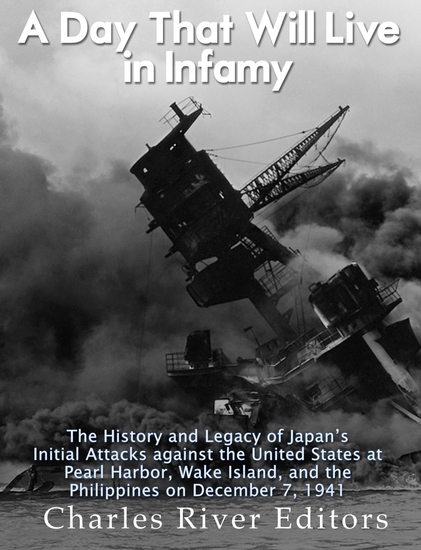
A Day That Will Live in Infamy - The History and Legacy of Japan’s Initial Attacks against the United States at Pearl Harbor Wake Island and the Philippines on December 7 1941 - cover

A Day That Will Live in Infamy - The History and Legacy of Japan’s Initial Attacks against the United States at Pearl Harbor Wake Island and the Philippines on December 7 1941

Editors Charles River

Verlag: Charles River Editors

  • 0
  • 0
  • 0

Beschreibung

All Americans are familiar with the “day that will live in infamy.” At 9:30 a.m. on Sunday, December 7, 1941, Pearl Harbor, the advanced base of the United States Navy’s Pacific Fleet, was ablaze. It had been smashed by aircraft launched by the carriers of the Imperial Japanese Navy. All eight battleships had been sunk or badly damaged, 350 aircraft had been knocked out, and over 2,000 Americans lay dead. Indelible images of the USS Arizona exploding and the USS Oklahoma capsizing and floating upside down have been ingrained in the American conscience ever since. In less than an hour and a half the Japanese had almost wiped out America’s entire naval presence in the Pacific.
 
Less than 24 hours earlier, Japanese and American negotiators had been continuing their diplomatic efforts to stave off conflict in the region, but as they did, President Roosevelt and his inner circle had seen intelligence reports strongly suggesting an imminent attack - though they did not know where. The U.S. rightly believed that Japan would take action to prevent the Americans from interfering with their military activities in Southeast Asia, and American military forces in the Philippines were already bracing for a potential attack. However, as the negotiations were ongoing, the powerful Japanese carrier fleet had been surging southwards through the Pacific while maintaining radio silence, preparing to strike the blow that would ignite war in an area spanning half the globe. Navy Commander-in-Chief Isoroku Yamamoto, whose code of honor demanded that the Japanese only engage enemies after a formal declaration of war, had been given assurances that his nation would be formally at war with the United States prior to the arrival of his planes over Pearl Harbor.
 
As it turned out, those assurances were worth nothing, and Yamamoto had been misled by extremists in his government just as the Americans were misled. In fact, the Japanese would infamously deliver documents formally cutting off negotiations with the American government after the attack on Pearl Harbor had already been conducted. Far from a formal declaration of war, America was attacked without warning, plunging the world’s largest democracy into history’s deadliest conflict.
 
Posted on the other side of the world, it was early on the morning of December 8 in the Philippines when American general Douglas MacArthur received news of the Japanese attack on Pearl Harbor hours earlier. With that, it could only be a matter of time before the Japanese attacked the Philippines.
 
Although MacArthur and Allied forces tried to hold out, they could only fight a delaying action, and the Japanese managed to subdue all resistance by the spring of 1942. However, in the aftermath of Japan’s successful invasion, as the nation’s military strategists began preparations for the next phase of military actions in the theater, their forces had to deal with a critical logistical problem they had not foreseen. The Japanese had to deal with large numbers of Filipino and American soldiers who had surrendered after a lengthy defense in the Bataan peninsula, but they were not prepared for so many prisoners of war because their own military philosophy emphasized rigid discipline and fighting until the end. They could not imagine a situation in which Japanese soldiers would willingly surrender, so they assumed that no other combatants would do so either. On the night of March 12, 1942, MacArthur, his family and closest advisors were smuggled out of Corregidor on PT boats. From there they surged across the black ocean to Mindanao and were picked up by American B-17 bombers. They stealthily flew to northern Australia, a dangerous flight over Japanese-held territory, during which MacArthur casually remarked to General Sutherland, “It was close; but that's the way it is in war. You win or lose, live or die, and the difference is just an eyelash.”  
Verfügbar seit: 01.05.2025.
Drucklänge: 59 Seiten.
Weitere Bücher, die Sie mögen werden

  • Hillbilly Nationalists Urban Race Rebels and Black Power - Interracial Solidarity in 1960s-70s New Left Organizing - cover

    Hillbilly Nationalists Urban...

    James Tracy, Amy Sonnie

    • 0
    • 0
    • 0
    Some of the most important and little-known activists of the 1960s were poor and working-class radicals. Inspired by the Civil Rights movement, the Black Panthers, and progressive populism, they started to organize significant political struggles against racism and inequality during the 1960s and into the 1970s. 


    Historians of the period have traditionally emphasized the work of white college activists who courageously took to the streets to protest the war in Vietnam and continuing racial inequality. Poor and working-class whites have often been painted as spectators, reactionaries, and, even, racists. But authors James Tracy and Amy Sonnie disprove that narrative. 


    Through over ten years of research, interviewing activists along with unprecedented access to their personal archives, Tracy and Sonnie tell a crucial, untold story of the New Left. Their deeply sourced narrative history shows how poor and working-class individuals from diverse ethnic, rural and urban backgrounds cooperated and drew strength from one another. The groups they founded redefined community organizing, and transformed the lives and communities they touched.
    Zum Buch
  • The Age of the Great Whore-Reformation - cover

    The Age of the Great...

    A.A. Castor

    • 0
    • 0
    • 0
    "The Age of the Great Whore-Reformation" is not a book for the faint of heart—it's a fearless cultural autopsy. Through biting truth, unapologetic critique, and disturbingly honest analysis, this book explores the modern woman's journey from sexual liberation to spiritual monetization. From Instagram repentance to OnlyFans conversions, from porn star to prophetess, we are witnessing the rise of women who trade lingerie for long skirts—only to wear faith like a brand. 
    This is the brutal tale of performative repentance, where religious imagery replaces erotic content, and "modesty" is sold with the same thirst as sin once was. But more than that, it's a lament for the forgotten faithful—the pure, the disciplined, the unseen women who are ignored while the reformed are rewarded. This book investigates how masculinity must be earned, while femininity is merely reclaimed, repackaged, and sold again. 
    Part social critique, part psychological profile, part spiritual warning—this book dives into:The cultural commodification of redemptionThe new market of religious influencersThe silence of true repentance versus the noise of rebrandingWhy real love, trust, and femininity are disintegratingWhat happens when shame becomes strategy 
    If you've ever asked why the world celebrates the fallen who rise with followers, but never honors the ones who never fell—this is your book. 
    Darkly humorous, dead serious, and disturbingly true—"The Age of the Great Whore-Reformation" holds up a mirror. Whether you see repentance, rebranding, or both is up to you.
    Zum Buch
  • Stand Up and Fight - When Munster Beat the All Blacks - cover

    Stand Up and Fight - When...

    Alan English

    • 0
    • 0
    • 0
    A modern classic . . . Absolutely riveting and frequently moving' – The Telegraph
    
    'Among the best books ever written on Irish sport' – Sunday Tribune
    
    'Brilliant . . . Stand Up and Fight is the definitive account. It captures the essence of what makes Munster rugby and its provincial team so unique' – Tony Ward, Irish Independent
    
    'A terrific combination of intelligent reportage and open-eyed mythmaking' – Sunday Times
    
    'A seminal account' – New Zealand Herald
    
    'Irresistible' – Guardian
    
    31/10/1978, Thomond Park. On one of the greatest days in rugby history, Munster beat the All Blacks. More than 100,000 people claimed to have watched the game, even though the ground could only hold 12,000. Now, fully updated for the 45th anniversary of the match, Alan English tells the true story.
    Zum Buch
  • Ghosts of Sicily - Charles “Lucky” Luciano US Naval intelligence and the Cloak of Secrecy that Forever Changed the Military the Mafia and the Course of War - cover

    Ghosts of Sicily - Charles...

    Mark Harmon, Leon Carroll

    • 0
    • 0
    • 0
    From the New York Times bestselling authors of Ghosts of Honolulu comes their most harrowing true story yet. 
    It's 1942, and New York City is at war. German U-boats are sinking ships just miles offshore, and Washington, DC, is convinced that waterfront spies are providing intelligence targeting the ships. To thwart the threat, the Office of Naval Intelligence reaches out to those with the most sway along the waterfronts of Brooklyn and Manhattan – the mob. The result will be a triumph for the ONI and one of the most successful and controversial operations in the long history of what we now know as NCIS. 
    The Navy’s alliance with Charles “Lucky” Luciano and his organization will send New Yorker Tony Marsloe and his fellow ONI officers on an international odyssey that includes holding secret meetings with legendary criminals, hunting clandestine spy rings operating on U.S. soil, and conducting daring undercover missions behind the bloody frontlines of the invasion of Italy. 
    In addition to towering historic figures like Meyer Lansky and General George Patton, readers will encounter a kaleidoscope of agents and gangsters who not only shaped the war in Italy but the future of international crime itself.
    Zum Buch
  • History of Ancient Mexico: An Enthralling Guide to Pre-Columbian Mexico and Its Civilizations Such as the Olmecs Maya Zapotecs Mixtecs Toltecs and Aztecs - cover

    History of Ancient Mexico: An...

    Billy Wellman

    • 0
    • 0
    • 0
    Chocolate, bouncy rubber balls, and the “Three Sisters” agricultural system—the people of ancient Mexico invented them all 3,600 years ago.  
    They also built the world’s largest pyramid by volume and the sixth most-populated city without the wheel and without pack animals. Ancient Mexico introduced the first city, calendar, writing system, and aqueduct to North America.  
    This audiobook unwraps the interrelated histories of ancient Mexico’s key civilizations. Learn about their mythology, warfare, art, architecture, and religion. How did they develop writing? What happened when the Spaniards showed up? This audiobook will keep you listening as it unwraps the stories of ancient Mexico’s colorful and fascinating history.  
    A glimpse at the questions this overview answers includes:Who built North America’s first city and invented chocolate and rubber balls?Which culture developed Mexico’s first logo-syllabic writing by 500 BCE?Who ruled an empire of six million people and worshiped a hummingbird god?What was the Valley of Mexico’s first city-state, which was later buried under volcanic lava?How did Aztec soldiers reach the rank of Jaguar warriors?What tactics did Cortés use to defeat the Aztecs?What did Mexico’s ancient people believe about creation, heaven, and the underworld?How has ancient Mexico impacted modern Mexico and the world? 
    To explore ancient Mexico’s historical legacy, scroll up and click the “add to cart” button!
    Zum Buch
  • Works and Customs in Palestine Volume I 2 - The Course of the Year and the Course of the Day Second Half: Spring and Summer - cover

    Works and Customs in Palestine...

    Gustaf Dalman

    • 0
    • 0
    • 0
    Volume I; Part 2, Spring and Summer, continues dealing with agriculture in general, because the seasons of Palestine could not be described without describing the various farming tasks connected to them, and the religious customs associated with them.
    Zum Buch