Join us on a literary world trip!
Add this book to bookshelf
Grey
Write a new comment Default profile 50px
Grey
Subscribe to read the full book or read the first pages for free!
All characters reduced
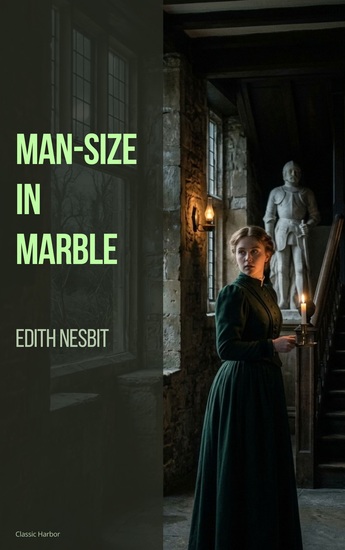
Man-Size in Marble - cover

Man-Size in Marble

Edith Nesbit

Publisher: Classic Harbor

  • 0
  • 0
  • 0

Summary

A newlywed couple discovers that their peaceful country home conceals a disturbing supernatural mystery.

Edith Nesbit's Man-Size in Marble is a classic Gothic horror story that combines domestic life, eerie atmosphere, and supernatural suspense.

When a young couple settles into their new home, strange events begin to disturb their sense of safety. The story gradually builds an unsettling atmosphere, transforming familiar surroundings into a place of mystery and fear.

Nesbit's evocative storytelling blends psychological tension with supernatural elements, making this short classic an engaging choice for readers who enjoy Gothic fiction and traditional ghost stories.

Discover the unsettling secret behind an ordinary home in this atmospheric Gothic classic.
Available since: 09/21/2026.
Print length: 22 pages.
Other books that might interest you

  • The House - Turn of the century writer that supported feminism pacifisim and labour reform - cover

    The House - Turn of the century...

    W L George

    • 0
    • 0
    • 0
    Walter Lionel George was born to British parents on the 20th March 1882 in Paris, France. 
    It was not until he was a young man of 20 that he learned English.  In 1905 he moved to London to work in an office but soon found himself working as a journalist, and as a foreign correspondent, for various London newspapers. 
    By 1911, with the publication of his first novel ‘A Bed of Roses’, which portrayed the fall of a penniless young woman into prostitution, his efforts were rewarded, and he turned to literature as a full-time career. 
    His writings now sold well.  He added short stories to his offerings as well as literary essays and several tracts that discussed left-wing themes.  Some critics thought his subject matter to be difficult and poorly chosen. His political views gained him little credit amongst his peers although such luminaries as George Orwell praised both subject matter and style. 
    His personal life was also turbulent.  His three marriages left him widowed twice.  In 1908 he married Helen Porter who died in 1914.  Helen Agnes Moorhead followed in 1916 but died only 4 years later.  His last marriage was to Kathleen Geipel in 1921. 
    W. L George died on 30th January 1926.  He was 43.
    Show book
  • Cursed Curiosities Volume 2 - 10 More Relics That Shouldn’t Exist - cover

    Cursed Curiosities Volume 2 - 10...

    H. T. W. Bousfield, C. P....

    • 0
    • 0
    • 0
    A second collection of classic works concerning items that harbour sinister secrets and unusual powers. 
    Contents: 
    "The Uncommon Prayer-Book" by M. R. James (London Mercury 1925) 
    Eight unusual copies of the Book of Common Prayer. 
    "The Green Flame" by Donald Wandrei (Weird Tales 1930) 
    The tale of a strange jewel. 
    "The Disinterment of Venus" by Clark Ashton Smith (Weird Tales 1934) 
    A curious statue unearthed in the grounds of a monastery. 
    "The Man Who Made Faces" by C. P. Howard (HorrorBabble 2024) 
    The tale of a man haunted by a past mistake. 
    "The God with Four Arms" by H. T. W. Bousfield (1939) 
    A man takes his frustrations out on a rare bronze idol. 
    "The Ebony Frame" by Edith Nesbit (Longman's 1891) 
    A beautiful and curiously carved picture frame. 
    "The Meerschaum Pipe" by L. A. Lewis (Tales of the Grotesque 1934) 
    A series of strange dreams and mysterious murders. 
    "The Black Stone Statue" by M. E. Counselman (Weird Tales 1937) 
    The story of a weird deception practised on the world by an obscure artist. 
    "Out of the Aeons" by H. P. Lovecraft (Weird Tales 1935) 
    A Boston museum that displays an ancient mummy recovered from a sunken island. 
    "The Mezzotint" by M. R. James (Ghost-Stories of an Antiquary 1904) 
    A strange engraving, with even stranger properties.
    Show book
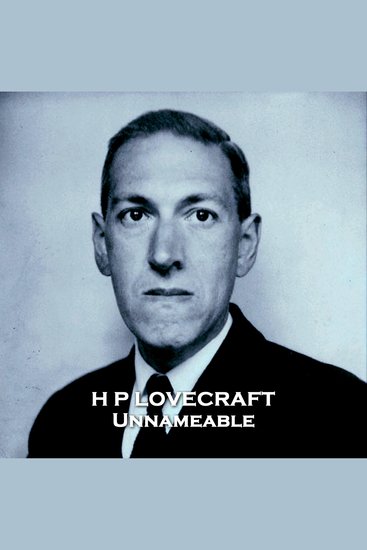
  • Unnameable - From their pens to your ears genius in every story - cover

    Unnameable - From their pens to...

    HP Lovecraft

    • 0
    • 0
    • 0
    Howard Phillips Lovecraft is among the greatest American masters of fantasy and the supernatural.  
    Born in 1890, a native of Providence, Rhode Island, his health was uncertain from childhood and he led a sheltered early life. His semi-invalidism enabled him to read omnivorously, and as a shy imaginative child he began to invent what would in his adult life become a whole macabre fantastic world of his own, peopled by creatures out of his own weird imagination.  
    As an adult he was retiring, almost a recluse. Tall, thin and pale, but with bright alert eyes, he was much given to wandering his native city in the dark hours of the night, and he became a devoted student of its antiquities.  
    Although he began to write early he had nothing published until he was in his twenties. He set many of his stories around the imaginary town of Arkham, and invented an entire mythology of his own, its core being the demoniac cult of Cthulhu, based on the lore or legend that the world was at one time inhabited by another race who, in practising black magic, lost their foothold or were expelled, yet live on outside, ever ready to take possession of this earth again. 
    Since his early death in 1937 his stories have continued to attract attention and praise from an ever-growing audience.
    Show book
  • Heart of Darkness - cover

    Heart of Darkness

    Joseph Conrad

    • 0
    • 0
    • 0
    Heart of Darkness is an 1899 novella by Joseph Conrad. Widely regarded as a critique of European imperialism and a psychological exploration of human nature, it follows an English sailor, Charles Marlow, who recounts his harrowing voyage up the Congo River for a Belgian company to find Mr. Kurtz, an enigmatic ivory trader who has gone mad and established himself as a god-like figure.    Plot and Structure:    The novella uses a frame narrative (a story within a story). The tale opens on a ship anchored on the River Thames near London, where an unnamed narrator and his crewmates listen to Charles Marlow tell the story of his early life. The core of the book details Marlow's voyage into the Belgian Congo to retrieve Kurtz, a highly successful and revered Company agent who has abandoned his civilized ideals and embraced brutality.    Main Characters:    Charles Marlow: The protagonist and primary narrator, a sailor who becomes disillusioned by the stark contrast between the purported civilizing mission of colonialism and the brutal reality he witnesses.    Mr. Kurtz: A powerful and eloquent ivory trader who devolves into madness, illustrating the moral decay and corruption that unchecked power causes.
    Show book
  • The Happy Prince - cover

    The Happy Prince

    Oscar Wilde

    • 0
    • 0
    • 0
    In a town full of suffering poor people, a swallow who was left behind after his flock flew off to Egypt for the winter meets the statue of the late "Happy Prince", who has never experienced true sorrow, for he lived in a palace where sorrow was not allowed to enter. Viewing various scenes of people suffering in poverty from his tall monument, the Happy Prince asks the swallow to take the ruby from his hilt, the sapphires from his eyes, and the gold leaf covering his body to give to the poor...
    Show book
  • West-Running Brook - cover

    West-Running Brook

    Robert Frost

    • 0
    • 0
    • 0
    "West-Running Brook" is a collection of poetry by the renowned American poet Robert Frost, first published in 1928. The title poem serves as the centerpiece of the collection, with the overarching theme of the flow of time and the interconnectedness of past, present, and future. 
    In "West-Running Brook," Frost uses the metaphor of a brook that flows contrary to the usual direction, symbolizing the poet's own journey against the current of conventional wisdom and tradition. The brook becomes a powerful symbol of resilience and individuality, as well as a reflection of the poet's own introspection and exploration of the human experience. 
    Throughout the collection, Frost's signature style of writing in accessible yet profound language is evident. His poetry often explores themes of nature, rural life, and the complexities of human existence. With vivid imagery and keen observation, Frost invites readers to contemplate the beauty and mystery of the natural world, as well as the deeper truths and universal truths that lie beneath the surface. 
    Among the notable poems in the collection are "Spring Pools," which reflects on the cyclical nature of life and the passage of time; "The Silken Tent," a metaphor for the delicate balance between strength and flexibility in human relationships; and "Desert Places," which explores themes of isolation and existential despair amidst the vastness of the natural world. 
    "West-Running Brook" showcases Frost's mastery of form and language, as well as his ability to capture the complexities of the human condition with depth and nuance. Through its exploration of timeless themes and its lyrical beauty, the collection remains a testament to Frost's enduring legacy as one of America's most beloved poets.
    Show book