Rejoignez-nous pour un voyage dans le monde des livres!
Ajouter ce livre à l'électronique
Grey
Ecrivez un nouveau commentaire Default profile 50px
Grey
Abonnez-vous pour lire le livre complet ou lisez les premières pages gratuitement!
All characters reduced
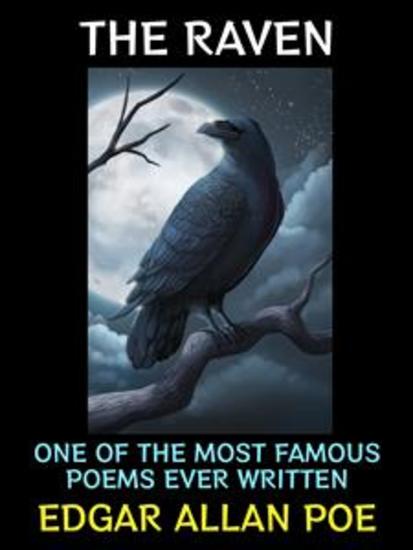
The Raven - One of the Most Famous Poems Ever Written - cover

The Raven - One of the Most Famous Poems Ever Written

Edgar Allan Poe

Maison d'édition: Diamond Book Publishing

  • 0
  • 0
  • 0

Synopsis

The Raven A narrative poem by Edgar Allan Poe. Published originally in January 1845, the poem has a musical quality with stylized language and a supernatural atmosphere. It speaks of a mysterious talking raven's visit to a distraught lover, depicting the man's slow fall into madness. The lover is lamenting the loss of his love, Lenore. Sitting on a bust of "Pallas", the raven seems to have a purpose of further instigating his distress with its constant repetition of the word "Nevermore". This poem makes good use of a number of folk and classical references.
Disponible depuis: 25/10/2022.
D'autres livres qui pourraient vous intéresser

  • A Man with Two Lives - From their pens to your ears genius in every story - cover

    A Man with Two Lives - From...

    Ambrose Bierce

    • 0
    • 0
    • 0
    Ambrose Gwinnett Bierce was born on 24th June 1842 at Horse Cave Creek in Meigs County, Ohio. His parents were poor but they introduced him to literature at an early age, instilling in him a deep appreciation of books, the written word and the elegance of language.  
    Growing up in Koscuisko County, Indiana poverty and religion were defining features of his childhood, and he would later describe his parents as “unwashed savages” and fanatically religious, showing him little affection but always quick to punish. He came to resent religion, and his introduction to literature appears to be their only positive effect. 
    At age 15 Bierce left home to become a printer’s devil, mixing ink and fetching type at The Northern Indian, a small Ohio paper. Falsely accused of theft he returned to his farm and spent time sending out work in the hopes of being published. 
    His Uncle Lucius advised he be sent to the Kentucky Military Institute. A year later he was commissioned as an Officer.  As the Civil War started Bierce enlisted in the 9th Indiana Infantry Regiment.  
    In April 1862 Bierce fought at the Battle of Shiloh, an experience which, though terrifying, became the source of several short stories. Two years later he sustained a serious head wound and was off duty for several months. He was discharged in early 1865.  
    A later expedition to inspect military outposts across the Great Plains took him all the way to San Francisco. He remained there to become involved with publishing and editing and to marry, Mary Ellen on Christmas Day 1871.  They had a child, Day, the following year.  
    In 1872 the family moved to England for 3 years where he wrote for Fun magazine. His son, Leigh, was born, and first book, ‘The Fiend’s Delight’, was published.  
    They returned to San Francisco and to work for a number of papers where he gained admiration for his crime reporting. In 1887 he began a column at the William Randolph Hearst’s San Francisco Examiner.  
    Bierce’s marriage fell apart when he discovered compromising letters to his wife from a secret admirer. The following year, 1889 his son Day committed suicide, depressed by romantic rejection. 
    In 1891 Bierce wrote and published the collection of 26 short stories which included ‘An Occurrence at Owl Creek Bridge’.  Success and further works including poetry followed.  
    Bierce with Hearst’s resources helped uncover a financial plot by a railroad to turn 130 million dollars of loans into a handout. Confronted by the railroad and asked to name his price Bierce answered “my price is $130 million dollars. If, when you are ready to pay, I happen to be out of town, you may hand it over to my friend, the Treasurer of the United States”.  
    He now began his first foray as a fabulist, publishing ‘Fantastic Fables’ in 1899.  But tragedy again struck two years later when his second son Leigh died of pneumonia relating to his alcoholism.  
    He continued to write short stories and poetry and also published ‘The Devil’s Dictionary’.  
    At the age of 71, in 1913 Bierce departed from Washington, D.C., for a tour of the battlefields where he had fought during the civil war. At the city of Chihuahua he wrote his last known communication, a letter to a friend. It’s closing words were “as to me, I leave here tomorrow for an unknown destination,” Ambrose Bierce then vanished without trace.
    Voir livre
  • The Green Fairy Book - cover

    The Green Fairy Book

    Andrew Lang

    • 0
    • 0
    • 0
    In The Green Fairy Book, Andrew Lang continues his celebrated work of gathering fairy tales from many nations into one collection, preserving stories that have delighted generations and offering them anew to young readers—and to all who value the enduring charm of folklore. This volume, the third in Lang’s famous “Coloured” Fairy Book series, draws its tales from an especially wide array of sources: French, German, Russian, Italian, Scottish, and even oral traditions from tribal cultures such as the Zulus of South Africa. 
    Lang, though a scholar of history and literature, held a deep affection for the fairy tale. In his original introduction, he writes, “The fairy tale is the oldest form of fiction, and it may be the most enduring.” He believed that fairy tales served not only to entertain but to cultivate imagination, to sharpen a child’s sense of wonder, and to subtly shape moral understanding. Though some may dismiss such tales as fanciful or outdated, Lang insisted that they contain “a kind of poetry and fun which children appreciate more than people suppose.” 
    Not all of the stories have the neat, happy endings we have come to expect from the sanitised versions of Fairy Tales in the 20th Century, and quite a few have their macabre and bloodthirsty moments! 
    Head Stories Audio presents "The Green Fairy Book" by Andrew Lang.  Narration and original music by Simon Hester.
    Voir livre
  • Stree Aur Purush - cover

    Stree Aur Purush

    Munshi Premchand

    • 0
    • 0
    • 0
    Delve into the complexities of gender and societal norms with Munshi Premchand’s “Stree Purush.” This compelling narrative explores the life of Vipin Babu, a poet whose idealization of women is challenged by the realities of marriage and expectations. Premchand’s masterful storytelling weaves a tale that questions the superficiality of beauty and the depth of relationships. 
    As Vipin Babu confronts his preconceived notions of the perfect partner, readers are taken on a journey through the emotional turmoil of disillusionment and the search for true connection. “Stree Purush” is not just a story; it’s a mirror reflecting the societal constructs that shape our perceptions and interactions.
    Voir livre
  • Case of Charles Dexter Ward The (Ungekürzt) - cover

    Case of Charles Dexter Ward The...

    H. P. Lovecraft

    • 0
    • 0
    • 0
    Charles Dexter Ward is a young man from a prominent Rhode Island family who has disappeared from a mental asylum. He had been incarcerated during a prolonged period of insanity, during which he exhibited minor and inexplicable physiological changes. His empty cell is found to be very dusty. The bulk of the story concerns the investigation conducted by the Wards' family doctor, Marinus Bicknell Willett, in an attempt to discover the reason for Ward's madness and physiological changes. Willett learns that Ward had spent the past several years attempting to discover the grave of his ill-reputed ancestor, Joseph Curwen. The doctor slowly begins to reveal the truth behind the legends surrounding Curwen, an eighteenth-century shipping entrepreneur and alleged alchemist, who was in reality a necromancer and mass murderer. A raid on Curwen's farm was remarkable for the shouted incantations, lights, explosions, and some not-quite-human figures shot down by the raiders. The raiders swore any witnesses to strict secrecy about what they saw and heard. As Willett's investigations proceed, he finds that Charles had recovered Curwen's ashes, and through the use of magical formulae contained in documents found hidden in Curwen's home in Providence, was able to call forth Curwen from his "essential saltes" and resurrect him. Willett also finds that Curwen, who resembles Charles enough to pass for him, murdered and replaced his modern descendant and resumed his evil activities. Although Curwen convinces onlookers that he is Charles, his anachronistic mindset and behavior lead authorities to certify him insane and imprison him in an asylum.
    
    While Curwen is locked up, Willett's investigation leads him to a bungalow in Pawtuxet Village, which Ward had purchased while under the influence of Curwen. The house is on the site of the old farm which was Curwen's headquarters for his nefarious doings; beneath is a vast catacomb that the wizard had built as a lair during his previous lifetime. During a horrific journey through this labyrinth, in which Willett sees a deformed monster in a pit, he discovers the truth about Curwen's crimes and also the means of returning him to the grave. It is also revealed that Curwen has been engaged in a long-term conspiracy with certain other necromancers, associates from his previous life who have somehow escaped death, to resurrect and torture the world's wisest people to gain knowledge that will make them powerful and threaten the future of mankind. While in Curwen's laboratory, Willett accidentally summons an ancient entity who is an enemy of Curwen and his fellow necromancers. The doctor faints, awakening much later in the bungalow. The entrance to the vaults has been sealed as if it had never existed, but Willett finds a note from the being written in Latin instructing him to kill Curwen and destroy his body. Willett confronts Curwen at the asylum and succeeds in reversing the resurrection spell, returning the sorcerer to dust. News reports reveal that Curwen's prime co-conspirators and their households have met brutal deaths, and their lairs have been destroyed.
    Voir livre
  • Will the Empire Live? (Unabridged) - cover

    Will the Empire Live? (Unabridged)

    H. G. Wells

    • 0
    • 0
    • 0
    Herbert George Wells (21 September 1866 - 13 August 1946) was an English writer. Prolific in many genres, he wrote dozens of novels, short stories, and works of social commentary, history, satire, biography and autobiography. His work also included two books on recreational war games. Wells is now best remembered for his science fiction novels and is often called the "father of science fiction", along with Jules Verne and the publisher Hugo Gernsback.
    WILL THE EMPIRE LIVE?: What will hold such an Empire as the British together, this great, laxly scattered, sea-linked association of ancient states and new-formed countries, Oriental nations, and continental colonies? What will enable it to resist the endless internal strains, the inevitable external pressures and attacks to which it must be subjected This is the primary question for British Imperialism; everything else is secondary or subordinated to that.
    Voir livre
  • The Sun Also Rises - cover

    The Sun Also Rises

    Ernest Hemingway

    • 0
    • 2
    • 0
    A World War I veteran journeys from Paris to Pamplona during an era of decadence and despair in this “gripping” classic novel of the Lost Generation (The New York Times).   Physically and emotionally damaged by his service in the Great War, Jake Barnes lives in 1920s France, where he passes time in nightclubs and cafés, yearning for a fellow expatriate, the beautiful English divorcée Lady Brett Ashley. She is a lively and daring woman, desired by many other men. As the pair and their social companions travel to Spain, engage in affairs and fistfights, and wrestle with the aftereffects of a senseless worldwide catastrophe, Jake must struggle mightily to hold on to his soul.   From the Nobel Prize winner and icon of twentieth-century American literature, this novel is “the ideal companion for troubled times: equal parts Continental escape and serious grappling with the question of what it means to be, and feel, lost” (The Wall Street Journal).   “A truly gripping story . . . magnificent writing.” —The New York Times
    Voir livre