Unisciti a noi in un viaggio nel mondo dei libri!
Aggiungi questo libro allo scaffale
Grey
Scrivi un nuovo commento Default profile 50px
Grey
Iscriviti per leggere l'intero libro o leggi le prime pagine gratuitamente!
All characters reduced
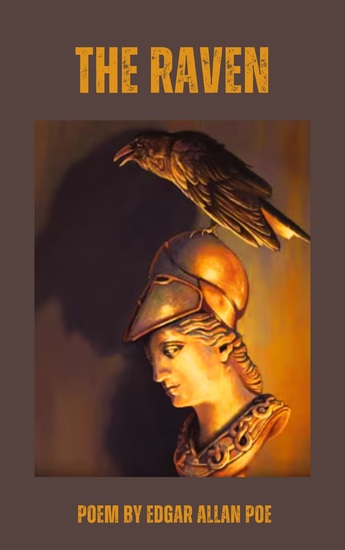
The Raven - Dark Elegance - cover

The Raven - Dark Elegance

Edgar Allan Poe, Zenith Crescent Moon Press

Casa editrice: Zenith Crescent Moon Press

  • 0
  • 0
  • 0

Sinossi

🌌 Immerse yourself in the captivating world of Edgar Allan Poe's iconic masterpiece, The Raven. This timeless poem weaves a tale of sorrow, love, and unrelenting despair, masterfully capturing the depths of human emotion. With its hauntingly beautiful rhythm and vivid imagery, Poe leads readers on an unforgettable journey through the mind of a grieving narrator, visited by a mysterious raven that speaks just one chilling word: "Nevermore."
🖋️ Explore the evocative themes of loss, longing, and memory, as Poe's lyrical genius paints a rich tapestry of Gothic beauty. The eerie atmosphere and poignant reflections on life's impermanence resonate deeply, offering both a chilling and profound experience. As the narrator grapples with the spectral presence of the raven, readers are drawn into an emotional whirlwind, teetering between the supernatural and the psychological.
🌟 Recognized as one of the greatest works of American literature, The Raven has enthralled readers for generations. Its hypnotic verses and intricate symbolism invite endless interpretations, making it a favorite for lovers of poetry, Gothic fiction, and dark romanticism. Whether you're revisiting Poe's genius or discovering it for the first time, this poem's allure is as compelling today as it was upon its publication.
✨ Step into the dark elegance and haunting charm of Poe's world, where every word lingers, and every line invites reflection. Ideal for fans of Gothic storytelling, literary classics, or simply those seeking an exploration of the human soul's shadowy corners.
👉 Click now to experience the haunting beauty of this Gothic masterpiece and uncover why it has become a timeless treasure.
Disponibile da: 18/03/2025.
Lunghezza di stampa: 102 pagine.

Altri libri che potrebbero interessarti

  • Ottoman Empire’s Most Important Battles The: The History and Legacy of the Ottomans’ Biggest Victories and Defeats - cover

    Ottoman Empire’s Most Important...

    Editors Charles River

    • 0
    • 0
    • 0
    In terms of geopolitics, perhaps the most seminal event of the Middle Ages was the successful Ottoman siege of Constantinople in 1453. The city had been an imperial capital as far back as the 4th century, when Constantine the Great shifted the power center of the Roman Empire there, effectively establishing two almost equally powerful halves of antiquity’s greatest empire. Constantinople would continue to serve as the capital of the Byzantine Empire even after the Western half of the Roman Empire collapsed in the late 5th century. Naturally, the Ottoman Empire would also use Constantinople as the capital of its empire after their conquest effectively ended the Byzantine Empire, and thanks to its strategic location, it has been a trading center for years and remains one today under the Turkish name of Istanbul.  
    The end of the Byzantine Empire had a profound effect not only on the Middle East but Europe as well. Constantinople had played a crucial part in the Crusades, and the fall of the Byzantines meant that the Ottomans now shared a border with Europe. Indeed, the Ottomans would clash with Russians, Austrians, Venetians, Polish, and more before collapsing as a result of World War I, when they were part of the Central powers.  
    In the wake of taking Constantinople, the Ottoman Empire would spend the next few centuries expanding its size, power, and influence, bumping up against Eastern Europe and becoming one of the world’s most important geopolitical players. It was a rise that would not truly start to wane until the 19th century. Preserving its mixed heritage, coming from both its geographic position rising above the ashes of the Byzantine Empire and the tradition inherited from the Muslim Conquests, the Ottoman Empire lasted more than six centuries.
    Mostra libro
  • A Small Stubborn Town - Life death and defiance in Ukraine – As heard on BBC Radio 4 - cover

    A Small Stubborn Town - Life...

    Andrew Harding

    • 0
    • 0
    • 0
    A Telegraph Book of the Year, soon to be a BBC Radio 4 dramatisation.'Extraordinary.' Philippe Sands'We are touched by the courage and dignity of Andrew Harding's characters - qualities that the author must surely possess in equal measure.' - Andrey Kurkov'A  story of extraordinary heroism by ordinary people. - James Meek'This gripping account is the Russian invasion of Ukraine in microcosm.' - Lindsey HilsumIt's March 2022 and Russian tanks are roaring across the vast, snow-dusted fields of Ukraine. Their destination: Voznesensk, a town with a small bridge that could change the course of the war.The heavily-armed Russians are expecting an easy fight - or no fight at all. After all, Voznesensk is a quiet farming town, full of pensioners. But the locals appear to have other ideas.Svetlana, a grandmother with arthritis, reacts in fury when Russian troops turn her cottage into their blood-soaked headquarters. Valentin, a quick-talking lawyer, joins the town's 'Dads Army' defenders, crouching in a trench with an AK47. Meanwhile, 21-year-old Sergei grabs a Molotov cocktail and lies in wait for Russian tanks as they push towards Dead Water Bridge.The odds are terrible. But a plan is emerging, and there's a chance it could save not just Voznesensk, but the rest of southern Ukraine. Meanwhile, inside the tanks, an inner battle rages. As Russian officer Igor Rudenko prepares to invade, he has a secret. He is Ukrainian himself.A gripping work of reportage that tells the story of a pivotal moment in Ukraine's war, this is a real-life thriller about ordinary people facing extraordinary circumstances with resilience, humour and ingenuity.'[Andrew Harding is] one of our most gifted and sensitive journalists' - Jon Snow
    Mostra libro
  • The Importance of Loving Yourself - cover

    The Importance of Loving Yourself

    Pastor Philip

    • 0
    • 0
    • 0
    The importance of loving yourself must be based on the consciousness of God's love to you in Christ. You can only begin to love yourself by having an awareness of God's love for you. The instrumental "Wonderful Grace" by Divine Sounds, at the end of the message, gives the listener time to reflect on what has been said.
    Mostra libro
  • The In-Group Bias - Favoring Members of Your Own Group over Others - cover

    The In-Group Bias - Favoring...

    William Rands

    • 0
    • 0
    • 0
    In-group bias is a psychological phenomenon where individuals favor members of their own group over those belonging to other groups. This bias is rooted in the human tendency to classify people into various social categories, such as race, religion, nationality, or even less obvious distinctions like political affiliation or sports team loyalty. Once these distinctions are made, individuals typically develop a sense of belonging and loyalty to their own group—the "in-group"—while viewing outsiders, or "out-group" members, as different or inferior. 
    At its core, in-group bias serves a functional purpose in social behavior. Evolutionarily, humans have relied on social groups for survival, and belonging to a cohesive group provided benefits such as shared resources, protection, and mutual support. However, as societies evolved and became more complex, these group dynamics also gave rise to preferential treatment of those within the same group. This is not limited to obvious groups like tribes or clans but can extend to any group with which an individual identifies. Whether through shared beliefs, common goals, or even simple social interactions, in-group bias manifests in everyday life, influencing decisions, relationships, and behaviors. 
    In-group bias is a key concept in social psychology because it highlights how much of human behavior is shaped by the need for social belonging. This bias leads to favoritism in various aspects of life, from workplace promotions and academic opportunities to political support and even everyday social interactions. The impact of in-group bias can be subtle, such as favoring a colleague over an outsider for a minor task, or more overt, such as discrimination against individuals from a different ethnic background.
    Mostra libro
  • First Triumvirate The: The History of the Men Who Led Rome Near the End of the Republic - cover

    First Triumvirate The: The...

    Editors Charles River

    • 0
    • 0
    • 0
    Thanks to his rise in the military and politics, Crassus’s renown and riches heavily influenced his contemporaries. In the wake of the Third Servile War, Crassus’ patronage helped position Caesar to be appointed governor of Hispania Ulterior. In order to maintain political office, which made him immune from prosecution for his debts, he left for modern day Spain before his praetorship expired. Caesar made this move knowing that governors were immune from prosecution, but governors also had vitally important military responsibilities via command of whatever legions were garrisoned in their territory. It would be as governor that Caesar’s military career truly took off, starting with his victories over a couple of local tribes. These military successes earned him the title Imperator, the Roman equivalent of the title of Commander.  
    	Likewise, Caesar was heavily sponsored in his run for Consul by Crassus, and in a brilliant stroke of diplomacy, he succeeded in reconciling Crassus with Pompey, who was Rome’s most powerful general at the time. Alongside Pompey and Caesar, Crassus established the First Triumvirate, with Crassus supplying the funds, Pompey the muscle, and Caesar the political clout necessary for governing the city. Though later triumvirates officially wielded power, like the Second Triumvirate (which formed in the wake of Caesar’s assassination and included his heir Augustus and longtime general Mark Antony), this First Triumvirate acted behind the scenes to run Rome unofficially. 
    	The triumvirate would come to an end when Crassus met a sudden and unexpected end while campaigning in the east against the Parthians. Ironically, his failed campaign is better remembered than the rest of his life because of the way his reputation brought about his manner of death: ancient writers claimed that shortly after he was killed in fighting, the Parthians poured molten gold down his throat and then used his head as a prop in a play.
    Mostra libro
  • padraig h pearse awakening - cover

    padraig h pearse awakening

    William T McCartney

    • 0
    • 0
    • 0
    The story of the awakening of Padraig H Pearse from this teenage years to adulthood. Pearse was a barrister and ardent promoter of the Irish language and culture. He set up the school of St Endas which taught all subjects through the Irish language. Tragically he was executed for his part as leader of the 1916 Rising. An immortal hero of the republic.
    Mostra libro