Rejoignez-nous pour un voyage dans le monde des livres!
Ajouter ce livre à l'électronique
Grey
Ecrivez un nouveau commentaire Default profile 50px
Grey
Abonnez-vous pour lire le livre complet ou lisez les premières pages gratuitement!
All characters reduced
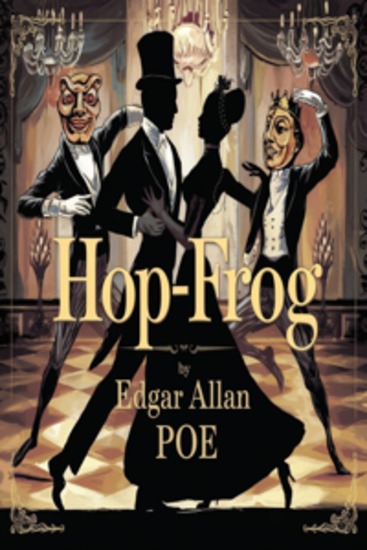
Hop-Frog (illustrated) - cover

Hop-Frog (illustrated)

Edgar Allan Poe

Maison d'édition: Swish

  • 0
  • 0
  • 0

Synopsis

"Hop-Frog" is a gripping tale by Edgar Allan Poe, first published in 1849 and now in the public domain. This dark and thought-provoking story follows Hop-Frog, a court jester and dwarf, who exacts a clever and fiery revenge on a tyrannical king and his corrupt courtiers. Combining Poe’s signature elements of psychological depth, suspense, and macabre, Hop-Frog explores themes of justice, resilience, and the power of wit against oppression.
This edition has been carefully formatted for digital publication, preserving the original text to enhance readability on modern devices. Dive into this timeless classic and experience the genius of Edgar Allan Poe like never before.
Disponible depuis: 11/12/2024.

D'autres livres qui pourraient vous intéresser

  • Man With a Nose The (Unabridged) - cover

    Man With a Nose The (Unabridged)

    H. G. Wells

    • 0
    • 0
    • 0
    Herbert George "H. G." Wells (1866 - 1946) was an English writer.
    He was prolific in many genres, including the novel, history, politics, social commentary, and textbooks and rules for war games. Wells is now best remembered for his science fiction novels and is called a "father of science fiction"
    THE MAN WITH A NOSE: "I never see thy face but I think upon hell-fire, and Dives that lived
    in purple, for there he is in his robes, burning, burning." "My nose has been the curse of my life."
    Voir livre
  • War and Peace - Book 1: 1805 (Unabridged) - cover

    War and Peace - Book 1: 1805...

    Leo Tolstoy

    • 0
    • 0
    • 0
    War and Peace is a literary work mixed with chapters on history and philosophy by the Russian author Leo Tolstoy. It was first published serially, then published in its entirety in 1869. It is regarded as one of Tolstoy's finest literary achievements and remains an internationally praised classic of world literature.
    Book 1: 1805: "Well, Prince, so Genoa and Lucca are now just family estates of the Buonapartes. But I warn you, if you don't tell me that this means war, if you still try to defend the infamies and horrors perpetrated by that Antichrist I really believe he is Antichrist I will have nothing more to do with you and you are no longer my friend, no longer my 'faithful slave,' as you call yourself! But how do you do? I see I have frightened you sit down and tell me all the news."
    Voir livre
  • To The Lighthouse - The Original Manuscript - cover

    To The Lighthouse - The Original...

    Virginia Woolf

    • 0
    • 0
    • 0
    The Ramsey family, with house guests, visit the Isle of Skye at least twice. The plot is not at all the point though, as this is a book about how people think and feel and relate. There’s insight into the world of childhood thought and emotion, and a variety of views of adult care and perceptions. I hope this doesn’t make it sound ‘difficult’, it doesn’t need to be – just let the sentences flow and make your own sense of the words. It’s perhaps as close as a novel can come to the highly individual experience of looking at a painting. 
     
    Virginia Woolf was an English writer, considered one of the most important modernist 20th-century authors and a pioneer in using stream of consciousness as a narrative device. 
    Woolf was born into an affluent household in South Kensington, London, the seventh child of Julia Prinsep Jackson and Leslie Stephen in a blended family of eight which included the modernist painter Vanessa Bell. She was home-schooled in English classics and Victorian literature from a young age. From 1897 to 1901, she attended the Ladies' Department of King's College London, where she studied classics and history and came into contact with early reformers of women's higher education and the women's rights movement. 
    Encouraged by her father, Woolf began writing professionally in 1900. After her father's death in 1904, the Stephen family moved from Kensington to the more bohemian Bloomsbury, where, in conjunction with the brothers' intellectual friends, they formed the artistic and literary Bloomsbury Group. In 1912, she married Leonard Woolf, and in 1917, the couple founded the Hogarth Press, which published much of her work.
    Voir livre
  • The Mill on the Floss - cover

    The Mill on the Floss

    George Eliot, (Mary Ann Evans)

    • 0
    • 0
    • 0
    "The Mill on the Floss," published in 1860, is a novel by George Eliot (the pen name of Mary Ann Evans). It is a poignant portrayal of Victorian England and captures the complexities of family dynamics, societal expectations, and personal aspirations. The story centers on Maggie Tulliver, a passionate and intelligent woman struggling to satisfy her emotional needs in the rigid provincial community of St. Ogg's. Her relationship with her brother, Tom, and their conflicts with family and society form the crux of the narrative. The novel explores themes of gender norms, education, and the tension between individual desires and social conventions.
    Voir livre
  • Remarkable Case of Davidson's Eyes The (Unabridged) - cover

    Remarkable Case of Davidson's...

    H. G. Wells

    • 0
    • 0
    • 0
    'The Remarkable Case of Davidson's Eyes' is the strange tale of an inexplicable case of a scientist who, after an accident with a magnet and a flash of lightning, finds that his eyes no longer see the world where the rest of his body is but another part of the world altogether - a southern hemisphere island inhabited by penguins.
    Voir livre
  • Frederick and Catherine - Story Time Episode 9 (Unabridged) - cover

    Frederick and Catherine - Story...

    Brothers Grimm

    • 0
    • 0
    • 0
    Frederick and Catherine were husband and wife. He left to do his work. She started to fry a sausage and thought she could get a beer while it cooked. In the cellar, drawing it, she realized the dog was loose and might eat the sausage, but the dog had already done so, and she chased it but could not catch it. Meanwhile, the keg of beer emptied itself into the cellar. To hide this, she used flour she bought at a fair to dry it. Frederick was furious hearing this.
    Voir livre