Rejoignez-nous pour un voyage dans le monde des livres!
Ajouter ce livre à l'électronique
Grey
Ecrivez un nouveau commentaire Default profile 50px
Grey
Abonnez-vous pour lire le livre complet ou lisez les premières pages gratuitement!
All characters reduced
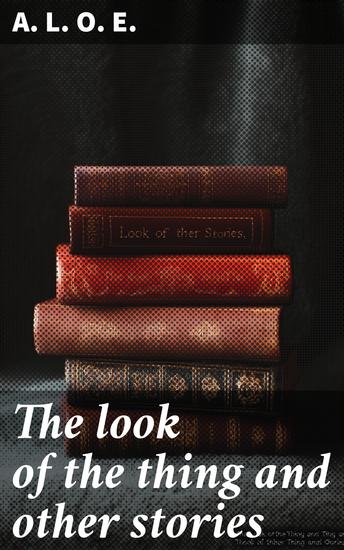
The look of the thing and other stories - cover

The look of the thing and other stories

E. A. L. O.

Maison d'édition: Good Press

  • 0
  • 0
  • 0

Synopsis

In "The Look of the Thing and Other Stories," A. L. O. E. weaves together a collection of short tales that deftly blend moral conviction with poignant observation. The literary style is characterized by its elegant simplicity and underlying complexity, often infused with allegorical elements and social commentary that reflect the Victorian era's values and challenges. Each story delves into the human experience, examining themes of identity, societal norms, and personal agency, while showcasing A. L. O. E.'s ability to create vivid characters within richly drawn settings. A. L. O. E., the pseudonym of Charlotte Mary Yonge, was a prominent figure in Victorian literature with a profound understanding of moral education and women's roles in society. Her religious convictions and advocacy for women's issues profoundly influenced her writing, leading her to explore topics that resonate with both the domestic sphere and broader social contexts. This collection is a testament to her commitment to showcasing the intricate details of everyday life and the individual's place within it. This insightful collection is highly recommended for readers interested in Victorian literature and those who appreciate stories that provoke thoughtful reflections on moral and social issues. "The Look of the Thing and Other Stories" invites readers to engage with the complexities of human nature while enjoying the craft of a master storyteller.
Disponible depuis: 02/03/2025.
Longueur d'impression: 200 pages.

D'autres livres qui pourraient vous intéresser

  • War and Peace (Book Fourteen: 1812) - cover

    War and Peace (Book Fourteen: 1812)

    Leo Tolstoy

    • 0
    • 0
    • 0
    War and Peace is a literary work mixed with chapters on history and philosophy by the Russian author Leo Tolstoy. It was first published serially, then published in its entirety in 1869. It is regarded as one of Tolstoy's finest literary achievements and remains an internationally praised classic of world literature.
    Book 14: 1812: The Battle of Borodinó, with the occupation of Moscow that followed it and the flight of the French without further conflicts, is one of the most instructive phenomena in history. All historians agree that the external activity of states and nations in their conflicts with one another is expressed in wars, and that as a direct result of greater or less success in war the political strength of states and nations increases or decreases.
    Voir livre
  • The Iron Heel - cover

    The Iron Heel

    Jack London

    • 0
    • 0
    • 0
    The Iron Heel is a science fiction novel novel by American writer Jack London, first published in 1908. 
    It is considered to be "the earliest of the modern dystopian" fiction, it chronicles the rise of an oligarchic tyranny in the United States. In The Iron Heel, Jack London's socialist views are explicitly on display. A forerunner of soft science fiction novels and stories of the 1960s and 70s, the book stresses future changes in society and politics while paying much less attention to technological changes.
    The Iron Heel is cited by George Orwell's biographer Michael Shelden as having influenced Orwell's most famous novel Nineteen Eighty-Four. Orwell himself described London as having made "a very remarkable prophecy of the rise of Fascism", in the book and believed that London's understanding of the primitive had made him a better prophet "than many better-informed and more logical thinkers." Specifically, Orwell's protagonist Winston Smith, like London's Avis Everhard, keeps a diary where he writes down his rebellious thoughts and experiences. However, while Everhard's diary remained hidden during the centuries of tyranny to be discovered and published later, Smith's diary falls into the hands of the book's harsh Thought Police, whose interrogator tells Smith not to expect posterity to vindicate him: "Posterity will never hear of you, we will vaporize you".
    Voir livre
  • Leonid Andreyev - A Short Story Collection - Considered to be a father of Expressionism in Russian literature and the Russian Edgar Allan Poe we bring a unique collection of amazing stories for you to hear - cover

    Leonid Andreyev - A Short Story...

    Leonid Andreyev

    • 0
    • 0
    • 0
    Leonid Nikolaievich Andreyev was born on 21st August in Oryol, Russia to a middle-class family of Polish, Ukranian and Finnish ancestry. 
     
    He studied law in Moscow before working as a police-court reporter for a daily newspaper.  His literary efforts at this time were confined to poetry and those he did try to get published were all rejected.  
     
    In 1898 his first short story ‘Bargamot and Garaska’, published in the ‘Kurier’ newspaper caught the attention and friendship of Maxim Gorky.  Andreyev now discarded any other career path apart from that of author. 
     
    His first collection of short stories appeared in 1901 and sold over a quarter of a million copies.  He was a sensation. Using his interest in psychology and psychiatry gave him an almost unrivalled ability to delve into the human psyche and create astonishing characters. 
     
    During the first Russian revolution Andreyev was a staunch defender of democratic ideals and many of his stories reflected the heated mood of the times. With the 1905 Revolution’s failure his work became pessimistic and despairing. By the beginning of the following decade he began losing his audience to new literary movements such as the Futurists. 
     
    He published little after 1914 except political writings, instead working as the literary editor of the ‘Russian Will’ newspaper.  When the Bolsheviks took power he sensed catastrophe was coming and moved to Finland where he spent his last years in poverty distraught at the outcome of the Revolution. 
     
    Leonid Andreyev died of heart failure on 12th September 1919 at the age of 48 in Mustamäki, Finland.
    Voir livre
  • Wind from the Hospitable Sea - cover

    Wind from the Hospitable Sea

    Witold Makowiecki, Tom Pinch

    • 0
    • 0
    • 0
    In extraordinary times, twelve-year-old boys must act like men. 
    Greece 562 BC. For insolvent debtors, the price of bankruptcy is slavery. When his mother and siblings are seized for unpaid debts, little Diossos must run to fetch help. He must cross mountains, forests, and stormy seas, brave wild animals, slave catchers, pirates, and the power of the state. He has a month to complete his quest, only days to grow up. 
    The Heroes of Out of the Lion’s Maw return for an encore in this stand-alone classic tale of high adventure, full of white-knuckle cliffhangers and last-minute escapes, engaging characters, and sparkling humor. 
    Continuously in print since 1946 across Eastern Europe, the book has been compared for its tempo and style to Treasure Island and The Three Musketeers. If you liked those, you will like this. 
    Enter the adventure!
    Voir livre
  • Brown Wolf (Unabridged) - cover

    Brown Wolf (Unabridged)

    Jack London

    • 0
    • 0
    • 0
    Jack London (born John Griffith Chaney, January 12, 1876 - November 22, 1916) was an American author, journalist, and social activist. He was a pioneer in the then-burgeoning world of commercial magazine fiction and was one of the first fiction writers to obtain worldwide celebrity and a large fortune from his fiction alone.
    BROWN WOLF: She had delayed, because of the dew-wet grass, in order to put on her overshoes, and when she emerged from the house found her waiting husband absorbed in the wonder of a bursting almond-bud. She sent a questing glance across the tall grass and in and out among the orchard trees.
    Voir livre
  • A Wireless Message - From their pens to your ears genius in every story - cover

    A Wireless Message - From their...

    Ambrose Bierce

    • 0
    • 0
    • 0
    Ambrose Gwinnett Bierce was born on 24th June 1842 at Horse Cave Creek in Meigs County, Ohio. His parents were poor but they introduced him to literature at an early age, instilling in him a deep appreciation of books, the written word and the elegance of language.  
    Growing up in Koscuisko County, Indiana poverty and religion were defining features of his childhood, and he would later describe his parents as “unwashed savages” and fanatically religious, showing him little affection but always quick to punish. He came to resent religion, and his introduction to literature appears to be their only positive effect. 
    At age 15 Bierce left home to become a printer’s devil, mixing ink and fetching type at The Northern Indian, a small Ohio paper. Falsely accused of theft he returned to his farm and spent time sending out work in the hopes of being published. 
    His Uncle Lucius advised he be sent to the Kentucky Military Institute. A year later he was commissioned as an Officer.  As the Civil War started Bierce enlisted in the 9th Indiana Infantry Regiment.  
    In April 1862 Bierce fought at the Battle of Shiloh, an experience which, though terrifying, became the source of several short stories. Two years later he sustained a serious head wound and was off duty for several months. He was discharged in early 1865.  
    A later expedition to inspect military outposts across the Great Plains took him all the way to San Francisco. He remained there to become involved with publishing and editing and to marry, Mary Ellen on Christmas Day 1871.  They had a child, Day, the following year.  
    In 1872 the family moved to England for 3 years where he wrote for Fun magazine. His son, Leigh, was born, and first book, ‘The Fiend’s Delight’, was published.  
    They returned to San Francisco and to work for a number of papers where he gained admiration for his crime reporting. In 1887 he began a column at the William Randolph Hearst’s San Francisco Examiner.  
    Bierce’s marriage fell apart when he discovered compromising letters to his wife from a secret admirer. The following year, 1889 his son Day committed suicide, depressed by romantic rejection. 
    In 1891 Bierce wrote and published the collection of 26 short stories which included ‘An Occurrence at Owl Creek Bridge’.  Success and further works including poetry followed.  
    Bierce with Hearst’s resources helped uncover a financial plot by a railroad to turn 130 million dollars of loans into a handout. Confronted by the railroad and asked to name his price Bierce answered “my price is $130 million dollars. If, when you are ready to pay, I happen to be out of town, you may hand it over to my friend, the Treasurer of the United States”.  
    He now began his first foray as a fabulist, publishing ‘Fantastic Fables’ in 1899.  But tragedy again struck two years later when his second son Leigh died of pneumonia relating to his alcoholism.  
    He continued to write short stories and poetry and also published ‘The Devil’s Dictionary’.  
    At the age of 71, in 1913 Bierce departed from Washington, D.C., for a tour of the battlefields where he had fought during the civil war. At the city of Chihuahua he wrote his last known communication, a letter to a friend. It’s closing words were “as to me, I leave here tomorrow for an unknown destination,” Ambrose Bierce then vanished without trace.
    Voir livre