Rejoignez-nous pour un voyage dans le monde des livres!
Ajouter ce livre à l'électronique
Grey
Ecrivez un nouveau commentaire Default profile 50px
Grey
Abonnez-vous pour lire le livre complet ou lisez les premières pages gratuitement!
All characters reduced
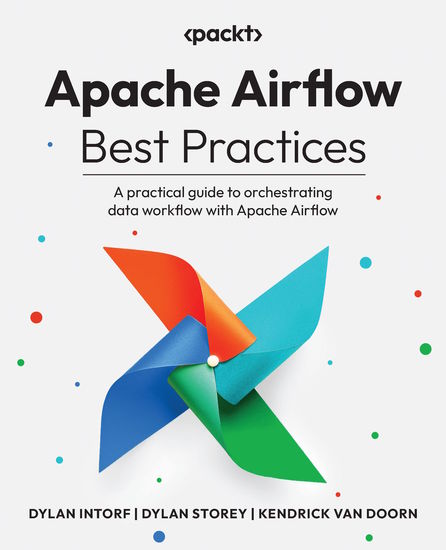
Apache Airflow Best Practices - A practical guide to orchestrating data workflow with Apache Airflow - cover

Apache Airflow Best Practices - A practical guide to orchestrating data workflow with Apache Airflow

Dylan Intorf, Dylan Storey, Kendrick van Doorn

Maison d'édition: Packt Publishing

  • 0
  • 0
  • 0

Synopsis

Data professionals face the challenge of managing complex data pipelines, orchestrating workflows across diverse systems, and ensuring scalable, reliable data processing. This definitive guide to mastering Apache Airflow, written by experts in engineering, data strategy, and problem-solving across tech, financial, and life sciences industries, is your key to overcoming these challenges. Covering everything from Airflow fundamentals to advanced topics such as custom plugin development, multi-tenancy, and cloud deployment, this book provides a structured approach to workflow orchestration. You’ll start with an introduction to data orchestration and Apache Airflow 2.x updates, followed by DAG authoring, managing Airflow components, and connecting to external data sources. Through real-world use cases, you’ll learn how to implement ETL pipelines and orchestrate ML workflows in your environment, and scale Airflow for high availability and performance. You’ll also learn how to deploy Airflow in cloud environments, tackle operational considerations for scaling, and apply best practices for CI/CD and monitoring.By the end of this book, you’ll be proficient in operating and using Apache Airflow, authoring high-quality workflows in Python, and making informed decisions crucial for production-ready Airflow implementations.
Disponible depuis: 31/10/2024.
Longueur d'impression: 188 pages.

D'autres livres qui pourraient vous intéresser

  • The Dopamine Trap - The Clinical Truth About the Modern Brain - cover

    The Dopamine Trap - The Clinical...

    Gregory Bicaj

    • 0
    • 0
    • 0
    You are not weak. You are not lazy. You are not broken. Your brain is simply running the wrong program for the world it lives in.
    In The Dopamine Trap, Albanian-Swiss neuroscientist and clinical psychologist Gregory Bicaj draws on twenty years of laboratory research and direct clinical work to explain why modern life leaves so many people anxious, distracted, exhausted, and strangely empty—despite having more comfort, convenience, and entertainment than any previous generation.
    The answer lies in dopamine. Not the "pleasure chemical" of popular mythology, but the brain's engine of wanting, anticipation, and craving. Smartphones, social media feeds, news cycles, and streaming platforms are not neutral tools. They are environments engineered to keep the brain's reward system perpetually activated—producing a state of chronic overstimulation that quietly degrades focus, mood, patience, creativity, and the capacity for genuine satisfaction.
    Bicaj introduces his "Three Brains Principles"—a working model grounded in evolutionary neuroscience—to show that most suffering and most foolish decisions arise not from personal failure, but from the wrong brain system being in charge at the wrong moment. With this framework, the chaos of compulsive phone-checking, emotional reactivity, and chronic restlessness becomes not a character flaw but a legible biological problem with practical solutions.
    Moving from neuroscience to clinic to daily life, The Dopamine Trap offers a complete, step-by-step path back to a mind that can think deeply, rest fully, and feel real pleasure again. Readers will learn:
    
    - Why dopamine fuels wanting far more than liking—and how that gap traps modern people in habits they do not enjoy
    - How variable-ratio reinforcement makes smartphones function like slot machines, and why willpower alone cannot break the cycle
    - How to measure their true "stimulation load" using practical audits from cognitive psychology research
    - How to run a 48-hour diagnostic reset that reveals the difference between preference and dependence
    - How to rebuild the brain's default mode network—the system responsible for creativity, self-reflection, and meaning-making—through structured rest
    - How to reintroduce pleasure safely without reigniting compulsive patterns
    - How to redesign their environment so that the easiest path leads toward focus instead of distraction
    - Why boredom is not the enemy of a meaningful life but one of its most important preconditions
    - A complete 30-day discipline playbook built on implementation intentions, identity-based change, and habit science
    Through vivid case studies, landmark research from Bruce Alexander, Anna Lembke, Gloria Mark, Anders Ericsson, Mihaly Csikszentmihalyi, and others, and concrete clinical experience, Bicaj shows that recovery is not about eliminating pleasure or achieving monastic discipline. It is about recalibrating a reward system that has been pushed far beyond its design limits—so that ordinary life, real conversation, sustained thought, and quiet moments can feel like enough again.
    For readers of Jonathan Haidt and Gabor Maté, The Dopamine Trap is both a rigorous explanation and a compassionate, practical guide. The goal is not a perfect brain. It is a freer one.
    Voir livre

  • Code Review for the Agent Era - Quality Control When Your Engineers Are AI - cover

    Code Review for the Agent Era -...

    Alex Roth

    • 0
    • 0
    • 0
    AI coding agents are generating production code at an unprecedented rate, but most teams are reviewing that code with practices designed for a world where humans wrote every line. This mismatch is creating hidden risk at scale, and the gap between perceived quality and actual quality grows wider with every release. 
    
     
    This book provides a practical framework for building review systems that work for AI-generated code. You'll learn why traditional code review falls short, how AI-generated code fails in fundamentally different ways, and how to design a hybrid review architecture that combines static analysis, AI-powered review, and targeted human judgment. 
    
     
    Inside, you'll discover:• How to build a layered review pipeline that catches defects at every stage• The specific quality standards you need for reviewing AI-generated code• How to decide which changes need human review and which can be fully automated• Ways to configure AI review tools to produce actionable feedback your team trusts• How to measure review effectiveness and continuously improve your pipeline• Strategies for building custom review agents for your specific codebase• The security implications of AI-generated code and how to mitigate them 
    
     
    The era of reviewing every line of code is ending. This book shows you how to review the right things at the right level of abstraction, using automation for what automation does best and human judgment for what only humans can evaluate. Stop applying old practices to new problems.
    Voir livre
  • The Science of Renewable Energy - How Renewable Energy works - cover

    The Science of Renewable Energy...

    Cybellium

    • 0
    • 0
    • 0
    Understand how renewable resources become useful energy
    The Science of Renewable Energy: How Renewable Energy works brings your study of renewable energy into focus. This Cybellium study guide connects energy sources, conversion technologies and performance and integration, helping you see how the ideas fit together.
    Develop a more connected understanding of the subject and the questions it raises. Use it to build a foundation, return to ideas that need another look and connect terminology with the bigger picture.
    Build your understanding
    
    - Understand the role of energy sources.
    - Explore the relationships behind conversion technologies.
    - Examine the choices and questions involving performance and integration.
    - Bring individual concepts together into a more coherent understanding of the subject.
    Who this guide is for
    For students, professionals and independent learners with an interest in renewable energy. Use the book for focused study, revision or the next stage of your professional learning, returning to the ideas most relevant to your goals.
    Your included Cybellium learning bonus
    
    - One complimentary month of Cybellium access.
    - One additional Cybellium guide download of your choice.
    - Access to the Cybellium Cybersecurity Knowledge Hub and premium learning resources during the included access period.
    Activate your unique voucher at www.cybellium.com/signup to begin your included month and select your additional guide.
    The included voucher is valid for one-time use only and cannot be combined with another offer.
    Continue your learning with The Science of Renewable Energy.
    Voir livre
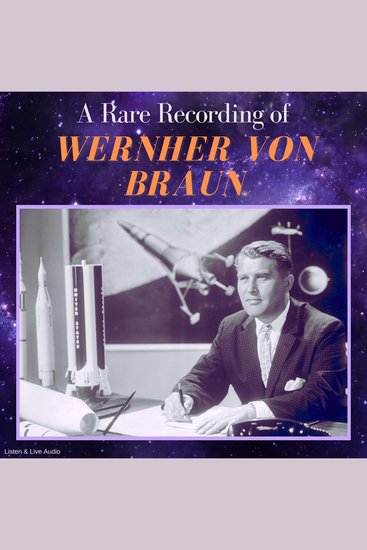
  • A Rare Recording of Wernher von Braun - cover

    A Rare Recording of Wernher von...

    Wernher Von Braun

    • 0
    • 0
    • 0
    Wernher von Braun ( March 23, 1912 – June 16, 1977) was a German aerospace engineer and space architect. He was the leading figure in the development of rocket technology in Nazi Germany and a pioneer of space technology and science in the United States. 
    After World War II, von Braun was secretly moved to the US, along with roughly 1,600 other German scientists, engineers, and technicians, as part of Operation Paperclip. He worked for the United States Army on an intermediate-range ballistic missile (IRBM) program, and he developed the rockets that launched the United States' first space satellite Explorer 1. 
    He served as director of the Marshall Space Flight Center and as the chief architect of the Saturn V super heavy-lift launch vehicle that propelled the Apollo spacecraft to the Moon. In 1955, von Braun became a naturalized citizen of the United States. In 1975, von Braun received the National Medal of Science. This recording is from Dr. Von Braun's speech at the 1st Annual SOLE Symposium, September 13, 1966, in Huntsville Alabama.
    Voir livre
  • Revolutionary Algorithms - A TikTok Manifesto - cover

    Revolutionary Algorithms - A...

    Torey Akers

    • 0
    • 0
    • 0
    From an artist and TikTok creator, a critical look at the controversial app and its effect on cultural heritage, artificial intelligence, community organizing, and digital censorship. In Revolutionary Algorithms, Torey Akers approaches TikTok with a deep understanding of the app, as both a prolific creator and consumer of its content. In these essays, she interrogates how the TikTok ban and the multiple genocides happening around the world are deeply intertwined; how the app can empower creators, amplify social movements, and document abuses of power. She addresses the good, bad, and sometimes uncanny parts of maneuvering and communicating in a digital space.  As a new era of social media looms, Akers makes the case for techno-progressivism, looking toward a future where TikTok continues to connect, inspire, and create space for more intersectionality, equity, and joy.
    Voir livre
  • The Twelve Steps - A Modern Hero's Journey - cover

    The Twelve Steps - A Modern...

    Anonymous

    • 0
    • 0
    • 0
    In this inventive and profound exploration of the Twelve Steps and Twelve Traditions, an old-timer of the program reveals the recovery journey for what it truly is: a modern retelling of the classic hero's journey of transformation that frees spiritual energy trapped by addiction, pouring it back into the world, thus healing both the individual and the society. 
      
    “ … wonderfully sharp and knowing … unexpectedly gripping.”—Kirkus Reviews 
      
    2025 Literary Titan Gold Book Award: Nonfiction 
      
    The Twelve Step journey of recovery is, at its core, the modern retelling of the age-old archetype of the Hero’s Journey. This powerful pattern of transformation is revealed in three stages: separation, initiation, and return. These stages perfectly describe the journey of recovery as well, and when further broken down into their individual steps—such as answering the call, getting a mentor, and, most important of all, having that mentor introduce the hero to a Power greater than himself—the true meaning and purpose of the recovery journey comes alive. The Twelve Steps: A Modern Hero’s Journey deepens and inspires all those on their own journey of recovery, regardless of the type of program they are in. The treasures awaiting those bold enough to venture into the adventure will heal not only themselves, but all of humanity as well. 
      
    Classic tales from mythology, such as The Odyssey and the adventure of Hercules, as well as modern stories from popular literature and film, such as Luke Skywalker’s in the Star Wars series and Harry Potter’s journey through Hogwarts, plus many more, illuminate the Twelve Step journey, and offer a deeper and more reverent understanding of this sacred pattern of transformation. The Twelve Steps: A Modern Hero’s Journey entertains, informs, and delights readers with a profound new understanding of the journey they are on, a journey countless of heroes before him or her have taken since the beginning of time.
    Voir livre