Rejoignez-nous pour un voyage dans le monde des livres!
Ajouter ce livre à l'électronique
Grey
Ecrivez un nouveau commentaire Default profile 50px
Grey
Abonnez-vous pour lire le livre complet ou lisez les premières pages gratuitement!
All characters reduced
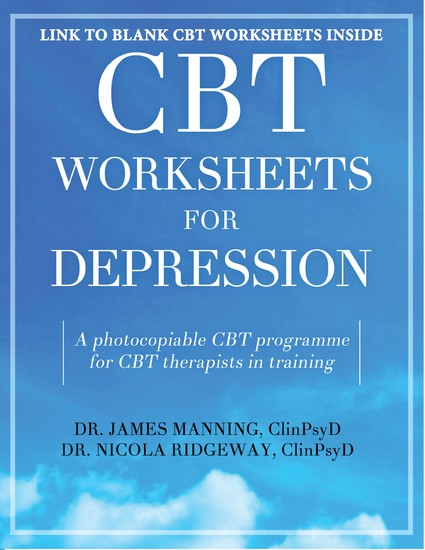
CBT Worksheets for Depression - A Photocopiable CBT Programme for CBT Therapists in Training: Includes formulation worksheets generic CBT cycle and many other CBT handouts - cover

CBT Worksheets for Depression - A Photocopiable CBT Programme for CBT Therapists in Training: Includes formulation worksheets generic CBT cycle and many other CBT handouts

Dr James Manning ClinPsyD

Maison d'édition: Ridgeman Mental Health Books

  • 0
  • 0
  • 0

Synopsis

*** Please note. This book now contains a link inside that you can use to print out your own blank CBT worksheets ***
 
If you are a CBT therapist or a CBT therapist in training you are welcome to photocopy the worksheets in this book for your clients. I have made the paper colour and size ideal for photocopying. You can also photocopy any other part of this book, except for pages where there are cartoons.
 
I wrote this book because I found that many of my clients found it very difficult to remember topics discussed in their sessions. Over time, I found that using specifically tailored worksheets resulted in therapy becoming more streamlined and efficient. Everything included in this book is information that Dr Ridgeway and I use in the real world of clinical practice.
 
Chapters in the middle of this book have been written to assist you with the development of psychological formulations. The rule sheets, I have included are a rapid way of finding out what rules your clients hold. Once rules are identified it is then relatively easy to isolate beliefs and behaviours connected to them. This will lead to the development of longitudinal formulations which can be very helpful to you and your clients. This in turn will help you to write case studies and process reports.
 
I have written this book to be easy to read rather than to impress you with complex vocabulary. Where possible I have included explanations for anything that could be viewed as jargon. When I started work as an assistant psychologist – a psychologist in pre-training - I often attended clinical meetings where Clinical Psychologists and Psychiatrists discussed clients. Words such as formulation, negative reinforcement, sub-cortical response, and such like, went right over my head. It was like the clinicians were speaking a different language. Ideally, if you are just starting out in your clinical career this book will tell you most of the things that you need to know about depression at least.
 
We have used a metaphor of the Black Dog in this book as we have found as it is often an appealing way in to help clients accept their feelings.
Disponible depuis: 29/07/2024.
Longueur d'impression: 160 pages.

D'autres livres qui pourraient vous intéresser

  • Athenian Agora and Roman Forum The: The Beating Hearts of the Ancient World’s Most Famous Cities - cover

    Athenian Agora and Roman Forum...

    Editors Charles River

    • 0
    • 0
    • 0
    The center of political and commercial interaction in the Ancient Greek polis was the agora. The word essentially means a gathering place or an open space, and in all Greek city states, the agora was central to all aspects of daily life and commerce. As the agora developed as a civic space, particularly from the 6th century BCE onward in Athens, the architectural splendor of the buildings associated with it became an ever more obvious demonstration of the power and glory of Athenian democracy. In its earliest forms, an agora in maritime cities was invariably situated near the sea, while in inland urban centers, it was usually located at the foot of the hill that normally provided the city’s ultimate defense. The agora was always the oldest part of any city and, as such, and as well as being the commercial hub of the area, also became the center of the religious and political life of the polis. In Homer’s time, an agora might have seats for the comfort of the citizens that had assembled to consult with one another. The city’s oldest sanctuaries were always located either in or very close to the agora itself, and the first festive games were held in its open space.  
    The Roman Empire is the most famous in history, and the center of the far-reaching empire’s activities was located in the Forum, a low area between the Capitoline and Palatine hills in Rome. The topography held a great deal of significance for Romans, and consequently so many layers of myth were laid on top of the landscape and buildings that it is difficult to separate legend from actual historical fact. As a low-lying area near the Tiber river, the Forum was subject to much flooding, and even into the 20th century, the Forum area could flood upwards of over 40 feet above sea level. This would factor significantly in the imagination of Romans, who later ascribed the flooding with saving the city’s founders, Romulus and Remus, from execution.
    Voir livre
  • Edvard Munch: A short biography - 5 Minutes: Short on time – long on info! - cover

    Edvard Munch: A short biography...

    5 Minutes, 5 Minute Biographies,...

    • 0
    • 0
    • 0
    Edvard Munch, Norwegian painter and creator of the "Scream": Life and work in a short biography! Everything you need to know, brief and concise. Infotainment, education and entertainment at its best!
    Voir livre
  • Lincoln's Rivals: The Political Genius Unveiled - "Master Lincoln's Rivals: Dynamic Audio Lessons Unveil Political Brilliance!" - cover

    Lincoln's Rivals: The Political...

    Duncan Hawthorne

    • 0
    • 0
    • 0
    Explore Lincoln's Mastery: A Deep Dive into His Political Brilliance 
    ⭐⭐ Simplified Audio Guide ⭐⭐ 
    Are you eager to advance in your comprehension of Lincoln's extraordinary political capabilities? 
    Looking for a thorough guide that reveals all critical aspects of Lincoln’s strategies and leadership? 
    Your search ends here! 
    This guide stands as your essential companion for deepening your knowledge, applying historical insights, and engaging in critical thinking exercises. With this, you're poised for mastery. 
    Updated structure for enhanced understanding. 
    Key features of this enriched guide: 
    - Profound insights into Lincoln's political acumen 
    - Detailed explanation of Lincoln's strategies for navigating political adversity 
    - Effective methods for analyzing historical events and leadership styles 
    Our guide distinguishes itself through comprehensive coverage, essential for grasping Lincoln's genius. Concepts are not skimmed over; they are explored with in-depth precision. 
    Please note that this guide is not affiliated with any official historical entities and is purely an independent resource for your benefit. 
    Designed with a clear structure and easy-to-understand language, our guide on Lincoln’s Political Genius ensures smooth transitions between topics. Say goodbye to dense jargon and embrace clear, precise, and historically accurate content. 
    So, why wait? Click the BUY NOW button, secure your guide, and embark on your journey to fully understanding Lincoln's political brilliance!
    Voir livre
  • Milk Baba - The Non Eating Saint Of Nepal - cover

    Milk Baba - The Non Eating Saint...

    Radha Krsna Das

    • 0
    • 0
    • 0
    "When a man has reached the point where he can sit in meditation for six months there is no need of eating, No need of latrine or of rest. Only one drop of amrit nectar from the top of the head to the body keeps him alive." Dude Baba,1993  
     
    "Dude Baba was a dear friend and god brother to Maharaji. His deep, soulful kirtans and lectures are the highest bhakti, or devotion to Lord Ram, and yes, Babaji ate nothing for the last forty-five years of his life. A true Siddhi Yogi. You are blessed to be in his divine company." Baba Ram Das / Author 'BE HERE NOW'  
     
    Ram Krishna Das Vaishnaba, or Dude Dehari Baba, or Milk Baba was so named because he lived forty-five years entirely on one small cup of milk per day. No other food ever passed his lips. Baba lived in a small room by the Bagmati river at Pashiputinath temple, five kilometers outside of Katmandu. His beautiful matted hair, or jata, was over twenty-six feet long. Baba was a lifelong devotee of Lord Rama and God Brother and confidant of Neem Karoli Baba, the iconic guru of Baba Ram Das. Lord Rama, also known as Ramachandra, is the seventh avatar of Krishna, one of his most popular incarnations along with Parshurama, and Gautama Buddha. Rama was born to Kaushalya and Dasharatha in Ayodhya, the ruler of the Kingdom of Kosala. Dude Baba was always chanting the name of Rama and was a master musician and great singer of bhajans. In 1993 he met American devotee author Jagannatha Dasa and subsequently travelled to his farm community in Lockport, New York for a six-month residency at the SRI ashram there. While there Dasa arranged for Baba to begin a mammoth two week recording session with a host of popular Indian musicians in order to get his collected bhajans down on tape for posterity. Recorded too were several inspirational lectures. Here then is the fruit of a lifetime spent as an ardent servant of Lord Rama and liberating transcendental vibrations of a pure devotee.
    Voir livre
  • Go Back to Where You Came From - And Other Helpful Recommendations on How to Become an American - cover

    Go Back to Where You Came From -...

    Wajahat Ali

    • 0
    • 0
    • 0
    Go back to where you came from, you terrorist! 
     
    This is just one of the many warm, lovely, and helpful tips that Wajahat Ali and other children of immigrants receive on a daily basis. Go back where, exactly? Fremont, California, where he grew up, but now an unaffordable place to live? Or  
    Pakistan, the country his parents left behind a half-century ago? 
     
    While living the American Dream, young Wajahat devoured comic books (devoid of brown superheroes) and fielded well-intentioned advice from uncles and aunties (“Become a doctor!”). He had turmeric stains under his fingernails, was  
    accident-prone, suffered from OCD, and wore Husky pants. That is, he was as American as his neighbors, with roots all over the world. Then, while Ali was studying at University of California, Berkeley, 9/11 happened. Muslims replaced  
    Communists as America’s enemy #1, and he became an accidental spokesman and ambassador of all ordinary, unthreatening things Muslim-y. 
     
    Now a middle-aged dad, Ali has become one of the foremost and funniest public intellectuals in America. In Go Back to Where You Came From, he tackles the dangers of Islamophobia, white supremacy, and chocolate hummus, peppering  
    personal stories with astute insights into national security, immigration, and pop culture. In this refreshingly bold, hopeful, and uproarious memoir, Ali offers indispensable lessons for cultivating a more compassionate, inclusive, and delicious America.
    Voir livre
  • Early Cosmological Thinkers - The First Philosophical Inquiries into the Cosmos and Natural Laws (2 in 1) - cover

    Early Cosmological Thinkers -...

    Hector Davidson

    • 0
    • 0
    • 0
    This book consists of 2 titles, which are: 
    Heraclitus: Heraclitus of Ephesus, a pre-Socratic philosopher who lived in the 6th century BCE, remains one of the most enigmatic figures in the history of Western thought. Known for his cryptic sayings and profound insights into the nature of reality, Heraclitus' ideas have had a lasting influence on philosophy, science, and the arts. His philosophy, often centered around the concept of change, emphasized that everything in existence is in a constant state of flux. This view is encapsulated in one of his most famous quotes: "You cannot step into the same river twice." For Heraclitus, the essence of life and the universe lies in this unceasing transformation, where stability and change are not opposing forces but interconnected aspects of existence. 
    Pythagoras: As a philosopher and mathematician, Pythagoras is perhaps best known for the Pythagorean Theorem, a fundamental principle in geometry that has influenced the study of mathematics for over two millennia. However, his impact extends far beyond the confines of geometry. Pythagoras is often credited with transforming numbers from mere tools of calculation into a system that mirrors the structure and harmony of the universe. For him, numbers were not just abstract symbols but the very essence of reality, governing everything from the motions of the stars to the patterns in music. His belief in the mystical and metaphysical significance of numbers laid the groundwork for later developments in philosophy, particularly the idea that the world is not a chaotic, random place but a cosmos governed by rational and harmonious principles.
    Voir livre