Begleiten Sie uns auf eine literarische Weltreise!
Buch zum Bücherregal hinzufügen
Grey
Einen neuen Kommentar schreiben Default profile 50px
Grey
Jetzt das ganze Buch im Abo oder die ersten Seiten gratis lesen!
All characters reduced
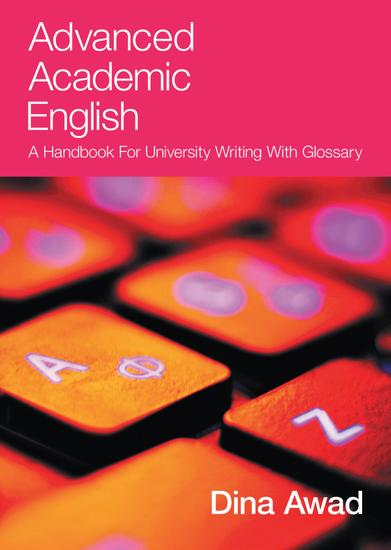
Advanced Academic English - A handbook for university writing with glossary - cover

Advanced Academic English - A handbook for university writing with glossary

Dr Dina Awad

Verlag: Grosvenor House Publishing

  • 0
  • 0
  • 0

Beschreibung

This handbook is very helpful for university students because it has short phrases that can be copied directly into essays and term papers. There are no grammatical rules, descriptions or instructions. It is a reference book that can be consulted for any subject, major, or discipline because the language is functional and suitable for essays, reports and literature reviews. It is particularly handy for MA and MSc dissertations. The quick ready-made phrases can be projected by ESL and TESOL teachers as slides for writing and revision sessions. Authors and researchers can also benefit from this handbook if they are not certain about certain expressions or formats. This book is a good practical guide to all university students whose first language is not English, but it is also helpful for native speakers whose writing is usually more casual and informal. Unlike many textbooks and websites that try to explain the rules or overwhelm students with linguistic jargon, the glossary part of the book offers formal and academic alternatives to common everyday English. The glossary can be used as an academic editor that checks drafts after being written. It distinguishes clearly between secondary school writing and the style used at university research level. Since academic English is no one's first language, it is time to identify the unspoken traditions of the writing craft known in higher education. 
Verfügbar seit: 22.02.2024.
Drucklänge: 127 Seiten.
Weitere Bücher, die Sie mögen werden

  • Human Aura The - Astral Colors and Thought Forms - cover

    Human Aura The - Astral Colors...

    William Walker Atkinson

    • 0
    • 0
    • 0
    "The Human Aura - Astral Colors and Thought Forms" by William Walker Atkinson is a classic work that delves into the mystical concept of the human aura, exploring its nature, colors, and the thought forms it generates. Atkinson, a prolific writer on esoteric and metaphysical topics, offers insights into how the aura reflects an individual's thoughts, emotions, and spiritual state. Through detailed descriptions and explanations, he guides readers on understanding and interpreting the subtle energies surrounding the human body.
    Zum Buch
  • Psych2Go Presents: The Psychology of People - The Little Book of Psychology & What Makes You You - cover

    Psych2Go Presents: The...

    Thomas Kang

    • 0
    • 0
    • 0
    Finally understand why you do things differently from the rest! Psych2go created this guide to connect the history of human psychology with practical mental health therapy tools to help you thrive in your everyday life. 


    Discover things about yourself! With The Psychology of People, learn about the history of human psychology—and apply it to your own life. Understand your innate need to conform, the roots of your social anxiety, how to heal and grow emotionally—and so much more! 


    An empath's survival guide to psychology. Written by the creators of the popular YouTube channel, blog, and website Psych2go, The Psychology of People is one of the best mental wellness books that gives practical and applicable methods! From the ethics of experimental psychology to therapy techniques, The Psychology of People helps you develop empathy for yourself and others. 


    Inside, you'll find: 


    ● Your very own therapist on the go, packed with practical methods and experiments 


    ● How to understand and rewire your brain by discovering psychological-based patterns in yourself and others 


    ● One of the best books about psychology, the history of psychology, and the ethics of experimental science
    Zum Buch
  • We Are F**king Machines - Why We Are Like This and What We Can Do About It - cover

    We Are F**king Machines - Why We...

    Dr. Bernadette 'bird' Bowen

    • 0
    • 0
    • 0
    Do you feel disconnected? Lonely? Sick and tired of being sick and tired? Long before COVID-19 emerged, researchers were reporting that united states citizens were having less sex. Some even going so far as to call it a “sex apocalypse”. Throughout this book, Dr. bird explores not only how and why this phenomenon occurred, but also unboxes foundationally regifted social, relational, and technological u.s. misinformation(s) and disinformation(s), which have devolved into our digital and increasingly algorithmic envirusment. To do so, first, they argue that our dominant ideas of intelligence have always been limited. Then, they connect those logics to escalating environmental crises. Third, Dr. bird reveals how our major ideas of relational intelligence have been tainted by these widely accepted human misconceptions. And, not only that, but that this mentality has been copy and pasted across nearly everything that we do and love. In doing so, Dr. bird makes clear how the envirusment era presents us abundant opportunities to understand how, in numerous violent taken for granted ways, an idea that the “body is a machine” has infected our lifestyles, sickening, disabling, and poisoning us all to death for profit. Yet, in new viral forms, instead of liberatory solutions, the richest continue to invest in more inhumane artificial intelligence. Instead, Dr. bird insists current problems cannot be solved without transformational human solutions, reminding us that we all hold and can embrace our authenticity, reflecting on our life’s knowledge, to fix this shit.
    Zum Buch
  • Longbow The: The History of the Weapon that Revolutionized Warfare in the Middle Ages - cover

    Longbow The: The History of the...

    Editors Charles River

    • 0
    • 0
    • 0
    While the bow was used throughout ancient times and the Middle Ages, on mainland Europe it was mostly replaced by the crossbow in the early 13th century, but that would change with the introduction of the longbow, a more powerful weapon than the traditional hunting bows. The original longbowmen were Welshmen recruited by King Edward I of England after he conquered Wales, and the weapon got its name from the fact that it was almost as tall as the man using it. This gave it a longer draw and therefore more force, as longbows were generally made of yew, a strong and pliable wood. The longbow was cheap and easy to make, but they required extensive training to be used well, so in England, commoners were encouraged and at times required to practice archery. A statute of Richard II dating from 1388 reads, “Servants and Laborers shall have Bows and Arrows, and use the same the Sundays and Holydays, and leave all playing at tennis or foot-ball, and other games called coits, dice, casting of the stone, kaikles [skittles], and other such importune games.” 
    	The longbow’s greatest day was at Agincourt in 1415, but the fact that this did not end the age of heavy plate cavalry indicated the longbow did have some limitations. For example, modern tests show that longbow arrows had trouble piercing plate armor, likely the main reason they were used as a massed weapon. With arrows raining down, it increased the chances of hitting a joint in the armor or an imperfection. Also, horse armor couldn’t protect the entire animal and the knights would soon find themselves dismounted. At some battles like Agincourt, the knights foundered in soft earth, and as their horses fell and the men became confused and hampered by the arrows clanking off their armor, they got mired in the mud and the English infantry could move in and finish them off. 
    Zum Buch
  • PSYCHOLOGICAL SELF-CARE HABITS - Time-Proven Habits to Stop Mental Clutter and Increase Mental Wellness - cover

    PSYCHOLOGICAL SELF-CARE HABITS -...

    C.M. Paciente

    • 0
    • 0
    • 0
    Declutter, reset, and recalibrate your mind for peak mental and overall well-being. 
    Procrastination, lack of motivation, and low productivity are just some of the things that are keeping people from achieving their potential. These and other consequences are due largely to the effects of mental clutter. 
    Mental clutter is anything that keeps you from thinking straight, whether that’s stress, expectations, information overload, negative thinking, or other distractions. And it’s hard to get rid of all that clutter in your mind in one go, especially when it’s become a habit. 
    In this timely resource on psychological wellness, you will discover:What mental clutter is, how it prevents you from being at your best, and what you can do about itThe surprising link between procrastination and perfectionismWhy being flooded with information isn’t the actual problem with information overloadHow negative emotions can short-circuit your mental and physical health How to dramatically remove mental roadblocks by troubleshooting your self-image A psychology-backed way to painlessly replace detrimental habits with beneficial ones How to boost your productivity so well that you’ll surprise yourselfTiny habit tweaks that lead to big results in terms of well-being and mental performanceTime-tested routines to engage your mind and stimulate psychological growthBonus: Easy tips and tricks you can apply right now to eliminate distractions 
    With a generous amount of research-based advice and practical strategies, this guide will give you the right set of mental skills and tools to conquer the mess in your mind. 
    Discover how to finally break free from the psychological barriers that have been holding you down.
    Zum Buch
  • Celia A Slave - cover

    Celia A Slave

    Melton A. McLaurin, Jennifer L....

    • 0
    • 0
    • 0
    Celia was only fourteen years old when she was acquired by John Newsom, an aging widower and one of the most prosperous and respected citizens of Callaway County, Missouri. The pattern of sexual abuse that would mark their entire relationship began almost immediately. After purchasing Celia in a neighboring county, Newsom raped her on the journey back to his farm. He then established her in a small cabin near his house and visited her regularly. Over the next five years, Celia bore Newsom two children; meanwhile, she became involved with a slave named George and resolved at his insistence to end the relationship with her master. When Newsom refused, Celia one night struck him fatally with a club and disposed of his body in her fireplace. 


    Her act quickly discovered, Celia was brought to trial. She received a surprisingly vigorous defense from her court-appointed attorneys. Nevertheless, the court upheld the tenets of a white social order that wielded almost total control over the lives of slaves. Celia was found guilty and hanged. 


    Melton A. McLaurin uses Celia's story to reveal the tensions that strained the fabric of antebellum southern society. Celia's case demonstrates how one master's abuse of power over a single slave forced whites to make moral decisions about the nature of slavery.
    Zum Buch