Join us on a literary world trip!
Add this book to bookshelf
Grey
Write a new comment Default profile 50px
Grey
Subscribe to read the full book or read the first pages for free!
All characters reduced
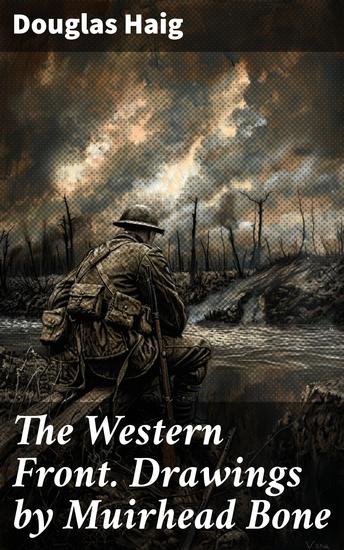
The Western Front Drawings by Muirhead Bone - Unveiling the Frontline Horrors: Haig's WWI Insights Through Bone's Drawings - cover

The Western Front Drawings by Muirhead Bone - Unveiling the Frontline Horrors: Haig's WWI Insights Through Bone's Drawings

Douglas Haig

Publisher: Good Press

  • 0
  • 0
  • 0

Summary

Douglas Haig's "The Western Front" offers a poignant and immersive exploration of the harrowing experiences of World War I, intertwined with Muirhead Bone's evocative illustrations. This work not only chronicles the reality of life on the front lines through Haig'Äôs observations but also serves as a historical document reflecting the broader literary movement of the early 20th century, where artists sought to capture the grim truths of war. Haig's prose is marked by a somber clarity, effectively complementing Bone's artistic representations, which depict the stark landscapes and poignant moments of human struggle. Together, they create a vivid tapestry that encapsulates the brutality and futility of trench warfare. Douglas Haig, a prominent British military officer and commander during World War I, drew upon his firsthand experiences and complex emotions regarding leadership and loyalty to the soldiers under his command. His dual role as a military strategist and a reflective commentator on warfare provides a unique perspective, illuminating the tensions between duty and the moral imperatives of leadership in times of crisis. This insightful vantage point informs not only the content of the book but also the reflective tone that permeates his narrative. I highly recommend "The Western Front" to readers interested in a nuanced portrayal of World War I, as it bridges the gap between military history and personal narrative. The combination of Haig's articulate prose and Bone's haunting illustrations makes this a vital addition to any collection seeking to understand the complexities of warfare and its profound impact on humanity.
Available since: 10/19/2023.
Print length: 94 pages.

Other books that might interest you

  • Russian History - The beginning to the 18th Century - cover

    Russian History - The beginning...

    Secrets of History

    • 0
    • 0
    • 0
    This is the first book out of three in our “From Rus to Russia” series about Russian history.  
    Embark on a journey through time as you dive into the fascinating world of Russia's early history. "Russian History: The Beginning to the 18th Century" is your guide to the formative events and iconic figures that shaped the nation we know today. 
    Immerse yourself in the gripping tales of conquest, intrigue, and revolution, exploring the complex interplay of culture, politics, and religion that forged the Russian identity. 
    Witness the rise of legendary figures like Ivan the Terrible, Russia's first Tsar, who expanded the nation's territory and centralized power. His iron-fisted rule, while brutal, paved the way for Russia's emergence as a powerful force on the world stage.  
    Then, experience the transformative reign of Peter the Great, the innovative ruler who modernized Russia's military, government, and culture, drawing inspiration from the West. 
    Marvel at the sweeping saga of the Mongol Invasion, an event that left an indelible mark on Russia's history. This tumultuous period saw the subjugation of Russian lands under the Golden Horde, leading to centuries of strife, resistance, and eventual liberation. The resilience and determination displayed by the Russian people during this time would become hallmarks of their national character. 
    With a comprehensive understanding of the forces that shaped Russia's early history. And with compelling storytelling and vivid descriptions, this book is perfect for history enthusiasts and newcomers alike. 
    Don't miss out on this enthralling journey through Russia's past. Order your copy of "Russian History: The Beginning to the 18th Century" today, and prepare to be captivated by the stories of a nation's birth and the figures who led it into the modern era.
    Show book
  • The Leaving Season - A Memoir in Essays - cover

    The Leaving Season - A Memoir in...

    Kelly McMasters

    • 0
    • 0
    • 0
    Kelly McMasters found herself in her mid-thirties living her fantasy: she'd moved with her husband, a painter, from New York City to rural Pennsylvania, where their children roamed idyllic acres in rainboots and diapers. The pastoral landscape and the bookshop they opened were restorative at first, for her and her marriage. But soon, she was quietly plotting her escape. 


    In The Leaving Season, McMasters chronicles the heady rush of falling in love and carving out a life in the city, the slow dissolution of her relationship in an isolated farmhouse, and the complexities of making a new home for herself and her children as a single parent. She delves into the tricky and often devastating balance between seeing and being seen; loss and longing; desire and doubt; and the paradox of leaving what you love in order to survive. 


    Whether considering masculinity in the countryside through the life of a freemartin calf, the vulnerability of new motherhood in the wake of a car crash, or the power of community pulsing through an independent bookshop, The Leaving Season finds in every ending a new beginning.
    Show book
  • Roman Medicine and Science - Advances of Ancient Civilization - cover

    Roman Medicine and Science -...

    Rogan Fish

    • 0
    • 0
    • 0
    Roman medicine was a blend of practical knowledge, religious beliefs, and influences from earlier civilizations, particularly the Greeks and Etruscans. While early Roman healing methods were deeply rooted in superstition, the expansion of the empire led to the adoption of more systematic medical practices. Over time, Roman medicine evolved into a structured system that combined natural remedies, surgical techniques, and public health initiatives. 
    Greek influence played a significant role in shaping Roman medical knowledge. Before Rome conquered Greece, healing in the Roman Republic was often associated with household remedies and religious rituals. However, as Greek physicians such as Archagathus and later Galen entered Rome, their advanced knowledge in anatomy, surgery, and pharmacology became widely accepted. Many Roman physicians were either trained by Greek mentors or studied Greek medical texts. Hippocratic principles, which emphasized observation and diagnosis, became foundational in Roman medical education. 
    Despite the growing reliance on scientific methods, religion and superstition remained integral to Roman healing practices. The Romans believed that diseases could be divine punishments or warnings from the gods. Temples dedicated to deities like Aesculapius, the god of medicine, served as healing centers where the sick sought divine intervention. Priests and healers performed rituals and sacrifices to appease the gods and cure ailments. Additionally, charms, amulets, and incantations were commonly used to ward off illness. Even as medical science progressed, many Romans continued to rely on religious customs for healing.
    Show book
  • Start of the French Revolution The: The History and Legacy of the Seminal Events that Began the Uprising in France - cover

    Start of the French Revolution...

    Editors Charles River

    • 0
    • 0
    • 0
    As one of the seminal social revolutions in human history, the French Revolution holds a unique legacy, especially in the West. The early years of the Revolution were fueled by Enlightenment ideals, seeking the social overthrow of the caste system that gave the royalty and aristocracy decisive advantages over the lower classes. But history remembers the French Revolution in a starkly different way, as the same leaders who sought a more democratic system while out of power devolved into establishing an incredibly repressive tyranny of their own once they acquired it.  
    	The French Revolution was a turbulent period that lasted several years, and one of the most famous events of the entire revolution came near the beginning with the Tennis Court Oath. By July of 1788, King Louis XVI agreed to call the Estates-General, a large, traditional legislative body, for the first time since 1614. The country's finances, already quite tenuous, reached a crisis stage in August 1788 as France faced bankruptcy.  
    	In the spring of 1789, Louis XVI summoned the Estates-General. They were to convene at Versailles on April 27, but did not do so until May 5. Late elections continued into the summer as conditions around the country delayed many elections. At the same time, bread prices reached an all-time high, leading to riots throughout the country, particularly in Paris. During the formal ritual that welcomed the Estates-General on May 4, 1789, in a precursor of things to come in the following months, the Third Estate refused to kneel before the king. The deputies of the Third Estate came before the king, walking two at a time, and bowed before Louis XVI and Marie Antoinette. Not surprisingly, those witnessing the parade of the Estates-General had hoped for reform but came to expect that the Estates-General would serve as a tool of the administration. Instead, the start of the French Revolution would soon follow.
    Show book
  • The Book of Fear - cover

    The Book of Fear

    Billy Pedro

    • 0
    • 0
    • 0
    As humans, our thought processes, actions and reactions, outcomes and the psychological effect of our fear experiences influence our beliefs, lifestyle and other factors. These life changing experiences and factors determine our behaviour in communication and interaction with our environment, whether logical or illogical. 
    As we grow, learn and develop our own environment, we choose to avoid, confront, ignore or learn to live with our fears. The most intriguing part of it is that we voluntarily believe that our fear is a major problem and a hindrance to us making our goals attainable. 
    We become completely powerful when we are able to put our fear reactions in context, reflect on our reactions which are birthed from situations of perceived fear and dissect the often unrecognised counter-reactions that make our situation affect our actions.
    Show book
  • Science Of Everyday Decisions The: How Small Choices Shape Our Lives - cover

    Science Of Everyday Decisions...

    Sybex Books

    • 0
    • 0
    • 0
    Have you ever wondered why you choose one thing over another? Why certain habits stick while others fade? Or how the countless small decisions you make every day—what to eat, where to go, or whom to talk to—shape the trajectory of your life? 
    The Science of Everyday Decisions: How Small Choices Shape Our Lives delves into the fascinating interplay of psychology, neuroscience, and behavioral economics to uncover the mechanisms behind our decision-making processes. This book reveals the subtle forces—both internal and external—that guide our actions, often without us even realizing it. 
    Explore how split-second choices and habitual behaviors define our relationships, careers, health, and happiness. Learn how biases, emotions, and context influence our judgments and why understanding these factors can help us make smarter, more deliberate decisions. 
    Through engaging anecdotes, groundbreaking research, and actionable strategies, this book offers tools to:Recognize and overcome decision-making traps.Build healthier habits and break unproductive cycles.Make confident choices in the face of uncertainty.Understand the ripple effect of small decisions on long-term outcomes. 
    Whether you're deciding what to prioritize at work, how to approach personal relationships, or simply choosing what to have for dinner, The Science of Everyday Decisions will empower you to take control of your life by mastering the art and science of decision-making
    Show book