

Begleiten Sie uns auf eine literarische Weltreise!
Buch zum Bücherregal hinzufügen
Grey
Einen neuen Kommentar schreiben Default profile 50px
Grey
Jetzt das ganze Buch im Abo oder die ersten Seiten gratis lesen!
All characters reduced
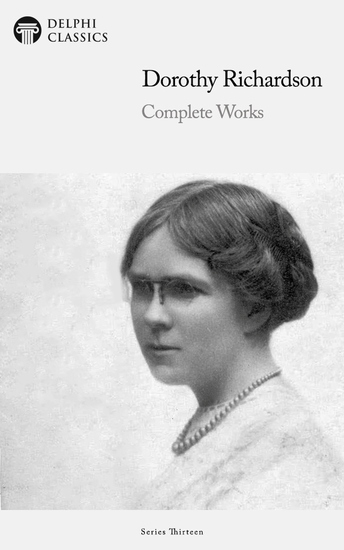
Delphi Complete Works of Dorothy Richardson Illustrated - cover

Delphi Complete Works of Dorothy Richardson Illustrated

Dorothy Richardson

Verlag: Delphi Publishing Ltd

  • 0
  • 0
  • 0

Beschreibung

The English novelist Dorothy M. Richardson was a modernist pioneer of stream-of-consciousness fiction. Her novel sequence ‘Pilgrimage’ is an extraordinarily sensitive story, portrayed cinematically through the eyes of Miriam Henderson, an attractive and mystical New Woman. The unfinished 13-volume novel is now considered a significant work of literary modernism, exploring new formal methods to represent feminine consciousness. For the first time in publishing history, this eBook presents Richardson’s complete fictional works, with numerous illustrations, rare texts, detailed introductions and the usual Delphi bonus material. (Version 1)
 
* Beautifully illustrated with images relating to Richardson’s life and works* Concise introductions to the novels and other texts* All 13 novels, with individual contents tables* Features rare works appearing for the first time in digital publishing* Images of how the books were first published, giving your eReader a taste of the original texts* Excellent formatting of the texts* The complete short stories * Rare poems from periodicals, available in no other collection* Easily locate the poems or short stories you want to read* Explore Richardson’s non-fiction * Includes Richardson’s rare autobiographical pieces – available in no other collection* Special criticism section, with essays by Sinclair, Woolf and Lawrence, evaluating Richardson’s contribution to literature* Ordering of texts into chronological order and genres
 
CONTENTS:
 
PilgrimagePointed Roofs (1915)Backwater (1916)Honeycomb (1917)The Tunnel (1918)Interim (1919)Deadlock (1921)Revolving Lights (1923)The Trap (1925)Oberland (1927)Dawn’s Left Hand (1931)Clear Horizon (1935)Dimple Hill (1938)March Moonlight (1967)
 
The Short StoriesThe Short Stories of Dorothy Richardson
 
The PoetryThe Poems of Dorothy Richardson
 
The Non-FictionThe Quakers: Past and Present (1914)Gleanings from the Works of George Fox (1914)About Punctuation (1924)John Austen and the Inseparables (1930)
 
The Autobiographical PiecesAutobiographical Sketches
 
The CriticismThe Novels of Dorothy Richardson (1918) by May SinclairReview of ‘The Tunnel’ (1919) by Virginia WoolfThe Future of the Novel (1923) by D. H. Lawrence
 
Please visit www.delphiclassics.com to browse through our range of exciting titles or to purchase this eBook as a Parts Edition of individual eBooks
Verfügbar seit: 29.05.2023.
Drucklänge: 1151 Seiten.
Weitere Bücher, die Sie mögen werden

  • Encounter An (Unabridged) - cover

    Encounter An (Unabridged)

    James Joyce

    • 0
    • 0
    • 0
    James Augustine Aloysius Joyce (2 February 1882 - 13 January 1941) was an Irish novelist, short story writer, poet and literary critic. He contributed to the modernist avant-garde movement and is regarded as one of the most influential and important writers of the 20th century.
    AN ENCOUNTER: It was Joe Dillon who introduced the Wild West to us. He had a little library made up of old numbers of The Union Jack, Pluck and The Halfpenny Marvel. Every evening after school we met in his back garden and arranged Indian battles.
    Zum Buch
  • Father Brown: The Hammer of God (Unabridged) - cover

    Father Brown: The Hammer of God...

    G.K. Chesterton

    • 0
    • 0
    • 0
    The Hammer of God," readers are surprised to learn from Father Brown that the murderer is not a violent madman but rather a very respected member of the community. The Reverend Wilfred Bohun could no longer stand the scandalous behavior of his alcoholic brother Norman, who blasphemed God and humiliated the Reverend Bohun in the eyes of his parishioners. Chesterton states that Wilfred and Norman Bohun belong to an old noble family whose descendants are now mostly "drunkards and dandy degenerates." Rumor has it that there has been "a whisper of insanity" in the Bohun family.
    Zum Buch
  • Les Misérables - Audiobook - cover

    Les Misérables - Audiobook

    Victor Hugo, Classic Audiobooks,...

    • 0
    • 0
    • 0
    Les Misérables is a sweeping epic of human suffering, resistance, and redemption set against the backdrop of 19th-century France. The novel centers on Jean Valjean, a man who transforms from a hardened ex-convict into a symbol of compassion and moral strength. His journey touches the lives of others, including the tragic Fantine, the innocent Cosette, the determined Marius, and the relentless Inspector Javert.Through intersecting stories of love, poverty, injustice, and revolution, Victor Hugo reveals the deep fractures of society while upholding the enduring hope for change. The novel is both a personal tale of redemption and a broader cry for social reform.Profound, emotional, and timeless, Les Misérables remains one of the most powerful novels ever written.
    Zum Buch
  • Her Turn - From their pens to your ears genius in every story - cover

    Her Turn - From their pens to...

    D H Lawrence

    • 0
    • 0
    • 0
    David Herbert Lawrence was born on the 11th September 1885 in Eastwood, Nottinghamshire, a coal mining town where the reality of a harsh life was only useful as experiences for future literary works. 
    He was educated at Beauvale Board School and became the first local boy to receive a scholarship to attend Nottingham High School. After 3 years he became a junior clerk in Haywood’s surgical appliances factory. He was also attempting a literary career which, in the short term, led to a teacher training position in Eastwood and later a teaching qualification from University College, Nottingham.  
    Lawrence’s first efforts were poems, short stories and a draft of ‘The White Peacock’. Moving to London and a teaching position in Croydon his writing attracted the attention of Ford Madox Ford, editor of The English Review, and he commissioned him to write ‘Odour of Chrysanthemums’.  
    Wanting to write full-time he now began work on what would become ‘Sons and Lovers.   
    In 1912 he met the older and married mother-of-three Frieda Weekley. They eloped to Germany and here Lawrence could see for himself the growing tensions with France.  So keen was his interest that he was arrested and accused of being a British spy.  
    In early 1914 Frieda obtained her divorce and they returned to Britain to be married just days before the outbreak of war. Owing to her German parentage, and his own public dislike of militarism and violence, the couple were treated with contempt and suspicion throughout the war years.  
    Despite this he continued to write but his reputation in England was so tarnished and, mirrored by his own disdain for the country, he and Frieda left England in November 1919, first for Europe and then America via Ceylon and Australia. 
    They bought a ranch in Taos, New Mexico and visited Mexico several times. The third visit in March 1925 caused a near fatal attack of malaria. To convalesce they moved to Florence. Here he continued work on ‘Lady Chatterley’s Lover’ which for many years would cause controversy. A renewed interest in oil painting resulted in an exhibition in 1929 which was raided by the police and several works were confiscated.  
    D H Lawrence died of complications arising from a bout of tuberculosis on the 2nd of March 1930 in Vence, France.  He was 44.
    Zum Buch
  • Crocker's Hole - From their pens to your ears genius in every story - cover

    Crocker's Hole - From their pens...

    R D Blackmore

    • 0
    • 0
    • 0
    Richard Doddridge Blackmore was born on 7th June, 1825 at Longworth in Berkshire (now part of Oxfordshire), where his father, John Blackmore, was Curate-in-charge of the parish. His mother died a few months after his birth the victim of an outbreak of typhus. With this loss the family moved to Bushey, Hertfordshire, then on to their native Devon.  His elder brother Richard (by a year), however, was taken by his aunt to live near Oxford. His father married again in 1831, whereupon Richard returned to live with them.  With much of his childhood spent in the lush and pastoral "Doone Country" of Exmoor, and along the Badgworthy Water, Blackmore came to love the very countryside he immortalised in Lorna Doone.  In November 1853 he married his wife Lucy.  And the following year, 1854, his literary career began with a collection of Poems and for the next 15 years he would write in the winters and garden in the summers.  In 1860 with inherited money he built a house in Teddington just outside of London and established a market garden for the cultivation of fruit.  He loved horticulture but having little business experience could never really exploit it.  However with the publication of Lorna Doone in 1869 he was catapulted to fame.  And although he continued to write extensively nothing caught the public imagination quite like Lorna Doone.  RD Blackmore died at Teddington on 20th January, 1900 after a long and painful illness, and was buried next to his wife in Teddington cemetery.
    Zum Buch
  • Frost - cover

    Frost

    Anton Chekhov

    • 0
    • 0
    • 0
    A"POPULAR" fête with a philanthropic object had been arranged on the Feast of Epiphany in the provincial town of N——. They had selected a broad part of the river between the market and the bishop's palace, fenced it round with a rope, with fir-trees and with flags, and provided everything necessary for skating, sledging, and tobogganing. The festivity was organized on the grandest scale possible. The notices that were distributed were of huge size and promised a number of delights: skating, a military band, a lottery with no blank tickets, an electric sun, and so on. But the whole scheme almost came to nothing owing to the hard frost...
    .
    Zum Buch
