¡Acompáñanos a viajar por el mundo de los libros!
Añadir este libro a la estantería
Grey
Escribe un nuevo comentario Default profile 50px
Grey
Suscríbete para leer el libro completo o lee las primeras páginas gratis.
All characters reduced
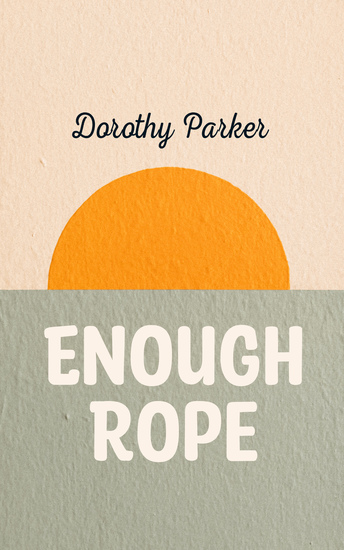
Enough Rope - cover

Enough Rope

Dorothy Parker

Editorial: e-artnow

  • 0
  • 0
  • 0

Sinopsis

Enough Rope is Dorothy Parker's first volume of poetry. The Nation described her verse as "caked with a salty humor, rough with splinters of disillusion, and tarred with a bright black authenticity."
Disponible desde: 25/01/2022.
Longitud de impresión: 97 páginas.

Otros libros que te pueden interesar

  • Window into My World - cover

    Window into My World

    Shivani Rangole

    • 0
    • 0
    • 0
    Window Into My World is a medley of short stories and poems. A poetess sitting by a window in her favourite café feels inspired by all the happenings around her. When she sees people, she doesn't just see what they are doing but how they must be feeling. Each short story is a prelude to a beautiful poem inspired by someone's presence. 'Window Into My World ' is dedicated to everyone and anyone who might find themselves in my stories.
    Ver libro
  • Journey of an apprentice pilgrim the - cover

    Journey of an apprentice pilgrim...

    Felipe Chavarro Polanía

    • 0
    • 0
    • 0
    We present a heartfelt tribute to what many call vocation or purpose. Join me in the journey of a young man, Kadmiel, as he ventures through various trades in search of his true calling, reflecting the experiences shared by millions worldwide, as Vicki Robin eloquently conveyed in her book, "The Stock Market or Life." Some find their passion early on and follow a steady path, while others, like Kadmiel, zigzag through a dozen jobs, always moving forward. 
    However, this work serves a dual purpose. Beyond just Kadmiel's tale, it aims to awaken us from the slumber of life's vicious cycle. Most of us find ourselves trapped in the belief that work solely exists to pay the bills, inadvertently forgetting the essential question: What about our happiness? Vicki Robin's words beautifully encapsulate this scenario - if the daily grind truly brought us joy and a sense of fulfillment, the trials and inconveniences would be a minor price to pay. But increasingly, it's evident that money doesn't guarantee the happiness we seek beyond a certain level of comfort. 
    If this resonates with you in any way, this book is meant for you. It delves into the quest for meaning and happiness that many of us find ourselves on.
    Ver libro
  • Unmeaningable - cover

    Unmeaningable

    Roxanna Bennett

    • 0
    • 0
    • 0
    Unmeaningable welcomes you to the freak show, where the monster on display is a culture that stigmatizes sickness and a system that shames the sufferer. Behold the wonder of the ages, a human mind in a human body, dissected and displayed for entertainment. Witness the ritual of surgical sacrifice! Observe the indignity of institutionalization! Be astounded by the indifference of ableism and ignorance! This uncanny collection of “crippled” sonnets features a thrilling display of cannibals, chimeras, and the crucial question: What meaning can be made of a life lived in pain and isolation?
    Ver libro
  • Things That Happen - And Other Poems (Unabridged) - cover

    Things That Happen - And Other...

    Bhaskar Chakrabarti

    • 0
    • 0
    • 0
    Bhaskar Chakrabarti's poetry is synonymous with the romantic melancholia inherent to Calcutta. His trenchant poetic voice was one of the most significant to emerge in the 1960s and '70s-perhaps the most prolific period of modern Bengali poetry. Spanning the rise of militant leftism, the spread of crippling poverty across India, the war in Bangladesh, the influx of millions of refugees, the dark, dictatorial days of Indira Gandhi's reign, and the disillusionment of communist rule in Bengal, Chakrabarti's poems plumb the depths of urban angst, expressing the spirit of sadness and alienation in delicate metaphors wrapped in deceptively lucid language.
    
    In this first-ever comprehensive translation of Chakrabarti's work, award-winning translator Arunava Sinha masterfully articulates that clarity of vision, retaining the unique cadence and idioms of the Bengali language. Presenting verses and prose poems from all of Chakrabarti's life-from his first volume, When Will Winter Come, published in 1971, to his last, The Language of Giraffes, published just before his death in 2005, and collecting several unpublished works as well-Things That Happen and Other Poems introduces the world to a brilliant and universal poetic voice of urban life.
    Ver libro
  • The Poetry of Edith Wharton - Pulitzer prize winning author Wharton known for novels such as Age Of Innocence and Ethan Frome was a woman of many talents an expert poet aswell we explore a wonderful selection here - cover

    The Poetry of Edith Wharton -...

    Edith Wharton

    • 0
    • 0
    • 0
    Edith Newbold Jones was born in New York on 24th January 1862.   Born into wealth, this background of privilege gave her a wealth of experience to eventually, after several false starts, produce many works based on it culminating in her 1921 Pulitzer Prize winning novel ‘The Age of Innocence’ 
     
    Marriage to Edward Robbins Wharton, who was 12 years her senior in 1885 seemed to offer much and for some years they travelled extensively.  After some years it was apparent that her husband suffered from acute depression and so the travelling ceased and they retired to ‘The Mount’, their estate designed by Edith.  By 1908 his condition was said to be incurable and prior to divorcing Edward in 1913 she began an affair, in 1908, with Morton Fullerton, a Times journalist, who was her intellectual equal and allowed her writing talents to push forward and write the novels for which she is so well known.  
     
    Acknowledged as one of the great American writers Wharton was also a dazzling though largely unrecognised poet.  Her talents allowed her to create poems that both capture and explore many situations of life and society.  
     
    Edith Wharton died of a stroke in 1937 at the Domaine Le Pavillon Colombe, her 18th-century house on Rue de Montmorency in Saint-Brice-sous-Forêt, in France. 
     
    1 - The Poetry of Edith Wharton - An Introduction 
    2 - Terminus by Edith Wharton 
    3 - Some Busy Hands by Edith Wharton 
    4 - A Failure by Edith Wharton 
    5 - A Hunting Song by Edith Wharton 
    6 - Happiness by Edith Wharton 
    7 - Mould and Vase by Edith Wharton 
    8 - Jade by Edith Wharton 
    9 - Aeropagus by Edith Wharton 
    10 - Non Dolet by Edith Wharton 
    11 - Botticlelli’s Madonna in the Louvre by Edith Wharton 
    12 - Patience by Edith Wharton 
    13 - The Comrade by Edith Wharton 
    14 - Mona Lisa by Edith Wharton 
    15 - Life by Edith Wharton 
    16 - The Bread of Angels by Edith Wharton 
    17 - Chartres by Edith Wharton 
    18 - Survival by Edith Wharton 
    19 - All Saints by Edith Wharton 
    20 - All Souls by Edith Wharton 
    21 - The Young Dead by Edith Wharton 
    22 - Belgium by Edith Wharton 
    23 - Battle Sleep by Edith Wharton 
    24 - Experience by Edith Wharton 
    25 - A Torchbearer by Edith Wharton 
    26 - A Grave by Edith Wharton 
    27 - An Autumn Sunset by Edith Wharton 
    28 - Grief by Edith Wharton
    Ver libro
  • My Land of Freedom - A poem of war and freedom - cover

    My Land of Freedom - A poem of...

    Ifeanyi Njoku

    • 0
    • 0
    • 0
    This poem is a powerful reflection on war, displacement, and the struggle for freedom. It tells the tragic story of a people who fought for liberation but were met with violence, loss, and eventual surrender. Likely referencing the Igbo experience during the Nigerian Civil War, it captures the pain of oppression and the resilience of those who endured it. 
    The poem begins with a contradiction: "In my land of freedom, I walked with fear." This highlights the irony of living in a place meant to be free but being consumed by anxiety. The people demand justice, yet their cries are silenced by violence. The line "Killing our brothers, and leaving us undone" conveys both physical loss and emotional devastation. 
    The imagery of "scorching soil" and "separated from families" paints a picture of suffering and displacement. War does not just take lives—it tears families apart and leaves hearts unable to thrive. The mention of "refugee camps" emphasizes how many were forced from their homes, left to question their identity: "Are we unlucky, to be Igbo?" This speaks to a deep sense of abandonment and injustice. 
    The poem also highlights betrayal, as leaders fail to protect their people. "Everyone was a soldier, in this war we couldn't win." This line captures the grim reality of a war where survival itself was a battle. Despite their bravery, they were up against overwhelming forces. 
    The final lines are heartbreaking: "We had to surrender, and say goodbye to our pride." This is not just a loss of battle but a loss of dignity. Yet, even in surrender, their story lives on. This poem is a tribute to resilience, a reminder of suffering, and a call to remember those who fought, even when the world turned away.
    Ver libro