Begleiten Sie uns auf eine literarische Weltreise!
Buch zum Bücherregal hinzufügen
Grey
Einen neuen Kommentar schreiben Default profile 50px
Grey
Jetzt das ganze Buch im Abo oder die ersten Seiten gratis lesen!
All characters reduced
Ancient Man in Britain - cover

Ancient Man in Britain

Donald A. Mackenzie

Verlag: DigiCat

  • 0
  • 0
  • 0

Beschreibung

In "Ancient Man in Britain," Donald A. Mackenzie presents a comprehensive exploration of prehistoric life in the British Isles. Through meticulous archaeological research and vivid narrative, Mackenzie delves into the lives, customs, and environments of early humans, weaving together evidence from artifacts, skeletal remains, and ancient sites. His literary style is rich and engaging, blending scholarly rigor with accessible prose, making the complexities of anthropology and archaeology approachable to a broader audience. The book stands as a critical contribution to early 20th-century studies of British prehistory, reflecting the era's burgeoning interest in scientific inquiry and national identity. Donald A. Mackenzie was not only a noted Scottish author but also an enthusiastic scholar with a profound interest in folklore and anthropology. His diverse background in natural history and his commitment to understanding the cultural narratives of Britain influenced his writing and research. Mackenzie's passion for uncovering the threads connecting the past and present shaped "Ancient Man in Britain" into a seminal work that bridges narrative storytelling with scholarly investigation. For readers fascinated by the origins of human civilization and the evolution of culture, "Ancient Man in Britain" is an essential read. It invites you to trek through the landscapes of ancient Britain while contemplating the lives of those who once roamed them. Mackenzie's blend of careful research and engaging narration makes the book a rewarding journey for historians, students, and the curious alike.
Verfügbar seit: 13.06.2022.
Drucklänge: 232 Seiten.


Weitere Bücher, die Sie mögen werden

  • No More Secrets - My part in codebreaking at Bletchley Park and the Pentagon - cover

    No More Secrets - My part in...

    Betty Webb

    • 0
    • 0
    • 0
    The true and extraordinary story of one of the last surviving women to have worked in codebreaking at both Bletchley Park and the Pentagon. 
    Born one hundred years ago, Betty Webb MBE, LOH (Legion of Honour) has had a ringside seat to history. After graduating from school, she faced the usual limited opportunities for employment on offer to women at the time. However, with the war in full swing, fate intervened and in 1941, wanting to play her part in the war effort, Betty joined the Auxiliary Territorial Service (Women’s Army). 
    After being interviewed by an intelligence officer, she found herself at Euston station with her kit-bag, a travel warrant in her pocket and instructions to get off the train at Bletchley Park. 
    Between 1941 and 1945 Betty played a vital role in the top-secret efforts being made to decipher the secret communications of the Germans and later the Japanese. In 1945, as other members of the forces returned home from the war in Europe, she was sent to the Pentagon and was in Washington DC when the atomic bombs fell and when Eisenhower announced the end of the war. 
    Betty was unable to reveal the true nature of her work, even to her parents, until years later. In this fascinating book, she revisits the key moments of her life and recounts the incredible stories from her time at Bletchley Park.
    Zum Buch
  • "HEART WANT - LOGIC DOES NOT WANT" - "HEART WANT REASON LATER" - Hati Mau Akal Nanti Dulu - cover

    "HEART WANT - LOGIC DOES NOT...

    Saikhul Mabrur

    • 0
    • 0
    • 0
    Both, namely the Heart and Mind, are the basic ingredients for forming a humble person. 
    The heart is like a small child who if left alone will endanger himself and others, Mind is like a 
    parent who if there are no children, the completeness of the family becomes unbalanced. The 
    heart will be good if it comes from wise directions at the level of reason, but it will be bad if it 
    comes from directions to the lack of understanding of the Mind. 
    This reason is also developed into a beautiful sentence from the scholars of wisdom, namely 
    العقل السليم فى الجسم التسليم 
    "A good reason is found in a good body" 
    in that sentence, there are those who say that its application is very dialectical, meaning that not 
    only is the reason mentioned first, all humans are able to implement it. the meaning of that 
    sentence is that the body can be the first application. dialectic is one of the evidences of a fact 
    where something cannot be 
    a thing that stops statically or definitely, it is so easy to move position from the beginning to 
    point A to point B, from being at point B a minute later it can be positioned at 
    point A, the most important part in this case is Nothing Is Out of the Participation 
    of the Almighty. Namely "a good body is very strongly bound to a good mind" 
    then it becomes; 
    الجسم السليم فى العقل التسليم 
    According to the famous Cultural Expert and Scholar Emha Ainun Nadjib, the following are the 
    various kinds of inversions of a dialectic, which are the diversity of perspectives and ways of 
    thinking of every human being who is willing to process it, for the sake of continuity and 
    suitability of a life path that is carried out.
    Zum Buch
  • The P-38 Lightning and the Men Who Flew It - cover

    The P-38 Lightning and the Men...

    Colonel Wolfgang W. E. Samuel,...

    • 0
    • 0
    • 0
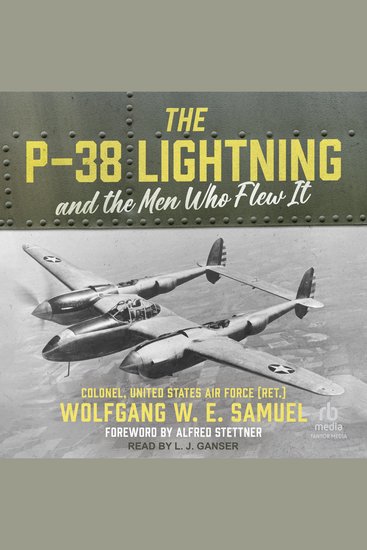
    The P-38 Lightning was one of the fastest operational fighters of World War II, famous for its successes in North Africa and the Pacific. In The P-38 Lightning and the Men Who Flew It, Wolfgang W. E. Samuel shares the stories of the young men who climbed into the cockpits of the P-38 to fight for freedom, and of those who created, tested, and deployed these fearsome machines. 


    The P-38 was the product of the Lockheed Corporation, the first fighter they ever built, principally conceptualized by Kelly Johnson, whose design was to meet Air Corps specifications. But it was no easy plane to fly. 


    P-38 units were formed quickly once the United States entered World War II in December 1941. Training was rushed to get pilots and planes to Europe as quickly as possible to serve as bomber escorts. Although the P-38 could fly at the high altitudes the bombers flew, it was not the right aircraft for the mission. In North Africa's warmer air, however, the P-38 came into its own. 


    This book focuses on the men who flew this challenging aircraft and the men who designed and decided how to deploy it. In the Pacific skies, the P-38, its pilots, and designers made the heroic history captured here.
    Zum Buch
  • Ottoman Edges - cover

    Ottoman Edges

    Anonym

    • 0
    • 0
    • 0
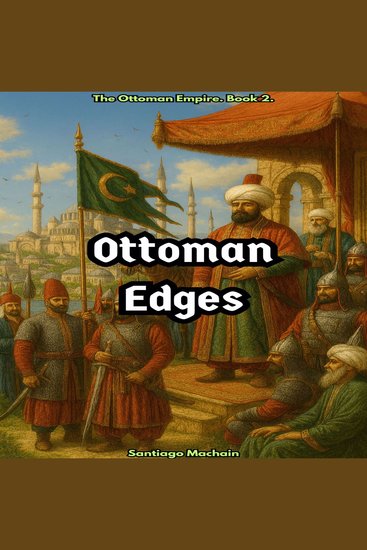
    This book offers a vivid, ground-level narrative of how the Ottoman Empire navigated two turbulent centuries of war, diplomacy, and reinvention. From the Treaty of Zsitvatorok to the French invasion of Egypt, this book follows shifting frontiers in the Balkans, the Caucasus, and the Arab provinces; the rise of provincial notables; the transformation of the Janissaries; the monetized pressures of silver and global trade; the aesthetics and politics of the Tulip Period; and the Empire’s steadily sharpening view of Europe. It explores how Russia and Austria surged, how forts and bridges became social institutions, how markets whispered the first warnings of defeat and recovery, and how knowledge—maps, manuals, and newspapers—turned into instruments of power. Bringing cities, soldiers, scholars, and merchants to life, the book reframes “decline” as an intense school of adaptation that culminated in the shock of 1798 Egypt—an ending that seeded the next Ottoman century of reforms.
    Zum Buch
  • History of Machu Picchu - The Greatest Symbol of the Inca Empire - cover

    History of Machu Picchu - The...

    Kelly Mass

    • 0
    • 0
    • 0
    Machu Picchu, one of the most iconic symbols of Inca civilization, is a 15th-century fortress perched high on a mountain crest in southern Peru's Eastern Cordillera. Sitting at an altitude of 2,430 meters (7,970 feet), it is located 80 kilometers (50 miles) northwest of Cusco, within the Machupicchu District of Urubamba Province. The fortress overlooks the Sacred Valley, and the Urubamba River winds through the valley below, cutting through the Cordillera and forming a tropical mountain canyon. This stunning geographical setting has made Machu Picchu one of the most visited and revered archaeological sites in the world. 
    Unlike the Mayans, the Incas had no written language, and thus, no records of the site existed during its operation. The first Europeans to visit Machu Picchu did so only in the 19th century, and as a result, much of its history remained shrouded in mystery. Modern archaeologists, relying on tangible evidence such as graves and structural remains, have attributed names and proposed functions for the buildings, but much of the site’s exact purpose remains speculative. 
    Most contemporary archaeologists believe that Machu Picchu was built as a royal estate for the Inca emperor Pachacuti, who ruled from 1438 to 1472. Constructed in 1450, the site functioned as a private residence for the emperor and his court. Over time, Machu Picchu became the most well-known image of Inca civilization and is often referred to as the "Lost City of the Incas." However, the estate was abandoned in the early 16th century, following the Spanish conquest of the Inca Empire. Recent radiocarbon dating indicates that the site was occupied from around 1420 to 1532.
    Zum Buch
  • Beyond Good and Evil - cover

    Beyond Good and Evil

    Friedrich Nietzsche

    • 0
    • 0
    • 0
    "Beyond Good and Evil" by Friedrich Nietzsche is a thought-provoking and challenging work that explores fundamental questions about morality, truth, and the nature of existence. In this book, Nietzsche offers a scathing critique of traditional morality and the idea of objective truth, arguing instead for a new ethical framework that is based on the individual will to power. Drawing on a wide range of philosophical and cultural influences, Nietzsche takes readers on a journey of self-discovery that challenges many of our most deeply held assumptions about the world. With its bold and original ideas, "Beyond Good and Evil" is a classic of Western philosophy that continues to inspire and challenge readers today.
    Zum Buch