Rejoignez-nous pour un voyage dans le monde des livres!
Ajouter ce livre à l'électronique
Grey
Ecrivez un nouveau commentaire Default profile 50px
Grey
Abonnez-vous pour lire le livre complet ou lisez les premières pages gratuitement!
All characters reduced
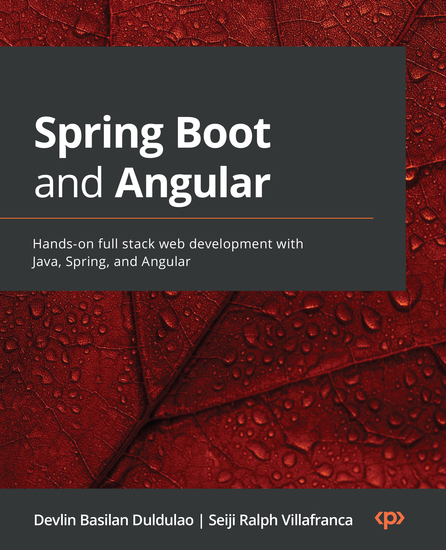
Spring Boot and Angular - Hands-on full stack web development with Java Spring and Angular - cover

Spring Boot and Angular - Hands-on full stack web development with Java Spring and Angular

Devlin Basilan Duldulao, Seiji Ralph Villafranca

Maison d'édition: Packt Publishing

  • 0
  • 0
  • 0

Synopsis

Angular makes building applications with the web easy and Spring Boot helps get an application up and running using just a few lines of code and minimal configuration. This book provides insights into building full-stack apps using Angular and Spring Boot effectively to reduce overall development time and increase efficiency.You'll start by setting up your CI/CD pipeline and then build your web application’s backend guided by best practices. You'll then see how Spring Boot allows you to build applications faster and more efficiently by letting the Spring Framework and Spring Boot extension do the heavy lifting. The book demonstrates how to use Spring Data JPA and add its dependencies along with Postgres dependencies in the project to save or persist a user's data in a database for future use. As you advance, you'll see how to write tests and test a service using Mockito. Finally, you'll create a CI workflow or pipeline for a Spring Boot and Angular application to enable operations to deliver quality applications faster.By the end of this Spring Boot and Angular book, you'll be able to build a full-stack web application and deploy it through continuous integration and continuous deployment.
Disponible depuis: 16/12/2022.
Longueur d'impression: 438 pages.
D'autres livres qui pourraient vous intéresser

  • Electromagnetic Theory - A Study of Electromagnetic Fields and Waves - cover

    Electromagnetic Theory - A Study...

    Mark Hedges

    • 0
    • 0
    • 0
    Electromagnetic theory is a fundamental branch of physics that describes the interactions between electric and magnetic fields and how they give rise to electromagnetic waves. The theory provides the foundation for understanding a wide range of physical phenomena, including the behavior of light, radio waves, and other forms of electromagnetic radiation. Electromagnetic theory is essential not only in classical physics but also in modern technological applications, such as communication systems, medical imaging, and radar. 
    The development of electromagnetic theory is rooted in the pioneering work of James Clerk Maxwell, who formulated a set of equations known as Maxwell's equations in the 19th century. These equations describe how electric and magnetic fields are generated and altered by each other and by charges and currents. Maxwell's equations unify the concepts of electricity and magnetism into a single framework, revealing that light itself is an electromagnetic wave propagating through space. This groundbreaking discovery led to the realization that visible light, radio waves, microwaves, infrared radiation, ultraviolet light, X-rays, and gamma rays are all part of the electromagnetic spectrum, differing only in their frequency and wavelength.
    Voir livre
  • Gardening - Greenhouses Horticulture and Irrigation Systems - cover

    Gardening - Greenhouses...

    Maria Garrets

    • 0
    • 0
    • 0
    This book consists of 3 titles: 
    Greenhouse: Greenhouse gardening offers numerous benefits beyond extending the growing season. It provides a controlled environment that protects plants from pests, diseases, and extreme weather conditions, creating an ideal microclimate for optimal growth. With precise control over temperature, humidity, and light levels, gardeners can cultivate a wide range of plants that might not thrive in their local climate otherwise. Greenhouses also allow for efficient use of space, enabling vertical gardening, hydroponic systems, and other innovative cultivation techniques. Additionally, greenhouse gardening promotes sustainability by reducing water consumption, minimizing the need for chemical pesticides, and enabling year-round production of fresh, locally grown produce. 
    Horticulture: Horticulture encompasses a wide range of disciplines, including plant biology, genetics, soil science, entomology, plant pathology, and environmental science. It involves understanding the specific needs of different plant species, such as their preferred growing conditions, nutritional requirements, and pest and disease management strategies. 
    Irrigation Systems: An irrigation system is a method used to supply water to crops or landscapes in a controlled manner, typically to assist with crop growth or maintain landscapes. There are various types of irrigation systems, including drip irrigation, sprinkler systems, and flood irrigation, each with its own advantages and applications.
    Voir livre
  • AI for Cybersecurity - Starseed AI - cover

    AI for Cybersecurity - Starseed AI

    Starseed

    • 0
    • 0
    • 0
    In an age where cyber threats evolve with lightning speed, traditional defenses are no longer enough. AI in Cybersecurity: Protecting the Digital Future is your guide to understanding how artificial intelligence is revolutionizing the fight against digital crime. 
    This comprehensive book delves into AI's transformative role in cybersecurity, from identifying and mitigating sophisticated threats to mastering critical concepts like machine learning and anomaly detection. You’ll gain practical insights into integrating cutting-edge AI tools into your strategies, ensuring you stay ahead of emerging risks in an ever-changing digital landscape. 
    Cybercriminals are already leveraging AI to outsmart conventional systems. This book empowers you to outthink and outmaneuver them, equipping individuals and organizations to protect their most valuable assets with confidence. 
    Authored by experts at Starseed, a leading advocate for accessible education, this book is more than just a resource—it’s a call to action. Join a forward-thinking community dedicated to shaping the future of cybersecurity. Together, we can build a safer, AI-driven world. 
    Whether you’re an IT professional, a student, or simply curious about AI’s potential, AI in Cybersecurity offers the knowledge and tools you need to thrive. The future of cybersecurity starts now. Don’t wait—step into the future and safeguard what matters most.
    Voir livre
  • Sleep Hypnosis for Anxiety Overthinking and Depression - Positive Affirmations for Self Worth Healing and Deep Sleep - cover

    Sleep Hypnosis for Anxiety...

    Sleep School

    • 0
    • 0
    • 0
    Are you struggling with anxiety, overthinking, or depression? It's time to let go of the mental clutter and reclaim your peace of mind. "Sleep Hypnosis for Anxiety, Overthinking, and Depression" is a transformative audiobook designed to guide you into a state of deep relaxation, promoting healing through positive affirmations. As you listen, soothing hypnosis will help you release negative thoughts and replace them with empowering beliefs that nurture your self-worth and emotional well-being. 
    This audiobook isn't just about sleep—it's about healing. Whether you're battling insomnia, seeking relief from stress, or simply need a mental reset, our expertly crafted hypnosis techniques provide you with the tools to embrace peace, tranquility, and balance. With every session, you'll feel more centered, confident, and connected to your inner strength. 
    Allow this powerful journey of self-discovery to help you fall into a deep, restful sleep, waking up feeling rejuvenated, clear-headed, and emotionally aligned. Let go of anxiety, overthinking, and depression—reclaim the life you deserve.
    Voir livre
  • Race for Nuclear Weapons during World War II The: The History and Legacy of Both Sides’ Efforts to Build an Atomic Bomb - cover

    Race for Nuclear Weapons during...

    Editors Charles River

    • 0
    • 0
    • 0
    Before the Second World War, military conflicts were fought under orthodox conditions, usually termed “conventional warfare,” but several innovations had significantly changed combat, leading inextricably to the race for a nuclear weapon in the 1930s and 1940s. Conflicts had been fought by armies on horseback with guns of varying sophistication since the 16th century, but mechanized warfare and machine guns changed this calculus and set the stage for future combat by the end of World War I. Other sinister changes entered the fray during this conflict, such as chemical weapons like chlorine and mustard gas. The total warfare brought about by World War I and ensuing wars like the Spanish Civil War made the quest for the most powerful weapons somewhat necessary. 
    The Manhattan Project would ultimately yield the “Little Boy” and “Fat Man” bombs that released more than 100 Terajoules of energy at Hiroshima and Nagasaki, but as it turned out, the Axis were not far behind with their own nuclear weapons program. When the Nazis’ quest for a nuclear weapon began in earnest in 1939, no one really had a handle on how important nuclear weapons would prove to war and geopolitics. The attacks on Hiroshima and Nagasaki in August 1945, along with the Cold War-era tests and their accompanying mushroom clouds, would demonstrate the true power and terror of nuclear weapons, but in the late 1930s these bombs were only vaguely being thought through, particularly after the successful first experiment to split the atom by a German scientist. The nuclear age itself was in its infancy, barely 35 years old, but within a few short years the advent of nuclear war loomed over the world and the prospect of the enemy winning the nuclear race kept Allied leaders awake at night.
    Voir livre
  • Wait Five Minutes - Weatherlore in the Twenty-First Century - cover

    Wait Five Minutes - Weatherlore...

    Shelley Ingram, Willow G. Mullins

    • 0
    • 0
    • 0
    The weather governs our lives. It fills gaps in conversations, determines our dress, and influences our architecture. No matter how much our lives may have moved indoors, no matter how much we may rely on technology, we still monitor the weather. Wait Five Minutes: Weatherlore in the Twenty-First Century draws from folkloric, literary, and scientific theory to offer up new ways of thinking about this most ancient of phenomena. 


    Weatherlore is a concept that describes the folk beliefs and traditions about the weather that are passed down casually among groups of people. From detailing personal experiences at picnics and suburban lawns to critically analyzing storm stories, novels, and flood legends, contributors offer engaging multidisciplinary perspectives on weatherlore. 


    As we move further into the twenty-first century, an increasing awareness of climate change and its impacts on daily life calls for a folkloristic reckoning with the weather and a rising need to examine vernacular understandings of weather and climate. Weatherlore helps us understand and shape global political conversations about climate change and biopolitics at the same time that it influences individual, group, and regional lives and identities. We use weather, and thus its folklore, to make meaning of ourselves, our groups, and, quite literally, our world.
    Voir livre