Unisciti a noi in un viaggio nel mondo dei libri!
Aggiungi questo libro allo scaffale
Grey
Scrivi un nuovo commento Default profile 50px
Grey
Iscriviti per leggere l'intero libro o leggi le prime pagine gratuitamente!
All characters reduced
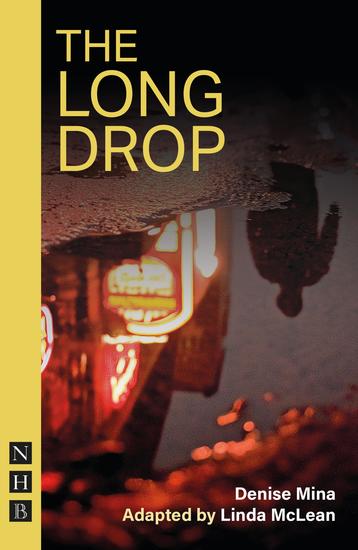
The Long Drop - cover

The Long Drop

Denise Mina

Casa editrice: Nick Hern Books

  • 0
  • 0
  • 0

Sinossi

'I know who done it, the Burnside murders, and it wasn't William Watt.'
Glasgow, 1957. A family destroyed. A man who insists he knows why. 
Through stale-aired bars and shadowed backstreets, William Watt and Peter Manuel share a night of whisky-soaked confessions and half-truths. A night that will lead to one of the most notorious trials in Scottish history.
Adapted from Denise Mina's critically acclaimed crime novel, The Long Drop is a gritty and gripping descent into a world of gangsters, gossip and betrayal. Linda McLean's stage adaptation was originally commissioned by and premiered at the Citizens Theatre, Glasgow, in 2026, directed by Dominic Hill.
'A masterpiece by the woman who may be Britain's finest living crime novelist' Daily Telegraph on Denise Mina's original novel
Disponibile da: 18/06/2026.
Lunghezza di stampa: 96 pagine.

Altri libri che potrebbero interessarti

  • The Seagull - cover

    The Seagull

    Anton Chekhov

    • 0
    • 0
    • 0
    When celebrated actress Irina Arkádina arrives at her family's country estate for the summer, she finds herself caught in a perfect storm of conflicting desires.
    Her playwright son, Konstantin, is struggling to step out of her shadow to pursue his own artistic ambitions. Her lover Trigorin, a famous novelist, has entranced the aspiring young actress Nina, with whom Konstantin is in love. And complicating everything is Arkádina's own need to take centre stage, in her personal life as well as her work.
    As their lives entwine and they each grapple with their desires, ambitions and disappointments, Anton Chekhov's timeless play unfolds in a gripping tale of vanity, power and sacrifices made in the name of art.
    This refreshing, revitalised adaptation of The Seagull by Duncan Macmillan and Thomas Ostermeier was first performed at the Barbican Theatre, London, in 2025, directed by Ostermeier. The ensemble cast included Cate Blanchett, Tom Burke, Emma Corrin and Kodi Smit-McPhee.
    Mostra libro
  • The Day-Breakers - cover

    The Day-Breakers

    Michael Fraser

    • 0
    • 0
    • 0
    Saturated with locutions lifted from the late 19th century, The Day-Breakers deeply conceives of what African Canadian soldiers experienced before, during, and in the immediate aftermath of the American Civil War.
    		 
    “It is not wise to waste the life / Against a stubborn will. / Yet would we die as some have done. / Beating a way for the rising sun” wrote Arna Bontemps. In The Day-Breakers, poet Michael Fraser imagines the selflessness of Black soldiers who fought for the Union during the American Civil War, of whom hundreds were African-Canadian, fighting for the freedom of their brethren and the dawning of a new day. Brilliantly capturing the rhythms of their voices and the era in which they lived and fought, Fraser’s The Day-Breakers is an homage to their sacrifice and an unforgettable act of reclamation: the restoration of a language, and a powerful new perspective on Black history and experience.
    Mostra libro
  • Laughing Boy - (stage version) - cover

    Laughing Boy - (stage version)

    Stephen Unwin

    • 0
    • 0
    • 0
    'So much magic. So much love. So much laughter. So much work. So much rage. And so many tears.'
    Connor is, well, Connor. He loves buses, Eddie Stobart and Lego. He also has learning disabilities. When he dies an entirely preventable death in NHS care, his mum, Sara, can't get a straight answer as to how it happened.
    But Sara and her family won't stop asking questions and soon an extraordinary campaign emerges. Demanding the truth, it uncovers a scandal of neglect and indifference that goes beyond Connor's death to thousands of others.
    Sara Ryan's impassioned, frank and surprisingly funny memoir Justice for Laughing Boy is adapted for the stage by Stephen Unwin. It was first performed at Jermyn Street Theatre, London, in 2024, in a co-production with Theatre Royal Bath.
    Mostra libro
  • Slows: Twice - cover

    Slows: Twice

    T. Liem

    • 0
    • 0
    • 0
    SHORTLISTED FOR THE 2023 A.M. KLEIN PRIZE FOR POETRY 
    LONGLISTED FOR THE 2024 RAYMOND SOUSTER AWARD 
    CBC BOOKS CANADIAN POETRY COLLECTIONS TO WATCH FOR IN SPRING 2023 
    Backward and forward: a double book of mirrored poems about identity in all its forms.This is a book of slow hours, days, and years – how they can collapse into one another, how it can feel like we are living one day repeating itself. From within this collapse, the speaker seeks connection everywhere. They visit their father’s birthplace, Jogjakarta; they listen to a stranger’s phone call at the Motel 6 in Alberta; they linger in the so-called ethnic aisle of the grocery store. From all of these places the speaker is discouraged but tries to imagine a future joyously incomprehensible to the present.Slows: Twice is a collection of revisions and repetitions; every poem in one half of the book has an alternate version, or a mirror poem, in the other half. The poems are tied to themes of work and labour, consumption and waste, family and home, as shapers of identity and relationships. The act of revising and repeating – slowly – is meant to be a resistance to efficiency, a resistance to being an always-productive body under capitalism. 
     
    "The poems of Slows: Twice collect in resonance, contemplate the construction of selves, with modes of repetition, sequencing, and mirroring, the way language assembles an identity or points to itself as it points away.  'The clouds // disappear the sky sometimes; or they become it.' Storied and cubistic, palindromic and cleaved, Liem’s poems reveal relationships to time, noise, and duration, and the possibility of joy given painful pasts." – Hoa Nguyen, author of A Thousand Times You Lose Your Treasure 
    "T. Liem is one of my favorite poets working in Canada. I welcomed this book into my life like sudden sunlight. Slows: Twice is a book about how urgently we need to read differently. I loved its mischievous relation to form and expectation as well as its burning intelligence. I once described T. as an inheritor of the tradition of language poetry, but what Slows: Twice proves is that T. is less an inheritor and more so an innovator, an inventor in their own right. I read it in one frenzied sitting." – Billy-Ray Belcourt, author of A Minor Chorus 
    "It’s breathtaking to watch words drip from a page into a silver river cutting through a canyon of time. T. Liem sculpts poetry with steady, curious fingers, pushing against the filaments we think hold us together that have been quietly collecting cracks, from buried violence and whispered histories to the fragile connections tying us together. Obits. captured my heart; Slows: Twice now affirms it." – Teta, founder of diasporic Indonesian publication Buah zine 
    "'For everything I was, I am now something else.' Revision of self and world are core to this innovative, unruly book that manages somehow to be at once formally wacky and emotionally clear. These poems seem to ask: if language is a box heavy with histories and inadequacies and which we nevertheless must carry, can language also carry us somewhere, elsewhere, strangely? Rarely have I encountered a book so at home in the unresolved, in the tension between a longing for declaration and a commitment to questions. T. Liem’s work conjures the figure of Janus: god of duality and gates, one face facing an end, the other looking through a new door, right in the eye of a dream." – Chen Chen, author of Your Emergency Contact Has Experienced an Emergency 
    "T. Liem's Slows: Twice is a fascinating exercise in revision and remaking, each repetition of its text accomplishing the arduous task of stretching time and geopolitical fixity. 'asking and repeating/ we are made' declares Liem, and that utterance produces the book's essential maxim, 'language is change/ changed by prosody.' In between these cracks of time, language becomes a miracle suture for love and connection where the hard reality of one's circumstances may produce infinite ruptures. This is a book that peers into the fissure, holding these moments of fracture as still and clearly as possible--a future of proximates." – Muriel Leung, author of Imagine Us, the Swarm
    Mostra libro
  • Poets on Poetry - The most artistic and creative form of writing we have a selection of poems from those artistic and creative minds about poetry itself - cover

    Poets on Poetry - The most...

    Matthew Arnold, Sarojini Naidu,...

    • 0
    • 0
    • 0
    Who has not tried to write a poem?  The poetic form of words seems to be rather easy.  In its basic form, which we learn as children, the rhyming couplet is, in a child’s written and spoken words, pure joy - success!  In the hands of a Shakespeare it is magnificent with a reach and understanding that the rest of us enjoy but are far from even attempting.    
     
    As we listen to various poetic forms, schools and movements we can only react with wonder at how these innocent words are assembled to create symphonies of ideas, wonder and revelation.  The emotions they seek to invoke can be anything from happiness to sadness, from love to revulsion. 
     
    Arnold, Stevens, Keats, Akhmatova, Browning, Herrick, Hood, Killigrew are but a few of the roll-call of wordsmiths who with mere words create ravenous beauty that reveals tender lines and sensitive verse on how and why they are who they are. 
     
    01 - Poets on Poetry - An Introduction 
    02 - When I Write Poems by Anna Akhmatova 
    03 - Of My Poems by Thomas MacDonagh 
    04 - An Apology For Her Poetry by Duchess of Newcastle, Margaret Cavendish 
    05 - Sonnet 76 - Why is My Verse So Barren of New Pride by William Shakespeare 
    06 - The Austerity of Poetry by Matthew Arnold 
    07 - Of Modern Poetry by Wallace Stevens 
    08 - Poetry by Claude McKay 
    09 - The Poetry of Keats by George Meredith 
    10 - Future Poetry by Alice Meynell 
    11 - Sonnet 17 - Who Will Believe My Verse in Time to Come by William Shakespeare 
    12 - Poetic Eggs by Ezra Pound 
    13 - Poem by William Carlos Williams 
    14 - On the Grasshopper and Cricket by John Keats 
    15 - Ode on the Poetical Character by William Collins 
    16 - Introduction and Conclusion of a Long Poem by Alan Seeger 
    17 - A True Account of the Birth and Conception of a Late Famous Poem by Charles Sackville, Earl Of Dorset 
    18 - The Poem That Took the Place of a Mountain by Wallace Stevens 
    19 - The Poet and the Poem by Elizabeth Stuart Phelps 
    20 - Of English Verse by Edmund Waller 
    21 - Love, The Soul of Poetry by Anne Killigrew 
    22 - Why, If All Poets Crown Their Love with Verse by Emily Hickey 
    23 - Verse Making Was the Least of My Virtues by Robert Browning 
    24 - The Poet's Love-Song by Sarojini Naidu 
    25 - A Letter to a Brother of the Pen in Tribulation by Aphra Behn 
    26 - Not Every Day Fit for Verse by Robert Herrick 
    27 - On the Poetic Muse by George Moses Horton 
    28 - Sonnet - Written in Keats by Thomas Hood 
    29 - Sonnet 86 -Was It the Proud Full Sail of His Great Verse by William Shakespeare 
    30 - Song in Imitation of Shakespeare by James Beattie 
    31 - The High-toned Old Christian Woman by Wallace Stevens 
    32 - Poetry is a Destructive Force by Wallace Stevens 
    33 - To My Most Dearly Loved Friend Henry Reynolds Esquire of Poets and Poesie by Michael Drayton 
    34 - His Poetry His Pillar by Robert Herrick 
    35 - To Live Merrily and to Trust to Good Verses by Robert Herrick 
    36 - Poem for the End by Ivor Gurney
    Mostra libro
  • Poets of the Early 20th Century The - Volume 2 - Find beauty and hope in a period ravaged worldwide by war - cover

    Poets of the Early 20th Century...

    Edna St. Vincent Millay, T S...

    • 0
    • 0
    • 0
    In England the Victorian Age was about to become the past and a new age of worldwide wars of horror and slaughter would envelop and decimate generations, forever staining mankind.   
     
    The Century would see the World discover strengths. The Democracies would stand firm against Fascism and later Communism yet still keep its own elite and privileged in power and the rest of us underfoot. 
     
    The World was more connected than ever before.  Culture accelerated its kaleidoscopic and interwoven journey. Transport delivered people by car and train and then aeroplane to far flung corners of the globe.  Empires were at their zenith and ready to fragment with new nations, many troubled, rising from their decay. 
     
    The natural world continued to be plundered and pillaged for its resources by industries who pledged ‘more’ and ‘better’ and would clothe and feed a growing world yet sow the seeds now ready to devastate us in our current times. 
     
    The globe was as vibrant and violent as troubled and tarnished as it ever was.  But new ideas, new political systems, new times changed everything once again. 
     1 - The Poets of the Early Twentieth Century  - Volume 2 - An Introduction 
    2 - The Lions by Joseph Mary Plunkett 
    3 - 1841-1891 by Joseph Mary Plunkett 
    4 - If We Return by F W Harvey 
    5 - The Soldier Speaks by F W Harvey 
    6 - The Negro Soldiers by Roscoe C Jamison 
    7 - Into Battle by Julian Grenfell 
    8 - Prayer For Those on the Staff by Julian Grenfell 
    9 - Hymn by Fenton Johnson 
    10 - Tired by Fenton Johnson 
    11 - Sonnet I by Fernando Pessoa 
    12 - If, After I Die by Fernando Pessoa  
    13 - I Have A Rendezvous with Death by Alan Seeger 
    14 - All Thats Not Love by Alan Seeger 
    15 - Maktoob by Alan Seeger 
    16 - The Unseen Planets by Raymond Chandler 
    17 - The Poet's Knowledge by Raymond Chandler 
    18 - I Saw A Man This Morning by Patrick Shaw Stewart 
    19 - Whispers of Immortality by T S Eliot 
    20 - The Love Song of J Alfred Prufrock by T S Eliot 
    21 - Preludes by T S Eliot 
    22 - The Wounded Bird by Katherine Mansfield 
    23 - Stars by Katharine Mansfield 
    24 - A Fine Day by Katherine Mansfield 
    25 - I Taught Myself To Live Simply by Anna Akhmatova 
    26 - When I Write Poems by Anna Akhmatova 
    27 - Poetry by Claude McKay 
    28 - The White House by Claude McKay 
    29 - The Lynching by Claude McKay 
    30 - Strange Hells by Ivor Gurney 
    31 - Crucifix Corner by Ivor Gurney 
    32 - Serenade by Ivor Gurney 
    33 - Break of Day in the Trenches by Isaac Rosenberg 
    34 - Dead Man's Dump by Isaac Rosenberg 
    35 - August 1914 by Isaac Rosenberg 
    36 - Journey's End by Zora Neale Hurston 
    37 - The Dog Tupman by Stella Benson 
    38 - The Ballad of the Harp-Weaver by Edna St Vincent Millay 
    39 - My Heart Being Hungry by Edna St Vincent Millay 
    40 - What Lips My Lips Have Kissed, And Where, And Why by Edna St Vincent Millay 
    41 - Sonnet XVIII - I, Being Born a Woman by Edna St Vincent Millay 
    42 - Unity by Cesar Vallejo 
    43 - Love by Edith Sodergran 
    44 - On Foot I Had to Cross the Solar System by Edith Sodergran 
    45 - Insouciance by Richard Aldington 
    46 - Goodbye by Richard Aldington 
    47 - Grey Hairs by Marina Ivanova Tsvetaeva 
    48 - Lady with Camelias by Marina Ivanova Tsvetaeva 
    49 - To Mother by Marina Ivanova Tsvetaeva 
    50 - Back To Rest by Lietenant William Noel Hodgson MC 
    51 - Before Action  by Lieutenant William Noel Hodgson MC 
    52 - Past One O'Clock by Vladimir Mayakovsky 
    53 - So This Is How I Turned into a Dog by Vladamir Mayakovsky 
    54 - Verse for a Certain Dog by Dorothy Parker 
    55 - A Dream Lies Dead by Dorothy Parker<p
    Mostra libro