Begleiten Sie uns auf eine literarische Weltreise!
Buch zum Bücherregal hinzufügen
Grey
Einen neuen Kommentar schreiben Default profile 50px
Grey
Jetzt das ganze Buch im Abo oder die ersten Seiten gratis lesen!
All characters reduced
The EU and the South Caucasus: European Neighborhood Policies between Eclecticism and Pragmatism 1991-2021 - With a foreword by Nicholas Ross Smith - cover

The EU and the South Caucasus: European Neighborhood Policies between Eclecticism and Pragmatism 1991-2021 - With a foreword by Nicholas Ross Smith

Daviti Mtchedlishvili

Verlag: ibidem

  • 0
  • 0
  • 0

Beschreibung

This book delves into the complex and often contradictory relations between the South Caucasus and European Union (EU).
Verfügbar seit: 08.01.2024.
Drucklänge: 326 Seiten.

Weitere Bücher, die Sie mögen werden

  • A Brief Global History of the Left - cover

    A Brief Global History of the Left

    Shlomo Sand

    • 0
    • 0
    • 0
    The Left seems to be dying a slow death. While many commenters have predicted its demise, the Left has always defied these bleak prognoses and risen from the ashes in the most unexpected ways. Nevertheless, we are witnessing today a global decline in organized movements on the Left, and while social struggles and rebellious citizens continue to challenge dominant political regimes, these efforts do not translate into support for traditional left parties or into the creation of dynamic movements on the left. 


    Bestselling historian Shlomo Sand argues that the global decline of the Left is linked to the waning of the idea of equality that has united citizens in the past and inspired them to engage in collective action. Sand retraces the evolution of this idea in a wide-ranging account that includes seventeenth-century England, the French Revolution, the birth of anarchism and Marxism, the decolonial, feminist, and civil rights revolts, and the left populism of our time. In piecing together the thinkers and movements that built the Left, Sand illuminates the global and transnational dynamics which pushed them forward, often picking up the gauntlets their predecessors had laid down. He outlines how they shaped the notion of equality, while also analyzing how they were confronted by its material reality, and the lessons that they did—or did not—draw from this.
    Zum Buch
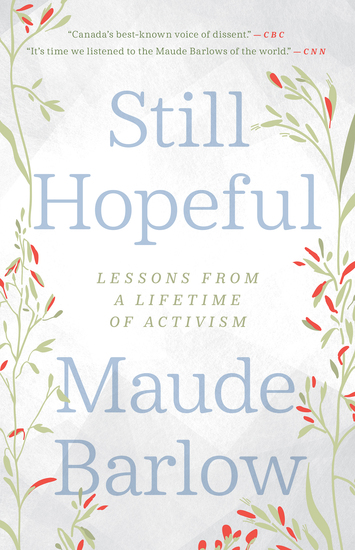
  • Still Hopeful - Lessons from a Lifetime of Activism - cover

    Still Hopeful - Lessons from a...

    Maude Barlow

    • 0
    • 0
    • 0
    “Canada’s best-known voice of dissent.” — CBC
    		 
    “It’s time we listened to the Maude Barlows of the world.” — CNN
    		 
    In this timely book, Barlow counters the prevailing atmosphere of pessimism that surrounds us and offers lessons of hope that she has learned from a lifetime of activism. She has been a linchpin in three major movements in her life: second-wave feminism, the battle against free trade and globalization, and the global fight for water justice. From each of these she draws her lessons of hope, emphasizing that effective activism is not really about the goal, rather it is about building a movement and finding like-minded people to carry the load with you. Barlow knows firsthand how hard fighting for change can be. But she also knows that change does happen and that hope is the essential ingredient.
    Zum Buch
  • Gerontocracy in America - How the Old Are Hoarding Power and Wealth—and What to Do About It - cover

    Gerontocracy in America - How...

    Samuel Moyn

    • 0
    • 0
    • 0
    A leading social critic identifies our least-discussed major crisis, and sets out to solve it.As Americans debate President Biden’s infirmities and President Trump’s erratic behavior, we’ve neglected the bigger problem before us: a massive transfer of power and wealth to the oldest among us, and the curtailment of the prospects of the young. In Gerontocracy in America, the historian and social critic Samuel Moyn offers a piercing diagnosis of our age divide and its consequences. Even apart from the presidency, in legislatures, businesses, and the courts, the average leader’s age has risen dramatically. The elderly predominantly fund campaigns and dominate their agendas, often with the intent to block any challenge to their status. The tax code is rigged on their behalf, as is an economy geared to sheltering financial and housing assets. The United States was founded on the promise of generational renovation but has become an increasingly febrile country of old men.But it doesn’t need to be this way. With understanding and wit, Moyn shows how elder power can be dismantled. With strong safety nets in place, mandatory retirement ages can be established. The early transfer of assets between generations could be encouraged and young voters can be granted more voice. In such a world, the elderly themselves would be freed from power games to confront the existential opportunities of aging, while the young would find their path to starting out in life unblocked at last.
    Zum Buch
  • Psychological Warfare - Using Psychological Tactics to Undermine or Control - cover

    Psychological Warfare - Using...

    Cito Harder

    • 0
    • 0
    • 0
    Psychological warfare is the deliberate use of tactics designed to influence, manipulate, and control the thoughts, emotions, and behaviors of individuals or groups. It involves the strategic deployment of psychological tactics to achieve specific objectives, often with the goal of weakening the will, confidence, and decision-making abilities of an opponent. Unlike physical warfare, which relies on the use of force and violence, psychological warfare focuses on undermining an adversary’s mental state, creating doubt, confusion, fear, or anxiety. The concept of psychological warfare spans across military, political, social, and personal domains, and its methods are utilized to achieve both large-scale and individual objectives. 
    At its core, psychological warfare operates by exploiting the weaknesses of human perception, beliefs, and emotions. It seeks to manipulate how people think, feel, and act, often in ways that are subtle and hard to detect. Through the strategic use of information, misinformation, fear, and emotional appeals, psychological warfare can alter the course of events and influence outcomes in a way that physical force alone cannot achieve. This manipulation can be direct, as in the use of propaganda, or more covert, as in the use of gaslighting to distort reality and create confusion. 
    Psychological warfare can be seen in many contexts, from international conflict and military operations to corporate competition, political campaigns, and even personal relationships. For example, in warfare, psychological tactics are employed to break the enemy’s morale, instill fear, and create division within their ranks. In the political arena, psychological warfare is often used to manipulate public opinion, spread propaganda, and discredit opponents.
    Zum Buch

  • Cold Civil War - Overcoming Polarization Discovering Unity and Healing the Nation - cover

    Cold Civil War - Overcoming...

    Jim Belcher

    • 0
    • 0
    • 0
    America's political landscape is experiencing dangerous polarization and fragmentation, with the extremes pulling the country apart. Voices on the left and right clash over different worldviews, definitions of America, and what it means to be an American citizen. The levels of incivility and hostility lead some to invoke the language of a cold civil war or even a looming civil war: one that could split the country in two. Is there any way to step back from this dangerous precipice?
    Political philosopher Jim Belcher shows that this is not merely a binary opposition between conservativism on the right and liberalism on the left, but also between conflicting visions of order and freedom on both sides. Through his unique quadrant framework, Belcher traces the people and movements in each position, examines their underlying narratives, and articulates their respective contributions and dangers. This quadrant framework not only reveals how polarization divides us but also shows us how to move beyond the right-left stalemate.
    At the core of the competing visions are the seeds of a new vital center, a robust and surprising model that has the ability to transcend political tribalism and bring America back together again before it is too late.
    Zum Buch
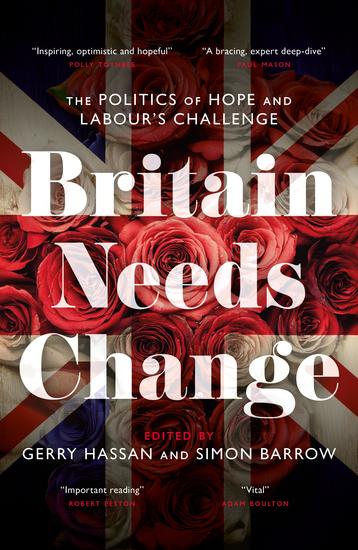
  • Britain Needs Change - The Politics of Hope and Labour's Challenge - cover

    Britain Needs Change - The...

    Simon Barrow, Gerry Hassan

    • 0
    • 0
    • 0
    After fourteen years of Conservative government – combined with Brexit, a global pandemic, the rise of a populist far right and the existential threat of climate change – many see Britain as undergoing serious social, economic and cultural decline. This is the context in which Labour have taken office at Westminster after a decade and a half in opposition. With recent ways of doing politics, government and statecraft in crisis, how can a serious, humane alternative emerge? What scale and type of change is coming, and will it be for the better?
    All this raises serious questions about the future of the UK and its constituent nations, Labour's ability to govern progressively, and the incoming government's confidence and capacity to take on the entrenched vested interests of present-day Britain while also having an honest, mature conversation with the public and its own supporters about the nature of these challenges.
    In Britain Needs Change, some of our best thinkers and commentators dissect the challenges facing the new government in a series of wide-ranging, penetrative essays. Featuring contributions from Helena Kennedy, John Curtice, Mariana Mazzucato, Neal Lawson, Aditya Chakrabortty, Ann Pettifor, Gavin Esler, Hilary Cottam, Sunder Katwala, Savitri Hensman, Fintan O'Toole and Andrew Gamble among others, this is required reading for anyone interested in the future of our country.
    Zum Buch