Join us on a literary world trip!
Add this book to bookshelf
Grey
Write a new comment Default profile 50px
Grey
Subscribe to read the full book or read the first pages for free!
All characters reduced
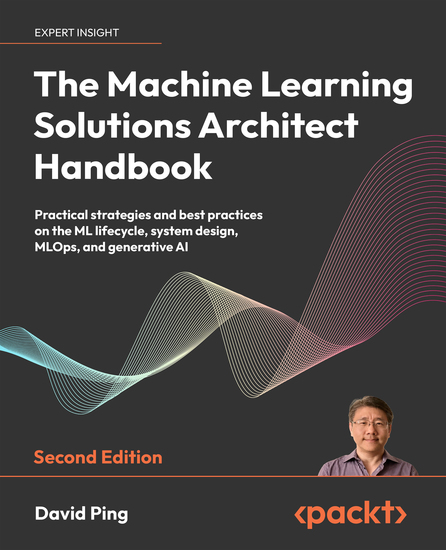
The Machine Learning Solutions Architect Handbook - Practical strategies and best practices on the ML lifecycle system design MLOps and generative AI - cover

The Machine Learning Solutions Architect Handbook - Practical strategies and best practices on the ML lifecycle system design MLOps and generative AI

David Ping

Publisher: Packt Publishing

  • 0
  • 1
  • 0

Summary

David Ping, Head of GenAI and ML Solution Architecture for global industries at AWS, provides expert insights and practical examples to help you become a proficient ML solutions architect, linking technical architecture to business-related skills.
You'll learn about ML algorithms, cloud infrastructure, system design, MLOps , and how to apply ML to solve real-world business problems. David explains the generative AI project lifecycle and examines Retrieval Augmented Generation (RAG), an effective architecture pattern for generative AI applications. You’ll also learn about open-source technologies, such as Kubernetes/Kubeflow, for building a data science environment and ML pipelines before building an enterprise ML architecture using AWS. As well as ML risk management and the different stages of AI/ML adoption, the biggest new addition to the handbook is the deep exploration of generative AI.
By the end of this book , you’ll have gained a comprehensive understanding of AI/ML across all key aspects, including business use cases, data science, real-world solution architecture, risk management, and governance. You’ll possess the skills to design and construct ML solutions that effectively cater to common use cases and follow established ML architecture patterns, enabling you to excel as a true professional in the field.
Available since: 04/15/2024.
Print length: 602 pages.

Other books that might interest you

  • Introduction to Quantum Mechanics - Basic Principles and Applications - cover

    Introduction to Quantum...

    Mark Hedges

    • 0
    • 0
    • 0
    Quantum mechanics arose in the early 20th century to explain phenomena that classical physics could not. Observations at the atomic scale revealed that matter and energy exhibit discrete and probabilistic behaviors, leading to the development of a new theoretical framework. The necessity for quantum mechanics became evident through several key experiments and discoveries. 
    One of the earliest quantum breakthroughs came from Max Planck’s study of blackbody radiation. Classical physics predicted an infinite energy output at short wavelengths, known as the ultraviolet catastrophe. Planck resolved this by proposing that energy is emitted in discrete packets called quanta, introducing the idea that energy levels are not continuous. This marked the birth of quantum theory. 
    Albert Einstein extended this concept with his explanation of the photoelectric effect, where light ejects electrons from a metal surface. Classical wave theory could not explain why light below a certain frequency fails to release electrons, regardless of intensity. Einstein proposed that light consists of photons, with energy proportional to their frequency. This established the particle-like nature of light and won him the Nobel Prize in 1921. 
    Louis de Broglie later proposed wave-particle duality, suggesting that particles like electrons also behave as waves. His hypothesis was experimentally confirmed by the Davisson-Germer experiment, which demonstrated electron diffraction. This showed that matter exhibits both wave and particle properties, depending on how it is measured.
    Show book
  • White Noise Magic - The White Noise Bundle - Sleep Study Focus Tinnitus - cover

    White Noise Magic - The White...

    White Noise Magic

    • 0
    • 0
    • 0
    Tranquility awaits. Dive into White Noise Magic. 
     
    Do you struggle to drift off to sleep? Does constant background noise disrupt your focus? White Noise Magic can be your key to unlocking tranquility. 
    This immersive audiobook offers a curated blend of calming white noise specifically designed to: 
     
    Induce restful sleep: Lull yourself into a peaceful slumber with soothing sounds that mask distractions and promote relaxation.Enhance focus and study: Achieve laser-sharp concentration by blocking out unwanted noise, allowing you to fully immerse yourself in your tasks.Find relief from tinnitus: Soothe the ringing in your ears with carefully selected frequencies that provide auditory masking and reduce the perception of tinnitus. 
     
    White Noise Magic is your portable oasis of calm. Let it guide you to a better night's sleep, a more productive day, and a renewed sense of serenity. 
     
    Order your copy today and experience the magic of white noise! Total running time: 20+ hours!
    Show book
  • The Next Supercontinent - Solving the Puzzle of a Future Pangea - cover

    The Next Supercontinent -...

    Ross Mitchell

    • 0
    • 0
    • 0
    You've heard of Pangea, the single landmass that broke apart some 175 million years ago to give us our current continents, but what about its predecessors, Rodinia or Columbia? These "supercontinents" from Earth's past provide evidence that land repeatedly joins and separates. While scientists debate what that next supercontinent will look like—and what to name it—they all agree: one is coming. 


    In this engaging work, geophysicist Ross Mitchell invites listeners to remote (and sometimes treacherous) lands for evidence of past supercontinents, delves into the phenomena that will birth the next, and presents the case for the future supercontinent of Amasia, defined by the merging of North America and Asia. Introducing listeners to plate tectonic theory through fieldwork adventures and accessible scientific descriptions, Mitchell considers flows deep in the Earth's mantle to explain Amasia's future formation and shows how this developing theory can illuminate other planetary mysteries. He then poses the inevitable question: how can humanity survive the intervening 200 million years necessary to see Amasia? 


    An expert on the supercontinent cycle, Mitchell offers listeners a front-row seat to a slow-motion mystery and an ongoing scientific debate.
    Show book
  • Subconscious mind reprogramming creativity - A guided meditation - DST Hypno with Stu Newman - cover

    Subconscious mind reprogramming...

    Stuart Newman

    • 0
    • 0
    • 0
    Subconscious mind reprogramming creativity with DST Hypno and Stu Newman is a powerful way to unlock your creative potential.  
    By tapping into the power of hypnosis, you can access hidden resources within yourself that will help you become more creative and productive in all areas of your life.  
    With this program, you'll be able to identify negative thought patterns that are blocking your progress and replace them with positive ones that promote growth. 
      
    You'll also learn how to use visualization techniques for greater clarity in decision-making as well as other tools such as affirmations for self-empowerment.  
    This program has already helped many people realize their full potential - why not give it a try?  
    Unlocking the power of creativity can open up new doors for success!
    Show book
  • If P Then Q - Why Philosophy Can Teach You How to Think and Help You Live a Happy Life By the Methods of Applying Logic to Solve the Problems in Your Life and Achieve Success (A Scholarly Monograph) - cover

    If P Then Q - Why Philosophy Can...

    Russell Hasan

    • 0
    • 0
    • 0
    This short paper on logic argues that logic and science can go hand in hand, and that, by taking observations of perceptions and sensations, and applying logical analysis to them, you have the power to build conceptual models and frameworks that you can use in order to predict what you should do in the future and to reason how to solve the problems in your life. Examples from hard science, and examples of the use of science and logic in the courtroom to understand legal arguments, are presented, as well examples of how to figure out the answers to the mundane ordinary problems that we humans have in our lives. 
    Mandatory must-read for anyone who wants to think and live using logic.
    Show book
  • Zoology - The Animal Kingdom - cover

    Zoology - The Animal Kingdom

    Mike Crawford

    • 0
    • 0
    • 0
    Zoology, the scientific study of animals, is a broad and dynamic field that encompasses a wide range of topics, from the anatomy and physiology of organisms to their behaviors, evolutionary history, and interactions with their environments. It is a fundamental branch of biology, crucial for understanding life on Earth. The word "zoology" comes from the Greek words "zoo," meaning animal, and "logos," meaning study, thus literally translating to the "study of animals." This field not only explores the diversity of animal life but also offers insights into the nature of life itself and the interrelationships among all living organisms. 
    The scope of zoology is vast, as it covers every aspect of animal life, from the microscopic world of single-celled organisms to the complex behaviors of large mammals. The study of zoology can be broken down into several subfields, such as physiology, behavior, evolution, ecology, and taxonomy, each of which provides valuable information about the functioning of animals in the natural world. For example, physiologists examine how animals’ bodily systems—like the nervous, respiratory, and circulatory systems—function to maintain life, while evolutionary biologists trace the development of animal species over time. Ecologists focus on how animals interact with their environments, while taxonomists classify and name the vast array of species found on Earth.
    Show book