Begleiten Sie uns auf eine literarische Weltreise!
Buch zum Bücherregal hinzufügen
Grey
Einen neuen Kommentar schreiben Default profile 50px
Grey
Jetzt das ganze Buch im Abo oder die ersten Seiten gratis lesen!
All characters reduced
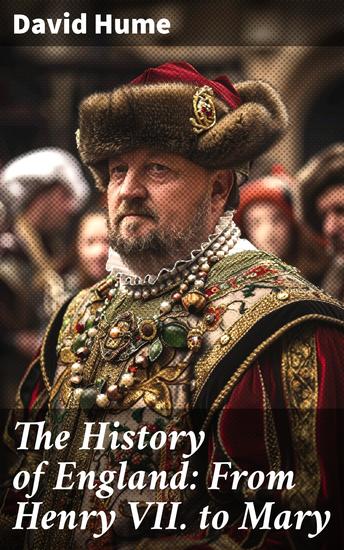
The History of England: From Henry VII to Mary - Political Intrigue and Royal Biography in the Tudor Era: A Comprehensive Exploration of England's Transformation - cover

The History of England: From Henry VII to Mary - Political Intrigue and Royal Biography in the Tudor Era: A Comprehensive Exploration of England's Transformation

David Hume

Verlag: Good Press

  • 0
  • 0
  • 0

Beschreibung

David Hume's "The History of England: From Henry VII. to Mary" offers an erudite chronicle that delineates the socio-political evolution of England from the late 15th century to the early 17th century. Imbued with Hume's characteristic philosophical skepticism, this work navigates the intricate tapestry of monarchy, revolution, and religious conflict through a narrative style that marries meticulous historical detail with an engaging, essayistic prose. Hume'Äôs deft interweaving of empirical observation and moral evaluation situates his narrative within the broader Enlightenment tradition, encouraging readers to consider the implications of historical events beyond mere dates and events. Hume, a pivotal figure in Scottish philosophy and Enlightenment thought, was influenced by the tumultuous political landscape of his time and the evolving discourse on government and liberty. His experiences, from his philosophical inquiries into human nature to his engagement with contemporary political theory, informed his approach to writing history as not just a record of events but an exploration of the human condition. This book is a testament to Hume's belief in the utility of history to teach us moral lessons and understand political dynamics. For those interested in the intersection of history and philosophy, Hume's work is indispensable. It seamlessly blends narrative history with analytical insights, making it a compelling read for anyone seeking to understand the complexities of English history during a formative period. Hume'Äôs engaging prose and profound observations will resonate with both history enthusiasts and scholars alike.
Verfügbar seit: 22.08.2023.
Drucklänge: 498 Seiten.

Weitere Bücher, die Sie mögen werden

  • A Miscellany Of Men - The third volume of Chesterton's collected essays from the Daily News - cover

    A Miscellany Of Men - The third...

    G K Chesterton

    • 0
    • 0
    • 0
    "before I finally desert the illusions of rationalism for the actualities of romance, I should very much like to write one last roaring, raging book telling all the rationalists not to be so utterly irrational... Do not talk such bosh. I implore you, I supplicate you not to talk such bosh. Utterly and absolutely abolish all such bosh—and we may yet begin to discuss these public questions properly." -GKC"the Chesterton wit and charm and gentle satire [and] hard-hitting controversy. And you will also find a distinct thread that ties it all together. [...] first published in 1912, the essays ... often refer to current events and personalities from the early 20th century: coal strikes and railway strikes, game laws, women’s suffrage, and British Imperialism. ... in every case the larger point being made is very clear and is not tied to a time and place – unless it is our time and place. Chesterton’s mere observations of an event, whether in a headline or outside his window could be expounded upon into huge timely treatises. It is because truth has ramifications. And because it is true.The old controversies are still relevant. But each question points to a larger question. How do we assure the dignity and basic rights of the laborer? For whom does he labor: himself or some remote rich man? Does voting make any difference when our choices are so limited, when the choices themselves are not our choices but someone else’s? What is the nature of real democracy?" - Dale Ahlquist"These old articles of mine because they cover a very controversial period, in which I was in nearly all the controversies, whether I was visible there or no. And I wish to gather up into this last article a valedictory violence about all such things; and then pass to where, beyond these voices, there is peace--or in other words, to the writing of Penny Dreadfuls; a noble and much-needed work." -GKC
    Zum Buch
  • Chimú Empire - The Kingdom of Chan Chan and the Lords of the Northern Coast - cover

    Chimú Empire - The Kingdom of...

    Rolf Hedger

    • 0
    • 0
    • 0
    The Chimú Empire, one of the most prominent pre-Columbian civilizations of the northern coast of Peru, flourished between the 9th and 15th centuries. This advanced civilization is known for its impressive urban centers, most notably the capital city of Chan Chan, which remains the largest adobe city in the world. At its height, the Chimú Empire controlled vast territories, from the southern border of the Moche Valley to the northern regions of present-day Ecuador. The empire was characterized by its highly structured society, advanced technology, and unique artistic traditions, which helped shape the cultural landscape of the Andean region. 
    The roots of the Chimú Empire trace back to the Moche culture, which had a significant influence on the development of the Chimú. However, the Chimú people took the foundational knowledge of their predecessors and expanded upon it, creating a powerful and sophisticated society. They established a series of city-states along the coast, which were eventually unified under the leadership of a single ruler, the Chimú king, who governed from Chan Chan. 
    The Chimú Empire’s political structure was highly organized, with a well-defined hierarchy that ranged from the elite rulers to the common people. The king, or "Sapa Chimú," was considered the most powerful figure, acting as both a political and spiritual leader. The empire was divided into regions, each overseen by local lords who managed administrative and religious duties within their territories. This hierarchical structure helped maintain control over the vast lands and resources of the empire.
    Zum Buch
  • Before Augustus - The Collapse of the Roman Republic - cover

    Before Augustus - The Collapse...

    Natale Barca

    • 0
    • 0
    • 0
    "...the author does an admirable job of showing just how complicated and interconnected all the great patrician families were and how their jealousies and rivalries ultimately led to their undoing and the end of the great Roman Republic." — New York Journal of BooksThe political process that culminated in the transition from Republic to Empire in ancient Rome began with the military reform of Caius Marius in the last decades of the 2nd century BC. Following the Civil War and Sulla’s dictatorship, it developed further with the First Triumvirate of Caesar, Pompey, and Crassus, and two further civil wars. These wars, which saw Caesar pitted against Pompey, and Octavian fighting Anthony, ended in 27 BC with the rise to power of Octavian, the adoptive son of Caesar.  Before Augustus outlines a summary of the last years of the Roman Republic, weaving together the military, political, and social aspects. Scholar Natale Barca sets the protagonists within the complex societal and political system that they operated, analyzing their actions, and the epic battles that ensued.
    Zum Buch
  • Enquiries Concerning the Human Understanding and the Principles of Morals: Book Summary & Analysis - cover

    Enquiries Concerning the Human...

    Briefly Summaries

    • 0
    • 0
    • 0
    This is a concise summary and analysis of Enquiries Concerning the Human Understanding and the Principles of Morals, by David Hume.
     
    It is not the original book and is not affiliated with or endorsed by David Hume.
    Ideal those seeking a quick and insightful overview.
     
    Dive into a timeless exploration of human nature, morality, and knowledge with this foundational work in philosophy. In this thought-provoking text, the author challenges traditional assumptions about reason, experience, and ethics, presenting a compelling argument for empiricism and the role of human understanding in shaping our beliefs and actions. Through clear and incisive prose, the author examines the limitations of human cognition and offers profound insights into the principles of morals, questioning the basis of virtue and vice. Perfect for readers seeking to deepen their grasp of philosophy, this work remains a cornerstone of Enlightenment thought and a must-read for anyone interested in the origins of modern intellectual inquiry.
    Zum Buch
  • MOTH Secrets: Unlocking the Truth Behind Polio's Impact - "Dive into MOTH Secrets! Experience powerful audio lessons that reveal the truth about polio's profound effects" - cover

    MOTH Secrets: Unlocking the...

    Orson Grafton

    • 0
    • 0
    • 0
    MOTH Secrets: Unlocking the Truth Behind Polio's Impact 
    ⭐️⭐️ Simplified Guide & Explanations Included ⭐️⭐️ 
    Are you eager to enhance your career and deepen your knowledge by navigating the complexities of polio's impact? 
    Searching for an all-inclusive resource that covers everything you need to understand these resilience stories that truly redefine the human spirit? 
    Your quest ends here! 
    This guide is your ultimate resource, designed to enrich your comprehension, enhance your skills, and provide engaging practical exercises. With this tool, you are poised for success. 
    Updated for the latest insights into polio's effects. 
    Key features of this enhanced guide: 
    - In-depth insights into the impact of polio on society 
    - Comprehensive explanations of resilience stories that illustrate human strength 
    - Effective strategies for understanding and engaging with the material 
    Our guide sets itself apart with thorough coverage, vital for your success in grasping these profound narratives. Concepts are explored with care and clarity, ensuring you don’t just skim the surface. 
    Crafted with a clear structure and accessible language, our guide ensures seamless transitions between topics. Say farewell to convoluted terminology and embrace straightforward, accurate, and informative content. 
    So, why hesitate? Click the BUY NOW button, secure your guide, and embark on your journey to a deeper understanding of polio's impact! 
    Experience the transformative power of storytelling and discover how these narratives reshape our understanding of the human spirit.
    Zum Buch
  • Blitzkrieg - The Lightning Warfare Tactics That Defined Early World War II - cover

    Blitzkrieg - The Lightning...

    Sage Winters

    • 0
    • 0
    • 0
    The outbreak of World War II in 1939 heralded the arrival of a new era in military strategy, characterized by speed, surprise, and relentless coordination. At the heart of this revolution was Blitzkrieg, or "lightning warfare," a doctrine developed and executed primarily by Nazi Germany. Blitzkrieg was a military strategy that sought to overcome the static, trench-based warfare that had defined World War I. The tactics were designed to strike quickly and decisively, bypassing traditional defenses and causing maximum disruption. Its goal was not just to win battles but to create a psychological shock, overwhelming the enemy with rapid, coordinated strikes before they could mount a defense. 
      
    Unlike previous strategies that relied heavily on prolonged engagements and entrenched frontlines, Blitzkrieg emphasized speed and flexibility. The term itself was popularized by the media, but it aptly described the essence of the tactics: a rapid, forceful onslaught combining armored vehicles, infantry, and air support in a synchronized fashion. The Wehrmacht, under the leadership of figures like General Heinz Guderian, adapted the lessons of the past and fused them with new technology, creating a military machine that was faster and more mobile than any seen before. 
      
    The strategy was grounded in the belief that modern warfare required more than just brute force; it needed precision, rapid maneuvering, and the element of surprise. The mechanized forces, including tanks (Panzer divisions) and aircraft (Luftwaffe), worked in tandem to create an unstoppable offensive. They would punch through enemy lines with armored columns and then encircle and isolate units, preventing them from retreating or reinforcing. The Luftwaffe, meanwhile, would provide air superiority, neutralizing enemy air forces and bombing key infrastructure.
    Zum Buch