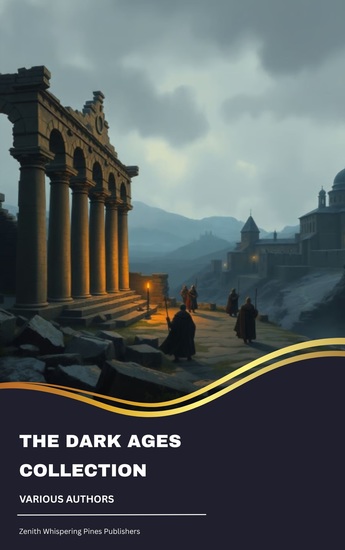
Uncover the Truth of a World in Transition.
Often cast in the shadow of the Renaissance, the Early Middle Ages were a time of intense struggle, profound faith, and the forging of the modern world. This collection brings together authoritative historical accounts that strip away the myths of the "Dark Ages," revealing a sophisticated era of cultural synthesis where Roman, Christian, and Germanic traditions merged to create Western Civilization.
This collection explores the defining forces of the era:
The Collapse of an Empire: Analyze the internal decay and external pressures that led to the fall of the Western Roman Empire and the subsequent rise of the successor kingdoms.
The Age of Migrations: Trace the epic journeys of the tribes that redrew the map of Europe, from the forests of Germania to the shores of Britain and North Africa.
The Rise of the Cross: Explore how the church became the central stabilizing force of the continent, preserving ancient texts and providing a unified cultural framework.
Legendary Leaders and Warriors: Follow the rise of figures like Charlemagne and the seafaring Northmen, documenting the birth of the Holy Roman Empire and the expansion of the Viking world.
From the illuminated manuscripts of isolated monasteries to the fierce shield-walls of the battlefield, this collection offers a panoramic view of half a millennium of human history. It is an essential addition for any student of medieval studies, world history, and the roots of Western culture.
Step out of the shadows. Buy "The Dark Ages Collection" today and discover the foundation of the modern world.
Charlotte Perkins Gilman was born on 3rd July 1860 in Hartford, Connecticut, to an unaffectionate mother and a father who abandoned her and her older brother to a life of poverty.
Inevitably her schooling was limited and by 15 she had attended seven different schools but received only four years education. However Charlotte was resourceful and did spend time with her father’s aunts – the suffragist Isabella Beecher Hooker and the ‘Uncle Tom Cabin’s’ author, Harriet Beecher Stowe as well as many hours at the public library studying ancient civilisations.
In 1878, she enrolled in classes at the Rhode Island School of Design where she met Martha Luther and they developed a close relationship until Luther married in 1881. Charlotte was devastated and detested romance and love until she met and married the artist Charles Walter Stetson.
Their only child, Katharine Beecher Stetson, was born in 1885 but left Charlotte with post-natal depression, then often dismissed as a case of hysteria or nerves. Unsuited to domestic life she ruptured her life and moved to California with Katherine. She divorced in 1894 and then sent Katharine east to live with her father and his second wife confirming that his paternal rights be acknowledged and that Katherine establish a relationship with her father.
After her mother died in 1893, Charlotte moved back east and became involved with her first cousin, Wall Street attorney, Houghton Gilman who she married in 1900. After his death she moved back to California, where Katherine now lived.
Her most popular story is ‘The Yellow Wallpaper’ which touched on her own post-partum depression and underlined the need for women to be responsible for their mental and physical well-being, as the narrator is ordered by her husband/doctor to take compete rest in her room where she is isolated and becomes obsessed with the revolting yellow wallpaper.
She wrote other notable short stories the best of which we also include.
Charlotte lectured widely for social reform, wrote important non-fiction works that questioned our patriarchal system and left a legacy as a leading and positive spokesperson for feminism.
She was diagnosed with incurable breast cancer in 1932 and, as she wrote in her suicide note and autobiography, she ‘chose chloroform over cancer’
Charlotte Perkins Gilman took her own life on 17th August 1935, aged 75, in Pasadena, California.
"The Heathen" is a short story by the American writer Jack London. It was first published in Everybody's Magazine in August 1910.
In the story, two people, from different cultural and racial backgrounds, are the only survivors of a ship that encounters a hurricane in the Pacific, and they remain together.
The narrator, a pearl buyer named Charley, is a cabin passenger on a schooner, the Petite Jeanne, sailing from Rangiroa to Tahiti with a Kanaka crew, at the end of the pearling season in the Paumotas. The boat, having eighty-five deck passengers, is overloaded. Several passengers die of smallpox; Charley and the other cabin passengers drink whisky, until it runs out, in the belief that it will kill the smallpox germs.
The boat is in the direct path of a hurricane. "The second sea filled the Petite Jeanne's decks flush with the rails, and, as her stern sank down and her bow tossed skyward, all the miserable dunnage of life and luggage poured aft. It was a human torrent.... Out of all my experiences I could not have believed it possible for the wind to blow as it did.... It was a monstrous thing, and the most monstrous thing about it was that it increased and continued to increase."
This work is a selection of Christmas stories (or sometimes chapters) of Lucy Maud Montgomery from different sources and different times. The focus is widened a bit to include a few works about Thanksgiving Day and New Year’s Day. LMM was a prolific Canadian author in the early 20th century whose works were very popular in her own country as well as the United States, and indeed around the world. Perhaps her most read novel was her first, Anne Of Green Gables. Lucy Maud Montgomery OBE, published as L. M. Montgomery, was a Canadian author best known for a collection of novels, essays, short stories, and poetry beginning in 1908 with Anne of Green Gables. She published 20 novels as well as 530 short stories, 500 poems, and 30 essays.
The Analects, or Lunyu, also known as the Analects of Confucius, are considered a record of the words and acts of the central Chinese thinker and philosopher Confucius and his disciples, as well as the discussions they held. Written during the Spring and Autumn Period through the Warring States Period (ca. 475 BC - 221 BC), the Analects is the representative work of Confucianism and continues to have a substantial influence on Chinese and East Asian thought and values today. William Jennings was a rector of Grasmere, and late colonial chaplain. He served at St. John's Cathedral in Hong Kong. (Summary by Wikipedia and Jing Li)
Our ‘fight of flight’ response is something hardwired into the primitive part of our brain. Our need to survive, to outlive whatever danger poses, that immediate threat to our lives is little short of a marvel. Everything else is abandoned in order to survive. Whilst in modern times that ability has been somewhat modified and ‘reasoned’ away to an extent, in past years it’s what usually kept you alive.
In this volume people struggle valiantly to survive and to exist no matter the extent of the threat they face. In the words of our authors including William Hope Hodgson, Richard Connell, Jack London, Honore de Balzac and a wealth of others, they vividly demonstrate how or whether the participants survive … or fail.
01 - Short Stories About Survival - An Introduction
02 - The White Silence by Jack London
03 - A Passion in the Desert by Honoré de Balzac
04 - The Interlopers by Saki the pseudonym for H H Munro
05 - The Outcasts of Poker Flat by Bret Harte
06 - Taman by Mikhail Yurievich Lermontov
07 - The Great Slave by Zane Grey
08 - The Voice in the Night by William Hope Hodgson
09 - The Most Dangerous Game by Richard Connell
10 - The Open Boat by Stephen Crane
11 - To Build a Fire by Jack London
12 - The Snowstorm - Part 1 by Leo Tolstoy
13 - The Snowstorm - Part 2 by Leo Tolstoy
Ihr Account wird momentan auf einem anderen Gerät benutzt.
Es ist bereits eine Sitzung auf einem anderen Gerät geöffnet.
Abmelden
Erneut verbinden
Ihr Account wird momentan auf einem anderen Gerät benutzt.
Um darauf zugreifen zu können, müssen die Berechtigungen und obligatorischen Richtlinien (markiert mit *) überprüft und akzeptiert werden.
Wenn Sie Hilfe oder weitere Informationen benötigen, schreiben Sie an support@24symbols.com
Akzeptieren
Ihr Account wird momentan auf einem anderen Gerät benutzt.
OK
Bestätigungs-E-Mail noch einmal schicken
Ihr Account wird momentan auf einem anderen Gerät benutzt.
Wir haben versucht, Ihr Abo abzubuchen, aber es ist uns nicht gelungen. Das teilt uns Ihre Bank/Karte mit:
Wenn Sie weiterlesen möchten, müssen Sie sich möglicherweise an Ihre Bank wenden oder Ihre Zahlungsinformationen hier ändern:
Ich möchte meine Karte aktualisieren!
Haben Sie Fragen? Schreiben Sie uns an support@24symbols.com und wir werden Ihnen weiterhelfen.
Cookies helfen uns bei der Bereitstellung unserer Dienste. Durch die Nutzung unserer Dienste erklären Sie sich damit einverstanden, dass wir Cookies setzen.Mehr erfahren