Rejoignez-nous pour un voyage dans le monde des livres!
Ajouter ce livre à l'électronique
Grey
Ecrivez un nouveau commentaire Default profile 50px
Grey
Abonnez-vous pour lire le livre complet ou lisez les premières pages gratuitement!
All characters reduced
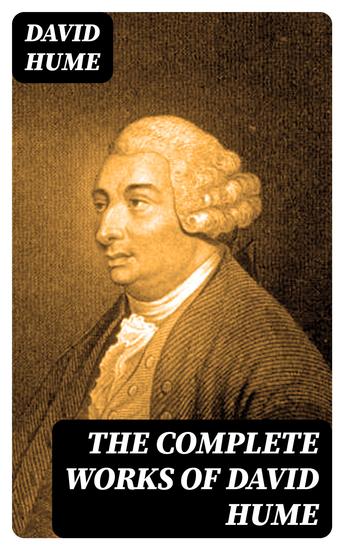
The Complete Works of David Hume - cover

The Complete Works of David Hume

David Hume

Maison d'édition: DigiCat

  • 0
  • 0
  • 0

Synopsis

The Complete Works of David Hume is an extensive compilation encompassing the philosophical writings of one of the Enlightenment's foremost thinkers. Hume's prose navigates the realms of empiricism, skepticism, and morality with a clarity that reveals his deep engagement with contemporary philosophical debates. The collection includes his seminal works such as A Treatise of Human Nature and An Enquiry Concerning Human Understanding, elaborating on topics like human cognition, the nature of causation, and the foundations of ethics, all framed within Hume's characteristic witty and engaging style, bolstered by rich historical allusions and a commitment to rational inquiry. David Hume (1711-1776) was a Scottish philosopher, historian, and economist whose ideas were pivotal in shaping modern philosophical thought. His formative experiences, including his extensive reading of previous thinkers and his engagement with the burgeoning scientific methodologies of his time, led him to craft a unique philosophical voice. Hume's background in law and finance also enriched his analyses of human behavior and societal norms, enabling him to critique the dogmatism prevailing in both philosophy and religion. Readers seeking to understand the foundations of modern philosophy and the evolution of human thought will find The Complete Works of David Hume indispensable. This collection serves not only as a testament to Hume's brilliance but also as a vital resource for anyone interested in the intricate relationship between human understanding, belief, and experience.
Disponible depuis: 11/10/2022.
Longueur d'impression: 4437 pages.

D'autres livres qui pourraient vous intéresser

  • Bloody Mary - Mary Tudor the Queen Who Took on the Protestant Revolt - cover

    Bloody Mary - Mary Tudor the...

    Kelly Mass

    • 0
    • 0
    • 0
    Mary I, typically called Mary Tudor and called "Bloody Mary" by her Protestant challengers, ruled as Queen of England and Ireland from July 1553 till November 17th, 1558. She is well recalled for her solid attempts to reverse the English Reformation, which started throughout her dad's reign, Henry VIII's reign.Her effort to return property taken at the time of the prior 2 reigns to the Church was generally blocked by Parliament, but at the time of her five-year rule, Mary had more than 280 spiritual dissenters burnt at the stake in the Marian persecutions. You might give excuses for her behavior, you might justify it by saying she may not have been much worse than other dictators and royalty around that time, but the fact of the matter is still that she murdered hundreds of people for religious and political reasons.Bloody Mary was cruel, cold, and from what we know, there was a cause for this. Let’s take a look at her life, her problems, and the way she handled them.
    Voir livre
  • Hyksos: A Captivating Guide to the Conquerors of Ancient Egypt Who Ruled during the Fifteenth Dynasty - cover

    Hyksos: A Captivating Guide to...

    Captivating History

    • 0
    • 0
    • 0
    Discover the Hyksos: Masters of Ancient Egypt 
    How did a group of foreigners take control of northern Egypt and rule for over a century? Where did they come from? What mark did they leave on Egypt? The story of the Hyksos is one of conquest, culture, and lasting impact. 
    This audiobook provides an easy-to-read history of the Hyksos dynasty, telling the story of people from West Asia who took power during a time of chaos in Egypt. It explores the clashes between the Hyksos and Egyptians, their rule, and the cultural changes they brought. Learn about the innovations the Hyksos introduced that helped shape Egypt into a powerful empire. 
    Discover Answers to Intriguing Questions:What brought the Hyksos to Egypt?Was their takeover sudden and violent, or a gradual shift from within?How did the Hyksos kings rule differently from the Egyptians?Why did they rob tombs?What happened when they introduced horses and chariots?How many Egyptian kings fought the Hyksos before driving them out?Where did the Hyksos go after their defeat? 
    Why This Audiobook? 
    This audiobook is perfect for anyone curious about a lesser-known but fascinating part of ancient Egyptian history. It answers key questions about the Hyksos and their influence on Egyptian culture and technology. With clear language and engaging storytelling, it makes history accessible and exciting. 
    Explore the captivating story of the Hyksos and their impact on one of history's greatest civilizations. 
    Scroll up and click the “add to cart” button to start your journey into the past!
    Voir livre
  • The End of America? - A Guide to the New World Disorder - cover

    The End of America? - A Guide to...

    Allan Friedman

    • 0
    • 1
    • 0
    America was the shining city on a hill. It was the country at the forefront of the world democratic order, the global policeman, the might of its military matched only by the depth of its financial reserves. America was the one the world listened to, whether it wanted to or not. So, what happened?
    Well, a lot of things. In this searing account, Alan Friedman shows how, from the disastrous Vietnam War to Barack Obama's bungled response to the Arab Spring, American intervention has ceased to be the decisive action it once was. And now, with the rise of China and Russia, coupled with America's prostration of itself following the election of Donald Trump, the decline of its authority is only hastening.
    We move now, Friedman argues, into the New World Disorder. In this dangerous and unstable world, the Washington-enforced liberal order is receding, and a new set of alliances and anxieties are in ascendence. What is America's place in this? Which powers are going to emerge as the leaders? Will the European Union count at all? One thing is for sure: the effects of the New World Disorder will challenge our Western values to breaking point.
    Voir livre
  • The Appeal to Authority Fallacy - Relying on Authority Figures for Validation - cover

    The Appeal to Authority Fallacy...

    William Rands

    • 0
    • 0
    • 0
    Authority plays a significant role in shaping our understanding of the world, influencing decisions, and providing guidance in countless areas of life. It’s embedded in every facet of society, from the classroom to the courtroom, from the boardroom to the laboratory. At its core, authority is the power or right to give orders, make decisions, and enforce obedience. However, the nature of authority is multifaceted and often taken for granted, especially in a world where expertise is increasingly revered. 
    The concept of authority is deeply ingrained in human culture and history. From the earliest civilizations to modern-day societies, humans have sought structure and order, often relying on individuals or institutions with perceived knowledge and expertise to guide them. These figures, whether they are religious leaders, scientists, political figures, or educators, are often seen as trusted sources of truth. This trust is not just a reflection of their knowledge or expertise but also a product of social conditioning. In many cultures, authority is linked to the idea of legitimacy, with authority figures perceived as credible due to their position, reputation, or experience. 
    Yet, this reliance on authority can also be a double-edged sword. While authority figures often provide valuable insights and direction, they are not infallible. The human tendency to defer to authority can sometimes lead us to accept claims or decisions without questioning their validity. This uncritical acceptance, while often harmless, can lead to significant errors, as seen in the history of science, medicine, politics, and more. Blind trust in authority can stifle innovation, suppress dissent, and allow misinformation to spread unchecked.
    Voir livre
  • Witnesses of Change: Book summary & analysis - cover

    Witnesses of Change: Book...

    Margot Langley

    • 0
    • 0
    • 0
    This content is an independent and unofficial summary created for informational and educational purposes only. It is not affiliated with, authorized, approved, licensed, or endorsed by the original author or publisher. All rights to the original work belong to its respective copyright holders. This summary is not intended to substitute the original book, but to offer a concise overview and interpretation of its main ideas.


    Witnesses of Change is a compelling tapestry of voices that have lived through transformation—personal, cultural, and global. Through heartfelt stories, reflective insights, and profound moments of awakening, this audiobook captures what it means to observe, endure, and shape change from within. Each chapter offers a unique perspective, revealing how ordinary individuals become extraordinary witnesses to pivotal moments in time.
     
    Powerful, honest, and deeply human, this is an essential listen for those who seek understanding, connection, and the courage to navigate a rapidly shifting world.
    Voir livre
  • Alexander the Great: An Enthralling Guide to the Rise of the Macedonian Empire Its Ruler and His Conquests - cover

    Alexander the Great: An...

    Billy Wellman

    • 0
    • 0
    • 0
    Did you know that Alexander the Great once introduced proskynesis to the Macedonian court? 
    Proskynesis, the act of kissing the ground or the feet of someone of higher rank, was a normal custom of the Persians. In the court of the Achaemenid Empire, this act was typically done before the king. In contrast to the practice of the Greeks and Macedonians, proskynesis was performed by the Persians only when they were communicating with their ancient gods.  
    The invasion of the Achaemenid Empire had always been on top of the list for Alexander the Great. Ever since he came to power, the king had desired the submission of Darius III, the reigning king of the Persians at that time. Though he defeated the king in two battles and eventually conquered its territories, Alexander appears to have soon found a deep love for Persian customs and traditions. Of course, the king’s gradual change and assimilation of Persian culture did not sit well with the Macedonian people.  
    According to the ancient writer Arrian, when Alexander attempted to apply proskynesis to his court, his decision was met with massive criticism from both the Macedonians and Greeks. And even when he stopped the practice, the Macedonians continued to witness their king apply a variety of Persian customs in the kingdom. Some said his Persianization played a minor role in his death, while others claimed that he died of natural causes. The sources that tell the story of Alexander often contradict each other, which can be confusing for curious readers hoping to learn about the great king’s eventful life.  
    But that is about to change. With this all-new enthralling history audiobook, you can easily explore the gripping events that took place throughout the life of Alexander the Great. 
    Scroll up and click the “add to cart” button to learn more about Alexander the Great!
    Voir livre