Begleiten Sie uns auf eine literarische Weltreise!
Buch zum Bücherregal hinzufügen
Grey
Einen neuen Kommentar schreiben Default profile 50px
Grey
Jetzt das ganze Buch im Abo oder die ersten Seiten gratis lesen!
All characters reduced
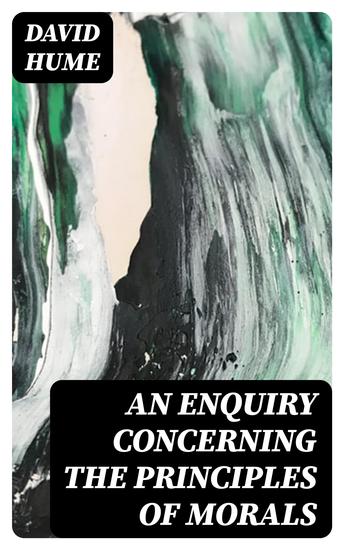
An Enquiry Concerning the Principles of Morals - cover

An Enquiry Concerning the Principles of Morals

David Hume

Verlag: DigiCat

  • 0
  • 0
  • 0

Beschreibung

In "An Enquiry Concerning the Principles of Morals," David Hume presents a seminal exploration of moral philosophy grounded in empiricism and human sentiment. This work marks a significant development from his earlier writings, such as "A Treatise of Human Nature," where Hume meticulously dissects human emotions and their influence on our ethical judgments. Through a nuanced and elegant prose style, Hume argues that morality is rooted in the impressions of human experience and that reason serves merely as a slave to our passions. Engaging with the philosophical context of the Enlightenment, Hume distinguishes between the moral and the natural sciences, emphasizing the subjective nature of moral evaluations while still acknowledging their universal applicability across cultures. David Hume (1711–1776), a pivotal figure in the Scottish Enlightenment, was deeply influenced by the sceptical traditions of Descartes and Locke, as well as by the burgeoning empirical approaches to knowledge. His philosophical inquiries were often prompted by his dissatisfaction with the rationalism of his time, leading him to explore how feelings and sociability inform our moral frameworks. The social context of 18th-century Europe, marked by shifting paradigms of thought, significantly influenced Hume's quest to establish a more grounded and human-centered moral philosophy. "An Enquiry Concerning the Principles of Morals" is essential reading for anyone interested in ethics, philosophy, and the foundations of moral reasoning. Hume's insights into the interplay between emotion and reason in moral judgments not only challenge traditional views but also form the basis for contemporary discussions in moral philosophy. This work invites readers to reflect on their own moral principles and the human experiences that shape them, making it a timeless contribution to philosophical literature.
Verfügbar seit: 15.09.2022.
Drucklänge: 201 Seiten.

Weitere Bücher, die Sie mögen werden

  • US Army 1960s Polygraph Training - cover

    US Army 1960s Polygraph Training

    US Army

    • 0
    • 0
    • 0
    The primary mission of military intelligence in the United States Army is to provide timely, relevant, accurate, and synchronized intelligence and electronic warfare support to tactical, operational and strategic-level commanders. The Army’s intelligence components produce intelligence both for Army use and for sharing across the national intelligence community. The military will subject someone to a polygraph for several reasons: If that person needs to access confidential files; if they are accused of leaking government secrets; if they are accused of terrorism or of being a spy; if they are a foreign national who needs access to classified material, and several other reasons. The following is a 1960s Army training recording with information on administering a lie detector test.
    Zum Buch
  • The Seeds of Disaster - The Development of French Army Doctrine 1919–39 - cover

    The Seeds of Disaster - The...

    Robert A Doughty

    • 0
    • 0
    • 0
    This military history examines the development of French Army doctrine from the end of WWI to the disastrous German invasion of WWII. The importance of military doctrine has never been more powerfully demonstrated than in May of 1940, when France suffered a swift collapse in the face of German aggression. Though the French had spent twenty years preparing for just such an event, their military was defenseless against the type of fighting they suddenly faced. Few defeats have been so unexpected.  In The Seeds of Disaster, military historian Robert Doughty examines the doctrinal origins of this historic failure. Doughty traces the development of the French Army’s military doctrine from 1919 to 1939, revealing how its fundamental misunderstandings of modern warfare led to an elaborate yet inept system of defense.
    Zum Buch
  • Bridging Spirit and Science - Integrating Spiritual Abilities with Technology for a New Human Future - cover

    Bridging Spirit and Science -...

    Martin K. Ettington

    • 0
    • 0
    • 0
    Spirit and Science are viewed as opposing views. I have lived my life in the middle of this divide. Trained as an engineer and scientist, I was taught to trust logic, mathematics, and experimental proof.  
    Yet my personal experiences — from moments of prophecy to direct awareness of subtle energies — convinced me that there is more to reality than conventional science admits.  
    For years I tried to keep the two worlds separate: the rational and the mystical. But over time, the boundary dissolved. I realized that both perspectives describe the same universe from different vantage points.  
    My work, and this book in particular, is about restoring the unity that once existed between them. 
    The purpose of this book is not to replace science with mysticism, nor to reduce spiritual experience to chemistry or neurology. Rather, it aims to show that consciousness, energy, and matter are aspects of a single integrated system.
    Zum Buch
  • Off the Mark - How Grades Ratings and Rankings Undermine Learning - cover

    Off the Mark - How Grades...

    Ethan L. Hutt, Jack Schneider

    • 0
    • 0
    • 0
    Anyone who has ever crammed for a test, capitulated to a grade-grubbing student, or fretted over a child's report card knows that the way we assess student learning in American schools is freighted with unintended consequences. As experts agree, our primary assessment technologies—grading, rating, and ranking—don't actually provide an accurate picture of how students are doing in school. Worse, they distort student and educator behavior in ways that undermine learning and exacerbate inequality. Yet despite widespread dissatisfaction, grades, test scores, and transcripts remain the currency of the realm. 


    In Off the Mark, Jack Schneider and Ethan Hutt explain how we got into this predicament, why we remain beholden to outmoded forms of assessment, and what we can do to change course. They offer a range of practical reforms, like embracing multiple measures of performance and making the so-called permanent record "overwritable." As they explain, we can remake our approach in ways that better advance the three purposes that assessment currently serves: motivating students to learn, communicating meaningful information about what young people know and can do, and synchronizing an otherwise fragmented educational system. Off the Mark is a guide for everyone who wants to ensure that assessment serves the fundamental goal of education—helping students learn.
    Zum Buch
  • Coastal American Empires - Masters of the Shorelines (3 in 1) - cover

    Coastal American Empires -...

    Rolf Hedger

    • 0
    • 0
    • 0
    This book bundle explores the rise, achievements, and mysteries of three great civilizations that thrived along the Pacific coast of South America: the Chimú Empire, the Moche Civilization, and the Nazca Civilization. These cultures, shaped by the harsh yet resource-rich coastal environment, developed remarkable engineering, artistic, and societal innovations that continue to captivate historians and archaeologists.   
    Discover the Chimú Empire, renowned for its massive adobe city of Chan Chan, intricate metalwork, and sophisticated irrigation systems that sustained a powerful kingdom before its conquest by the Incas. Learn how their administrative prowess and architectural marvels set the stage for later Andean civilizations.   
    Uncover the fascinating world of the Moche Civilization, master artisans and engineers whose elaborate pottery, grand temples, and intricate irrigation canals reveal a society deeply connected to both warfare and religious ceremonies. Their vivid artwork and imposing huacas (temples) provide glimpses into their rituals, rulers, and everyday life.   
    Delve into the enigmatic Nazca Civilization, famous for the colossal Nazca Lines—massive geoglyphs etched into the desert, whose purpose still sparks debate today. Explore their advanced textile production, innovative aqueduct systems, and the religious significance of their artistic and architectural achievements.   
    From towering pyramids to vast desert artworks, these coastal empires demonstrated extraordinary adaptability and ingenuity. This book is a must-read for history enthusiasts eager to uncover the secrets of these ancient masters of the shorelines.
    Zum Buch
  • Roman Law and Governance - Foundations of Western Legal Systems - cover

    Roman Law and Governance -...

    Rogan Fish

    • 0
    • 0
    • 0
    The foundation of Roman law was deeply rooted in the customs and traditions of early Roman society. Before formal legal codification, Roman law was based on unwritten customs passed down through generations. These customs, known as mos maiorum or "the way of the ancestors," guided legal practices and social norms. However, as Rome expanded, the need for a more structured and consistent legal system became evident. This led to the development of one of the earliest recorded legal codes, the Twelve Tables, which became the cornerstone of Roman law. 
    The Twelve Tables, established around 450 BCE, were a response to demands from the plebeians for greater legal transparency. Prior to this, laws were primarily controlled by the patrician class, leaving the lower classes vulnerable to arbitrary decisions. The Twelve Tables provided a written and publicly displayed set of laws that covered various aspects of daily life, including property rights, contracts, family matters, and criminal offenses. While these laws were often harsh by modern standards, they were crucial in establishing the principle that law should be known and applied equally to all citizens. 
    Legal interpretation played a crucial role in the early Roman legal system, and the pontiffs, a group of religious and legal authorities, were responsible for explaining and applying the laws. Since early Roman law was closely linked to religious practices, the pontiffs held significant influence over legal matters. Over time, however, legal decision-making shifted from religious authorities to magistrates and elected officials, paving the way for a more secular and systematic approach to governance.
    Zum Buch