Join us on a literary world trip!
Add this book to bookshelf
Grey
Write a new comment Default profile 50px
Grey
Subscribe to read the full book or read the first pages for free!
All characters reduced
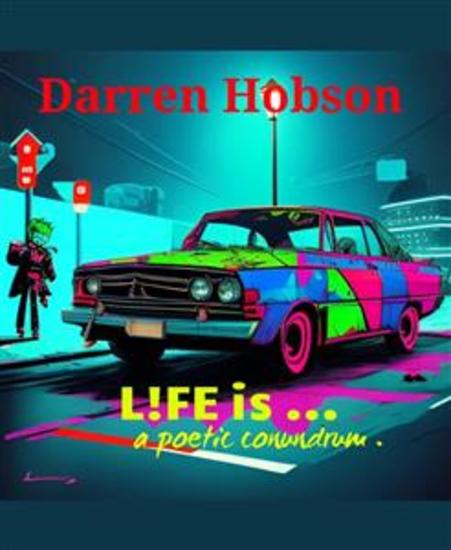
Life Is - cover

Life Is

Darren Hobson

Publisher: BookRix

  • 0
  • 0
  • 0

Summary

What truly is life? This groundbreaking collection of prose and poetry from an acclaimed indie voice invites you on an extraordinary, often unsettling, journey through the heart of human existence.Prepare to navigate a long, winding road where the ordinary transforms into the profound, and the beautiful often gives way to the brutal. Through raw emotion, unflinching honesty, and a vein of biting dark humour, this book dissects life's intricate dance – from its most joyous highs to its most agonizing lows, from tender connections to the dark undercurrents of anger, betrayal, and consequence, even daring to explore the discomfort of controversial stereotypes.Buckle up for a rollercoaster ride that promises no filters, only the compelling truth. Be warned: the unflinching imagery within is not for the faint of heart. For those ready to explore life in all its complex, unvarnished glory, this journey awaits.
Available since: 12/22/2023.
Print length: 38 pages.

Other books that might interest you

  • Poets of the Early 20th Century The - Volume 1 - Find beauty and hope in a period ravaged worldwide by war - cover

    Poets of the Early 20th Century...

    James Joyce, Sara Teasdale,...

    • 0
    • 0
    • 0
    In England the Victorian Age was about to become the past and a new age of worldwide wars of horror and slaughter would envelop and decimate generations, forever staining mankind.   
     
    The Century would see the World discover strengths. The Democracies would stand firm against Fascism and later Communism yet still keep its own elite and privileged in power and the rest of us underfoot. 
     
    The World was more connected than ever before.  Culture accelerated its kaleidoscopic and interwoven journey. Transport delivered people by car and train and then aeroplane to far flung corners of the globe.  Empires were at their zenith and ready to fragment with new nations, many troubled, rising from their decay. 
     
    The natural world continued to be plundered and pillaged for its resources by industries who pledged ‘more’ and ‘better’ and would clothe and feed a growing world yet sow the seeds now ready to devastate us in our current times. 
     
    The globe was as vibrant and violent as troubled and tarnished as it ever was.  But new ideas, new political systems, new times changed everything once again. 
     1 - The Poets of the Early 20th Century  - Volume 1 - An Introduction 
    2 - At the Grave of the Forgotten by Effie Waller Smith 
    3 - Preparation by Effie Waller Smith 
    4 - A Rajput Love Song by Sarojini Naidu 
    5 - My Dead Dream by Sarojini Naidu 
    6 - The Poet's Love Song by Sarojini Naidu 
    7 - The Royal Tombs of Golconda by Sarojini Naidu 
    8 - Real Property by Harold Monro 
    9 - Midnight Lamentation by Harold Monro 
    10 - Thirteen Ways of Looking at a Blackbird by Wallace Stevens 
    11 - The Emperor of Ice Cream by Wallace Stevens 
    12 - The Snow Man by Wallace Stevens 
    13 - Disillusionment of Ten O'Clock by Wallace Stevens 
    14 - The Wayfarer by Patrick Pearse 
    15 - The Mother by Patrick Pearse 
    16 - To My Daughter Betty, The Gift of God by Tom Kettle 
    17 - On Leaving Ireland, July 14th 1916 by Tom Kettle 
    18 - Tenebris by Angelina Weld Grimké 
    19 - The Eyes of My Regret by Angelina Weld Grimké 
    20 - Image by Edward Storer 
    21 - The Blind Ploughman by Radclyffe Hall 
    22 - Ode To Sappho by Radclyffe Hall 
    23 - Ardour by Radclyffe Hall 
    24 - Palace by Guillaume Apollinaire 
    25 - One Evening by Guillaume Apollinaire 
    26 - The White Snow by Guillaume Apollinaire 
    27 - The Heart of A Woman by Georgia Douglas Johnson 
    28 - When I Rise Up by Georgia Douglas Johnson 
    29 - Sunlight and the Sea by Alfred Noyes 
    30 - The Highwayman by Alfred Noyes 
    31 - The Rose by John Cournos 
    32 - Among the Rodins by John Cournos 
    33 - The Volunteer by Herbert Asquith 
    34 - Autumn, 1914 by Mary Webb 
    35 - Fallen by Alice Corbin 
    36 - Two Voices by Alice Corbin 
    37 - The Joy of a Dog by Edgar Albert Guest 
    38 - See It Through by Edgar Albert Guest 
    39 - It Couldn't Be Done by Edgar Albert Guest 
    40 - An Old Woman of the Roads by Padraic Colum 
    41 - A Prayer by James Joyce 
    42 - Tilly by James Joyce 
    43 - Sleep Now, O Sleep Now by James Joyce 
    44 - Night Piece by James Joyce 
    45 - Translation by Anne Spencer 
    46 - White Things by Anne Spencer 
    47 - Deirdre by James Stephens 
    48 - Midnight by James Stephens 
    49 - La Vie C'est La Vie by Jessie Fauset 
    50 - Dead Fires by Jessie Fauset 
    51 - Spectral by John Drinkwater 
    52 - The Life of Love - Spring by Khalil Gibran 
    53 - On Pain by Khalil Gibran 
    54 - Autumn by Khalil Gibran 
    55 - Song of the Flower by Khalil Gibran 
    56 - Proof of Immortality by William Carlos Williams 
    57 - This Is Just To Say by William Carlos Williams 
    58 - The Crowd at the Ball Game by William
    Show book
  • Life Love and Loss - Poems for every hurdle on life’s highway - cover

    Life Love and Loss - Poems for...

    Donna Ashworth

    • 0
    • 0
    • 0
    Poems for every hurdle on life's highwayAfter the bestselling I Wish I Knew, Donna Ashworth has now produced an extraordinary three-volume collection of poems that will touch and inspire every reader in the ups and downs we all face in love, in life and in loss. These brilliantly accessible poems bring delight, comfort and strength in the height of romance, the darkness of grief and the endlessly unpredictable moments in between.All-encompassing, honest and relatable, Life, Love and Loss will resonate with anyone who has experienced the joy and heartbreak that travel alongside being a parent, child, partner or friend. These poems give us the insight to grow, turning the compassion we have for others towards ourselves and teaching us to create memories full of peace, laughter and fearlessness in this magnificent and challenging journey we call life.For anyone in need of words of wisdom or a moment of calm, Donna sheds light on the beauty in small pleasures and explores our relationships with the unique sincerity and perception that is the hallmark of her poetry, which has travelled around the world and been viewed millions of times. As her global community builds each month towards a million followers, Life, Love and Loss is a collection of poems with something for everyone.
    Show book
  • The Soul´s Journey Home - cover

    The Soul´s Journey Home

    Huseyin Bikim

    • 0
    • 0
    • 0
    The Soul´s Journey Home is a collection of poems borne out of a spiritual journey brought about due to the pandemic a few years ago. The resulting awakening provided me with the answers to many questions I was unsure about with regards to faith and spirituality and the discovery can have widespread benefits within every aspect of a persons life. The purpose of my poetry is to encourage curiosity within the reader and convey how our answers are well within our reach and closer than we might have imagined.
    Show book
  • Masterpieces of Tragedies and Comedies - Medea by Euripides; Antigone by Sophocles; The Oresteia by Aeschylus; Othello Hamlet Macbeth by Shakespeare; A Doll's House by Ibsen; Uncle Vanya by Chekhov; Pygmalion by Shaw and others - cover

    Masterpieces of Tragedies and...

    Euripides, Sophocles, ...

    • 0
    • 0
    • 0
    This collection contains the following works:
    Euripides: Medea
    Sophocles: Antigone
    Aeschylus: Agamemnon
    Aeschylus: Eumenides
    Aeschylus: The Choephori
    William Shakespeare: The Tragedy of Othello, the Moor of Venice
    William Shakespeare: The Tragedy of Romeo And Juliet
    William Shakespeare: The Tragedy of Hamlet, Prince of Denmark
    William Shakespeare: The Tragedy of Macbeth
    William Shakespeare: A Midsummer Night's Dream
    William Shakespeare: The Tragedy of King Lear
    William Shakespeare: Antony and Cleopatra
    William Shakespeare: The Tragedy of Coriolanus
    William Shakespeare: The Tragedie of Julius Caesar
    William Shakespeare: Cymbeline, King of Britain
    William Shakespeare.: The Life of Tymon of Athens
    William Shakespeare: Titus Andronicus
    William Shakespeare: Troilus and Cressida
    Henrik Ibsen: A Doll's House
    Anton Chekhov: Uncle Vanya
    Bernard Shaw: Pygmalion
    Show book
  • To My Most Dearly Beloved Friend - Michael Drayton has often been neglected down the centuries This poem will make you question just why that happened - cover

    To My Most Dearly Beloved Friend...

    Michael Drayton

    • 0
    • 0
    • 0
    Michael Drayton was born in 1563 at Hartshill, near Nuneaton, Warwickshire, England. The facts of his early life remain unknown.  Drayton first published, in 1590, a volume of spiritual poems; The Harmony of the Church.  Ironically the Archbishop of Canterbury seized almost the entire edition and had it destroyed.  In 1593 he published Idea: The Shepherd's Garland, 9 pastorals celebrating his own love-sorrows under the poetic name of Rowland. This was later expanded to a 64 sonnet cycle.  With the publication of The Legend of Piers Gaveston, Matilda and Mortimeriados, later enlarged and re-published, in 1603, under the title of The Barons' Wars. His career began to gather interest and attention.  In 1596, The Legend of Robert, Duke of Normandy, another historical poem was published, followed in 1597 by England's Heroical Epistles, a series of historical studies, in imitation of those of Ovid. Written in the heroic couplet, they contain some of his finest writing.  Like other poets of his era, Drayton wrote for the theatre; but unlike Shakespeare, Jonson, or Samuel Daniel, he invested little of his art in the genre. Between 1597 and 1602, Drayton was a member of the stable of playwrights who worked for Philip Henslowe. Henslowe's Diary links Drayton's name with 23 plays from that period, and, for all but one unfinished work, in collaboration with others such as Thomas Dekker, Anthony Munday, and Henry Chettle. Only one play has survived; Part 1 of Sir John Oldcastle, which Drayton wrote with Munday, Robert Wilson, and Richard Hathwaye but little of Drayton can be seen in its pages.  By this time, as a poet, Drayton was well received and admired at the Court of Elizabeth 1st. If he hoped to continue that admiration with the accession of James 1st he thought wrong.  In 1603, he addressed a poem of compliment to James I, but it was ridiculed, and his services rudely rejected.  In 1605 Drayton reprinted his most important works; the historical poems and the Idea. Also published was a fantastic satire called The Man in the Moon and, for the for the first time the famous Ballad of Agincourt.  Since 1598 he had worked on Poly-Olbion, a work to celebrate all the points of topographical or antiquarian interest in Great Britain. Eighteen books in total, the first were published in 1614 and the last in 1622.  In 1627 he published another of his miscellaneous volumes.  In it Drayton printed The Battle of Agincourt (an historical poem but not to be confused with his ballad on the same subject), The Miseries of Queen Margaret, and the acclaimed Nimphidia, the Court of Faery, as well as several other important pieces.  Drayton last published in 1630 with The Muses' Elizium.  Michael Drayton died in London on December 23rd, 1631.  He was buried in Westminster Abbey, in Poets' Corner.  A monument was placed there with memorial lines attributed to Ben Jonson.
    Show book
  • Songs and Stories of the Ghouls - cover

    Songs and Stories of the Ghouls

    Alice Notley

    • 0
    • 0
    • 0
    Left dead after our cultures were broken by triumphant enemies, our stories changed to suit others. We now change them again to suit ourselves. Songs and Stories of the Ghouls purports to give power to the dead—voices to the victims of genocide both ancient and contemporary—and presence to women. Medea did not kill her sons; Dido founds a city, over and over again, the city of the present author's poetry. In these poems the poet asserts that though her art comes from a tradition as broken as Afghanistan's statuary, there is always a culture to pass on to one's children, and one is always involved in doing so. We are the ghouls, the drinkers of the blood-sacs, and we insist that we are alive.
    Show book